A Sermon for the Last Sunday after the Epiphany

Last night I went to bed early and set my alarm clock to allow me to sleep in a little.  I had a sermon ready to go and so I assumed I would sleep well.  After a very restless night I awoke convicted by the idea that I had prepared the wrong sermon.  The events of the last two weeks, things I had read, conversations that I had participated in, all came together to help me to see that I needed to say something different about today’s Gospel reading.  at the conclusion of the 8:00 service I knew that I had not quite gotten it right.  It was coming together but wasn’t done yet.  The sermon that follows is what I said at the 10:30, as best I could reconstruct it at 4:30 this afternoon when I finally got home.

This sermon draws on the Gospel reading for the Last Sunday after the Epiphany in year B of the Revised Common Lectionary, Mark 9:2-9.

You can find that reading here.

There is a link both within the text of the sermon and at the bottom of the page to the blog post that I quote.

You’ve got to love Peter.  Of all of the disciples he is the one that we know the most about.  Peter’s name gets mentioned more often than any of the other disciples.  It is almost always Peter who is front and center, face to face with Jesus, right in the middle of the action.  It was Peter, there in a boat so full of fish that it was beginning to sink, Peter whose mother in law was healed of a fever, Peter who names Jesus as the Son of God, Peter who said that he would follow Jesus anywhere, Peter who denies Jesus three times and Peter who, in the end, strips off his clothes, dives into the water and swims ashore to have breakfast with Jesus on the beach.  Peter’s character is so well developed, he seems so human, and that humanity helps us to find ourselves in the biblical narrative, how could you not love him?

So this morning, as Peter stands there on the side of the mountain with James and John, and suddenly Moses and Elijah appear with Jesus in a blinding light that was unlike anything that he had ever seen, we find ourselves sympathetic and connected to the fear that he feels.  After all, if Moses and Elijah, the two prophets who are central to the history and faith of the People of Israel have appeared then the world must be about to come to an end and the kingdom of God must be about to come to fruition at last.  No wonder he is afraid.  What will that look like?  What will it mean?  And so we are right there with him as he says, “Rabbi, it is good for us to be here; let us make three dwellings, one for you, one for Moses, and one for Elijah.”

In this morning’s Gospel reading the response to Peter’s frantic and terrified response comes from God.  God says, “This is my Son, the Beloved; listen to him!”  Now I have to tell you that knowing what we know about Peter, his impetuous nature, and his proclivity for putting his foot in his mouth, I hear these words from God inflected a little differently than we just heard them read.  Depending on the week I have had I either hear, “Oh come on Peter!  This is my Son.  Would you just stop talking for a minute and listen to what he is saying…?”  or, I hear “Peter Shut up!  This is my Son!  Listen to him!”   The funny thing is that Jesus hasn’t said anything yet!  The text says that Jesus went up the mountain with Peter, James, and John and that he was transfigured before them.  It doesn’t say that Jesus was in the middle of a sermon, that he was delivering a discourse, or that he was teaching.  The text doesn’t tell us that Jesus was saying anything at all.  In order to understand what God wanted Peter to listen to we have to back up in the story a little.

This morning’s Gospel reading begins with the second verse of the ninth chapter of Mark.  In the middle of the eighth chapter we hear Peter’s famous confession.  Jesus asks his disciples who they think he is and Peter says, “You are the Messiah.”  Peter is the star pupil.  He has finally gotten it right.  But Jesus sternly orders his disciples not to tell anyone who he is and then begins to tell them that he must be crucified, die and be raised from the dead after three days!  Peter interrupts him and says,  “Wait a minute!  That can’t happen to you!  Don’t talk like that.  You are the front-runner.  We are ahead in the polls.  If you keep talking likes this, going off message, you are going to ruin everything!”  Jesus turns to Peter and calls him Satan.  He reprimands Peter and tells him that he has his mind on earthly and not heavenly things.  Peter has gone from being the star to being in the doghouse in just two short paragraphs.  Then to make it even worse Jesus calls the crowds together with his disciples and says to them, “If any want to become my followers, let them take up their cross and follow me.  For those who want to save their life will lose it, and those who lose their life for my sake, and for the sake of the Gospel, will save it.  For what will it profit them to gain the whole world and forfeit their life?”   Then the Gospel says, “Six days later, Jesus took with him Peter and James and John, and led them up a high mountain apart, by themselves.”

Six whole days!  For six days the disciples have been wrestling with what Jesus said.  He has told them that following him is not about riding into Jerusalem to the cheers of the crowds.  It is not about healing people of their diseases and working great signs and wonders.  Jesus has told them that being his follower means living your life for others, working to be sure that the people around you have what they need to live whole and meaningful lives.  Jesus has just told them that we need to recognize other people’s needs, wants, agendas and opinions as equal to our own, that life and the world are not just for and about us, but for all of God’s children…  Six whole days they have had to struggle with this new ordering of reality and the world.   I am sure that they were upset.  I am sure that some of them were beginning to wonder if Jesus really was who Peter said he was.  I wouldn’t be surprised if some of them were ready to jump ship, to get out of the boat.

With all of that in mind it seems like Peter’s response might have sprung from a fear greater than what was inspired by the vision that he had been given.  It must have seemed much more attractive to stay up there on the mountain with those three luminous figures of the Hebrew tradition.  Going back down the mountain with Jesus’ identity confirmed by what he had just seen would mean a life lived for others, a life of service to the people around him, a sacrificial life spent holding up all of God’s children in ways that offered them the very gifts that he himself had received.  The idea of building three booths, residences, shrines to this experience and staying there, in the rarefied air, so close to God that they might touch and be touched… that probably sounded much better than going back down the mountain and rejoining the fray.

But that is just the point.  To be a follower of Jesus we have to go back down the mountain and be engaged with the world around us.  We can’t just sit up here where the air is clear, the light is bright and our hopes and faith have been strengthened by the experiences, the revelations that we have been given.  Peter, James and John had to go back into the world and actively participate in bringing the kingdom of God to fruition.  To be a follower of Jesus they had to be “engaged.”

This week someone, a member of this congregation, sent me an email that included a blog post written by the pastor of a church here in Dane County.  In this post he talks about a recent study that states “that in Dane County, fifty percent of ALL young African American men are either in prison, on probation or parole, or on extended supervision.”  That is a number that should outrage each and every one of us! Right here in Madison where we are progressive, broad minded, and fair?   How can this be?  This pastor, The Rev. Dr. Alex Gee, Senior Pastor of Fountain of Life Church in Madison, goes on to describe being accosted in the parking lot of his own church, while dressed in a three piece suit, because he was there at night, in his car, in an otherwise empty parking lot!  Really?  Yes really!  Right here in Madison we have homeless shelters that are filled to overflowing.  We have people who do not have access to adequate health care.  We have people who have to choose between buying food and buying their medications.  All around us people are hurting, people are struggling, people are living without the things that they need to be whole, to be the people God calls us all to be, to experience the kingdom of God that is held out to us in a vision of Jesus, Moses, and Elijah on a mountaintop.  And what is happening here is wrong!

Yes, I am talking politics here.  Actually I have been talking politics all morning, I have just been using another word, a synonym for a word that we aren’t supposed to use in church.  We are called to be “engaged” in the world around us.  We are called to come down from the mountain, to reach beyond the walls of this church into the community and the world, and to live lives that reflect and imitate the life of the one we follow.  Politics is just another word that means engagement with the people and the world around us.  This morning God says to us, “This is my Son.  I know it is hard but you must listen to Him!”

This morning, at the end of the Season of Epiphany I think that we are in great danger of succumbing to the temptation that afflicted Peter there on the mountain.  Ever since Christmas we have been hearing about, and celebrating, God made tangible, real, manifest in the world through the person of Jesus Christ.  For the last seven weeks we have been trying to attune our senses so that we can be aware of God moving and working in or own lives and in the lives of the people around us.  The season of Epiphany is filled with stories of mountaintop experiences, the wonder of God revealed.  Now we are being asked to leave that all behind, to come down from the mountain, and enter into the season of Lent, a season where we are called to look deep within ourselves to discover the places and ways that we keep the kingdom of God from coming to fruition, both in our own lives and in the lives of the communities we inhabit.  We are called to engage in politics and to fight the institutions and assumptions, the beliefs and ways of being that allow half of all young African American men to be enmeshed by the corrections system, that allow people to sleep on the streets at night, and that deny people access to the basic services that they need to thrive and participate in the Kingdom of God.

We are also called to be engaged in the politics that operate here within our own church when we see that the things we do, say, or believe are inhibiting the coming of the kingdom for all of God’s children.  There are members of the Episcopal Church who feel like lepers in their own community because they do not have access to the same sacraments that the rest of us do.  They are not allowed the sacrament of marriage or ordination because of the way that God made them.  This summer at our triennial General Convention we will be called to vote on a resolution that establishes a three year trial period for liturgies for the blessing of same sex unions.   There are poeple in our church, right here in our parish family, who are praying that we will pass that resolution.  I am too!  We need to tell them that there are no lepers in this church!  We are being called to engage the issues, the hurt, the pain, and the theology that swirl around this resolution.  If we do not then we will have built ourselves a church on the mountain that has become an idol, a place where we have insulated ourselves from the world around us.  If we do not engage then we will have chosen to ignore the moving of the Holy Spirit who is calling us to this work.  We must be engaged.


Some people would tell us that church and politics don’t mix, that talking about issues like these jeopardize the Body of Christ by causing conflict and disagreement and it would surely be much easier to stay up here, in the rarefied air, so close to God that we can touch and be touched.  It would be less risky to build three booths, residences, shrines, or even just a church and leave the mess of engagement, of politics, to the people who are still at the bottom of the hill.  But the strength and power of the Anglican Ethos, of the Episcopal Ethos lies in our belief that the things that bind us one to another: the love of Christ, the creeds, and our common worship here at this rail, are far more important and powerful than the things that divide us.  We are committed to finding our way forward together.  We can talk about these things, we can be engaged, we can wrestle with the issues and with the politics and we can still come together and hold out our hands at this altar.

Jesus has told us that being his follower means living our lives for others, working to be sure that the people around us have what they need to live whole and meaningful lives.  Jesus has just told us that we need to recognize other people’s needs, wants, agendas and opinions as equal to their own, that life and the world are not just for and about us, but for all of God’s children…  And God says, “This is my Son!  Listen to him.”

Amen.

 Voices We Need to Hear: Alex Gee, Senior Pastor of Fountain of Life Church

Gay Straight Episcopalians, Having the Conversation in Madison Wisconsin

The Episcopal Church will hold its triennial General Convention in Indianapolis this July.   One of the resolutions before convention will request a three year trial period for the use of blessings for same sex unions.  Issues of human sexuality and the church’s response to our LGBT members will be in the news this summer.  Gay Straight Episcopalians, a group made up of clergy and laity from all four Madison Episcopal churches, would like to offer you an opportunity to prepare for the conversations and questions that are bound to happen “around the water cooler” when your co workers and friends find out you are an Episcopalian.

Join us on Sunday February 12th at St Dunstan’s or on Wednesday February 15th at St Luke’s for a showing of the award winning documentary “For the Bible Tells Me So.”   Both showings are at 7:00.  No RSVP is necessary.

From Amazon’s Product Description:

Winner of the Audience Award for Best Documentary at the Seattle International Film Festival, Dan Karslake’s provocative, entertaining documentary brilliantly reconciles homosexuality and Biblical scripture, and in the process reveals that Church-sanctioned anti-gay bias is based solely upon a significant (and often malicious) misinterpretation of the Bible. As the film notes, most Christians live their lives today without feeling obliged to kill anyone who works on the Sabbath or eats shrimp.

Through the experience of five very normal, very Christian, very American families – including those of former House Majority Leader Richard Gephardt and Episcopalian Bishop Gene Robinson – we discover how insightful people of faith handle the realization of having a gay child. With commentary by such respected voices as Bishop Desmond Tutu, Harvard’s Peter Gomes, Orthodox Rabbi Steve Greenberg and Reverend Jimmy Creech, For The Bible Tells Me So offers healing, clarity and understanding to anyone caught in the crosshairs of scripture and sexual identity.

A Whole Season’s Worth of Epiphany in One Week!

It was an amazing week in the season of Epiphany as God was made manifest (from the Greek epiphainein to manifest) here in Madison through the witness, love and work of the Episcopal Church!

Pere Wisnel Dejardin, our friend and partner in ministry from Jeannette Haiti arrived on Saturday night, January 7th.   In the week that he was here in Wisconsin he Celebrated the Eucharist three times, preached on a Wednesday night, met with representatives, both clergy and lay, from all over the diocese, and spent time with Bishop Steven Miller and Canon David Pfaff, and the Steering Committee of the Diocese of Milwaukee Haiti Project.

In the short time that he was here, describing the hardships in Jeannette caused by the two month early onset of the dry season and the loss of a feeding program that was previously underwritten by another NGO, we raised almost $5,000.  That $5,000 will feed the students of Saint Marc’s School for 6 weeks!  Those six weeks will give us time to raise additional monies to continue the school lunch program and wire the finds to Haiti.

The Diocese of Milwaukee Haiti Project has emergency reserve funds and at a meeting with Pere Wisnel at Grace Episcopal Church on Friday evening we committed some of those funds to buy a tanker truck of water to be delivered to Jeannette.  That water will fill their cisterns and provide safe, clean drinking water in a place where the land is parched and dry!

Pere Wisnel left for Haiti in the early morning hours of January 14th with a sense of joy and hope for the people of Jeannette, uplifted by the support and love poured out on him and his parish by the people of the Diocese of Milwaukee.

As this week was wrapping up we read in the news about a fire at the Porchlight Transitional Housing Apartments.  On Friday night, a bitterly cold night when the fire trucks froze on the street, all 100 residents of the apartment building at the corner of Brooks and Johnson Streets had to be evacuated.  On Saturday afternoon the fire department cleared the building so that all but 16 of those residents could return to their apartments.

As I was reading the article describing the plight of those 16 women I received a call from LZ Ventures, our partners in developing the Saint Francis House Episcopal Student Ministry site.  LZ offered to delay the construction process at the Saint Francis House site so that the vacated building could be used as temporary Emergency Housing for our next door neighbors at Porchlight!  Within the hour the Saint Francis House Board, the Bishop of the Diocese of Milwaukee and the staff at Porchlight were in conversation, making plans to move the sixteen displaced residents of Porchlight into Saint Francis House.

Madison Property Management, managers of the Grand Central Student Apartments, also neighbors “on the block” brought furniture to Saint Francis House, had their staff re key the doors so that the women who would be using the space would feel secure in their temporary lodgings, installed smoke detectors and repaired lighted exit signs bringing the space back up to code.  All of this done so that 16 people would be safe and warm for a month!

In the days since the fire I have heard from parishioners whose work places are sponsoring bake sales to raise funds to help the residents of Porchlight replace the belongings that were lost in the fire.  I have heard from parishioners who are donating clothing, toiletries, furniture, and cash.  Mike Lisle, a member of our Vestry, contacted me and his company KleenMark has donated cleaning supplies so that the rooms at Porchlight, even the rooms that were deemed habitable after the fire, can be cleaned of the soot, ash and smell of smoke that permeated the entire building!

In the season of Epiphany we look for signs of God’s presence and activity in the world around us.  We look for moments where God’s love and grace are made manifest, tangible, real.  In this one week we have seen God at work in the world through the ministry and care of the Episcopal Church, through the work of the communities that we have gathered, and through the outpouring of support for people in need that so characterizes who we are.  We are the Church, the Body of Christ, God’s hands and feet in the world.  Thanks be to God!

Helping the Displaced Porchlight Residents

Here is the website for Porchlight which lists things that are needed by the poeple who lost their homes in Friday’s fire:

http://www.porchlightinc.org/

If you would like to make a financial contribution to help these 16 women get back on their feet you can do so by by clicking here.

The web donation form allows you to designate how you want the funds to be used.

The Church at its Best!

After a three year discernment process and a long and contentious approval process the Saint Francis House Episcopal Student Ministry property is scheduled for redevelopment, deconstruction of part of the existing building and construction of a new Student Apartment building that will provide an income stream to sustain and enliven the campus ministry.  On Friday night at fire broke out at the Porchlight Transitional Housing Apartments on Brooks Street.  This apartment building is adjacent to the Saint Francis House property.  The next day, Saturday, I was able to send this letter to the Madison Common Council:

My name is Andy Jones.  I am the Rector of Saint Andrew’s Episcopal Church and a member of the Saint Francis House Board.  I have a wonderful story to tell you.

This morning, while I was reading about the fire at Porchlight, I received a call from Steve Silverburg, a partner with LZ Ventures.  We have already turned the property at 1001 University Avenue over to LZ so that they can begin the development process.  Steve had seen the articles about the fire and spoken with his partners.  He was calling to say that they were willing to return the building to us and to delay the beginning of the construction process to allow the displaced residents of the Porchlight Facility temporary emergency shelter at Saint Francis House for up to one month.

the Saint Francis House Board, and the Bishop of the Diocese of Milwaukee immediately approved these arrangements and The Rev. Dr. Jonathan Grieser, Rector of Grace Episcopal Church, contacted the staff at Porchlight.

Porchlight has been able to relocate six of their displaced residents in other faciliites.  The remaining ten residents will stay with the Red Cross tonight and then take temporary shelter at Saint Francis House tomorrow.

Steve Silverburg called again this afternoon and Jim Stoppel, owner of Madison Property Management and manager of Grand Central Student Apartments, has offered to lend us furniture and supplies to make the Porchlight residents comfortable while they are being housed at Saint Francis House.

When we came before you asking for approval for our development project we said that we were committed to being good neighbors on the block.  This story demonstrates the depth and quality of that commitment.

I know that the approval process for the Saint Francis House development was a difficult decision.  I hope that this story helps to illustrate the fact that, in the end, we are all working together to develop and nurture a strong and vibrant community where people can come together and work for the common good.

Peace,
Andy+

A Sermon for the Fourth Sunday of Advent

This sermon draws on the Gospel reading assigned for the Fourth Sunday of Advent in Year B of the Revised Common Lectionary

You can find that reading here


I wasn’t going to go.  I knew that everyone else would, and that I would be home alone for a while, but I wasn’t going with them.  After all, I had gone off to school.  I had taken classes like: Intro to Logic, The Greek Mind, Existentialism, Plato and Aristotle, and Modern Philosophical questions, so I just didn’t see the need.  To top it all off, while I had been away at school studying all of those esoteric subjects my parents had separated and divorced.  The people at the parish where I grew up had responded very poorly, taking sides, telling stories, making it all much worse for me and for my family.  So there was no way that I was going to go to church on Christmas Eve.

We were going to spend the night at my father’s house on Christmas Eve so we packed our bags, loaded presents into the car, and I put on my most comfortable pair of jeans and an old denim shirt.  As usual, when we crossed the mountains just west of Frederick the pre sets on our car radio wouldn’t turn up anything but static so we began to run through the radio dial looking for something to listen to.   What caught our attention was a radio drama.  The voice actors were great, delivering their lines with emotion and enthusiasm.  There were some well done sound effects that made you feel like you were present in the story.  But the thing that drew us in, that captured us, was the story itself.  We spent the second half of that drive listening to a radio play of The Annunciation, the story that we just read from Luke’s Gospel, about an angel’s amazing announcement to a young girl.

We were so caught up in the story that when we arrived at my father’s house before it was over we didn’t want to turn it off and go inside.  So we sat in the driveway in our car and listened while my family, my father and my brother and sisters stood in the windows of the house and waved at us, flicking the outdoor lights on and off in an attempt to get us to come inside.  We finally decided that they probably thought we were having a fight so we had better go in and let them know we were ok.  We reluctantly turned off the radio and went in.

The evening proceeded in a very predictable way.   We gathered in the living room for hors d’oeuvres and drinks, then moved to the dining room table for dinner.   Some time later, after a wonderful meal and a delicious desert, people began to leave the table and get read for the walk to church.  That was when something unexpected happened.  I found myself saying to my father, “You know I wasn’t going to go to church so I didn’t dress up… do you have a tie that would go with this shirt?”  With a twinkle in his eye he disappeared and came back with a tie that almost went with the denim shirt I had chosen for the evening.  Then I did something really out of character.  I asked him if he would tie the tie for me…

We walked the several blocks to the church there in Shepherdstown and  about half way into the service I was shocked to find tears running down my face.  I was surprised, and a little frightened to find myself responding to the liturgy in this way but somehow I didn’t really want the tears to stop and I wasn’t concerned about hiding them from anyone.  My father must have noticed because as we were walking back to his house after the service he sidled up to me, elbowed me gently in the side and said, “Pretty powerful stuff there huh?”  That was when I wanted to hide.  I mumbled something affirmative and we walked the rest of the way home in silence.

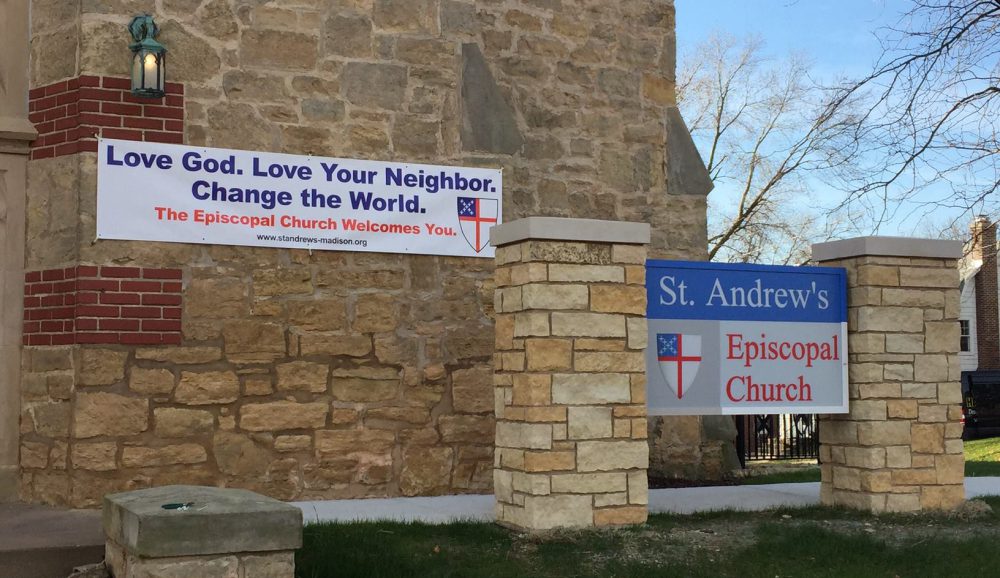
It was about three months later that I found myself responding to the sign that I had passed, without notice, on my way to and from work every day for the last seven years: The Episcopal Church Welcomes You.  It felt very much like a homecoming to me and it wasn’t long before I was there every Sunday, all morning, going to all of the services every week.


Now I wonder… If I were to ask you to trade places with me this morning, if you came up here and stood in this spot… what story would you tell?  Now I wouldn’t be asking you to tell your favorite or most memorable Christmas Eve story and I wouldn’t be asking you to relate a conversion story.  There was a different story that played a central role in the experience that I just recounted.  And that is the story that I am wondering about.

We all have them, a story, a narrative that we tell to ourselves and to other people, a story or narrative that makes sense of all of the things that we have experienced and the things that we believe.  That narrative takes all of our successes and failures, our joys and our pains, and creates a coherent, cohesive story that defines and describes who we are and what we believe.  It was my narrative, my understanding of myself and the world around me that was being challenged that night and I think it was the story of The Annunciation that made that challenge possible.  In fact, I think that it is the challenge to personal narrative that makes this story so important, so dear to us.   It is in this story that we find hope that our narrative might be re written.

Mary was probably only about thirteen years old.  She didn’t have all of the experiences, the pain, the joy the successes and the hurts to tie up in her narrative that I had accumulated over thirty some years.  But a girl of thirteen was old enough to get married in her day and I am sure that she had a narrative that she was very attached to.  Mary was betrothed to a man named Joseph who was a carpenter.  She was going to be married to a man with a trade, a man who was going to be able to provide for her and the children that she would bear to him.  Mary had something very important, she had a sense of security, and her prospects were bright, and she had vision, a plan, a narrative for the future that stretched before her.   Then it all changed in an instant.

It is fascinating the way our narrative describes us even as it begins to own us.  As I look back I see that the narrative that I claimed for myself, the story that I would have told to describe who I was, what I believe, and what was important to me that Christmas Eve was not an especially attractive one.   And I bet, at least I hope, that if I had been called upon to articulate that narrative twenty-one years ago I would have recognized its shortcomings.  But I was sure working hard to defend that narrative from all challenges and distractions.  We all do it.  We have a story that we tell about ourselves, a narrative that makes sense of all that we have learned and experienced, all that we have done or left undone, and we work to protect that narrative.  We don’t want that story called into question because that would undermine the way that we see ourselves and our actions and we might just be confronted with something we don’t like or would rather not see in ourselves.  We defend that narrative because we don’t want to change.

And yet, it is the possibility that the narrative might be rewritten that draws us to this story.  The angel comes to Mary and says, “Greetings favored one, the Lord is with you… You have found favor with God.”  Now that right there is enough to challenge your narrative.  Forget everything that you thought you knew about yourself.  Let go of all of the things that you have done, the things that you work to hide from everyone, the ways that you feel inadequate and small because you are highly favored of God.  No wonder she was afraid.  The Gospel says that, “she was much perplexed by his words and wondered what sort of greeting this might be.”  I’ll bet she was perplexed!  She was terrified because her narrative was being challenged.   Favored of God?  That meant re thinking everything!  But the angel didn’t stop there.  He went on to say that everything that she thought she knew about her future, her plans, her dreams, they were wrong too.  She was going to bear a child that would be a king and would change the world!  Mary’s narrative, the story that she told about her past, who she was, and her future, what she might become, was all wrong and was going to have to be rewritten.  There in that moment, with a light unlike any she had ever experienced filling the room, Mary bowed her head and said, “Here am I, the servant of the Lord; let it be with me according to your word.”

We all work very hard to defend our narrative.  We have a story to tell, one that has been fashioned through years of living, and we quail at the possibility that it might be wrong, that we might have to learn to tell our story differently.  At the same time we hear this story about a young girl whose life was changed, whose narrative was re written in a moment and we wonder, we wish, that the same thing could happen to us.

Someone gave me a gift this week.  They brought me something that, as I thought about this gospel, helped to pull it all together.  On Wednesday of this week someone brought me Kathleen Norris’s book Amazing Grace.  In her chapter on Annunciation, Norris quotes Thomas Merton from his work, Conjectures of a Guilty Bystander.  Merton writes about the place that he seeks in his contemplative practice as a,

“’point vierge’ at the center of his being ‘a point untouched by illusion a point of pure truth, which belongs entirely to God, which is inaccessible to the fantasies of our own mind or the brutalities of our own will.  This little point… of absolute poverty,’ he wrote, ‘is the pure glory of God within us.’” 1

A point within us which is inaccessible to the fantasies of our own mind or the brutalities of our own will as we struggle to create a story, a narrative that makes sense of all that we have experienced, learned and done…  Merton, and Kathleen Norris help us to see that is a virgin place, a place untouched, from which our story might be rewritten in a way that reveals us as the people whom God created us to be.  We all sense that space within us.  We all long to have our story spring from the glory of God, untainted by our own fantasies or the brutality of our own will.  This story of a young girl who allowed God to be born in and from that virgin place within her gives us hope that the impoverished stories that we tell about ourselves might be rewritten in a way that will make us whole.

For the last couple of weeks we have talked a lot about the need to prepare a room, to make room for Christ to be born within us.  In our collect today we prayed,

“Purify our conscience, Almighty God, by your daily visitation, that your Son Jesus Christ, at his coming, may find in us a mansion prepared for himself”

Perhaps the way to prepare that room in our hearts is to lower our defenses, to recognize out narrative as something that has changed in the past.  It has had to change in order to accommodate and reconcile new learnings, new events, new successes, new failures.  Preparing room for Christ to be born within and through us requires that we allow our narrative to be challenged by the reality that we are beloved, highly favored of God.  Preparing room in our hearts requires that we allow our narrative of what is possible, what we can and cannot do be shaped by that reality, our own favor in God’s eyes, so that we might be changed and so that the world might be changed through us.

Listen!  Can you hear it?  We are being welcomed home, “Greetings, favored one! The Lord is with you.”

Amen

1  Kathleen Norris, Amazing Grace: A Vocabulary of Faith (New York, Riverhead Books, 1998) 74.

A Sermon for the Third Sunday of Advent

This sermon focuses on the Old Testament and Gospel readings assigned for the  Third Sunday of Advent.

You can find those readings here.

He himself was not the light, but he came to testify to the light.

 “There was a man sent from God, whose name was John.”  We know a lot about this man named John.  From Luke’s Gospel we know that John was born to Elizabeth, who was past child-bearing years and thought to be barren.  We know that this miraculous birth was foretold to his father Zechariah, who was a priest of the temple, by an angel who said that John would “turn many of the people of Israel to the Lord their God” (Luke 1:16).  We know that Elizabeth, John’s mother, and Mary, Jesus’ mother, were relatives so John and Jesus were maybe cousins…

Luke also tells us that in the fifteenth year of the reign of Emperor Tiberius, when Pontius Pilate was governor of Judea and Herod was ruler of Galilee…  The word of God came to John, son of Zechariah in the wilderness.  He went into all the region around the Jordan proclaiming a baptism of repentance for the forgiveness of sins” (Luke 3:1-3).

Both Matthew and Mark note the beginning of John’s ministry saying that John appeared in the wilderness, dressed in camel hair and eating locusts and wild honey.  Both Matthew and Mark report that John’s message was so compelling that the whole countryside of Judea and Jerusalem were going out to see him.  Mark calls him the “John the Baptizer.”  Matthew calls him “John the Baptist.”

So it is very interesting that when the officials from the temple arrive and ask John who he is, he doesn’t have much to say!  With those credentials he could have said a lot…  “I am the one whose birth was foretold by an angel, born to a woman who was considered to be barren, whose cousin has begun to rock the world, and just look around you!  I am packing the house every day!”  But apparently John doesn’t tell them who he is so they have to start making suggestions on their own.  Are you the Messiah? No!  Isaiah? No! The Prophet?  No!  His interrogators get frustrated, “Come on man!  Give us something.  What are we going to tell the people who sent us?”  John finally relents, he offers a little more, but he still doesn’t tell them who he is.  He only tells them what he is.  A voice.  John tells them that he is no more than a voice, a role, a function…  “I am the voice of one crying out in the wilderness…”  Here he stands, knee deep in the muddy waters of the River Jordan, with the whole countryside coming out to see him and be baptized, and John is refusing to let these people focus their attention on him.  Instead he shifts their attention to something that everyone there was hoping, longing for.

When John quotes the Prophet Isaiah his audience would no doubt have been put in mind of the reading that we heard this morning.  After all it was this promise in Isaiah’s prophecy that had drawn them all out into this desolate place.  They had come out to hear John preach because they hoped that the oppressed were about to hear the good news, that broken hearts were finally going to be bound up, that captives would be granted liberty and the prisoners release.  They were there hoping that they would be comforted in their mourning and that instead of ashes they would be able to wear a victory garland.  When John quoted the prophet Isaiah the people of Israel would have also heard this promise of God’s Kingdom coming to fruition in their midst.

John isn’t willing to tell the people sent from the Priests and the Levites who he is because he knows that people are longing for the fulfillment of Isaiah’s prophecy and he knows that in this moment lies great danger.  Look again at our reading from Isaiah and you will see that, in this short reading, there are multiple speakers.  The first several verses are the anointed one, the one who has come to fulfill the promises of good news, binding up of broken hearts, liberty, release, and victory.  Then the voice changes and it is God speaking.  And God tells us that the fulfillment of those promises is just the beginning.  Not only will good news be procliamed, hearts mended, liberty granted and all the rest, but the ancient cities now lying in ruin will be rebuilt, and the devastations, the lost symbols of our relationship with god, will be raised up and restored.  More good news!  But there is a bit of a catch here.  Notice who Isaiah says will do this rebuilding, this restoration.  It is the people for whom the promises of good news, reconciliation, liberty, release and victory have been fulfilled who will bring the kingdom back to its former glory.  God says “they” will rebuild.  “They” will be called oaks of righteousness.  “They” will raise up.  John knows that the fulfillment of the promises for which the people long is not the end of the story, it is just the beginning, so he doesn’t want people to focus their attention on him.

It would be easier to focus on John himself than on what he is saying.  There is comfort, there is security, there is rest and peace in John.  Look!  Here he is!  It is going to happen at last and we will be saved from ourselves and from one another.  Whew!  Lets go home and celebrate with a glass of eggnog!  But when we look beyond John, to the rest of the story, to the vocation to which we are called even as the promises are being fulfilled, we see that we have a lot of work to do.  The rest and the peace for which we groan and long may not be part of our immediate future.  John refuses to flash his credentials here because he doesn’t want people to miss the fact that the arrival he is foretelling is not the end of the story.  It is a new beginning!

I think that we hear this passage from John’s Gospel today, on the third Sunday of Advent, the week before we hear the story of the Annunciation, of the Angle Gabriel’s visit to Mary, because we are in the same danger that the people of Judea and Jerusalem were in that day on the banks of the River Jordan.  We stand in this strange moment in time where we are celebrating and remembering an event that happened a long time ago, as we acknowledge and proclaim it’s currency today, as we await it’s happening again.  We stand here in Advent and remember Christ’s coming to us as a child born in a manger, as we experience Christ’s coming to us every day and moment of our lives, as we await the time when he will come again and all things will be put right and the kingdom will come fully to fruition.

We groan, we long for the good news, the mended hearts, the liberty, release and victory that is symbolized by the manger.  It would be easy to go Bethlehem and stay there, claiming the peace, comfort and rest that we need.  But it is terribly important that we listen to the next speaker in Isaiah’s prophecy, that we recognize the vocation to which God is calling us, and that we prepare ourselves to rebuild, restore and raise up the ruined cities and the devastations of our age.  We hear these readings today, on the third Sunday in Advent, before we hear the story of a young girl who opens herself to God and helps to usher in the kingdom, so that we know and understand that the Feast of the Incarnation does not, for us, mark the end, but that it indeed marks the beginning of the story.

Amen