A Sermon for the Last Sunday after the Epiphany

Last night I went to bed early and set my alarm clock to allow me to sleep in a little.  I had a sermon ready to go and so I assumed I would sleep well.  After a very restless night I awoke convicted by the idea that I had prepared the wrong sermon.  The events of the last two weeks, things I had read, conversations that I had participated in, all came together to help me to see that I needed to say something different about today’s Gospel reading.  at the conclusion of the 8:00 service I knew that I had not quite gotten it right.  It was coming together but wasn’t done yet.  The sermon that follows is what I said at the 10:30, as best I could reconstruct it at 4:30 this afternoon when I finally got home.

This sermon draws on the Gospel reading for the Last Sunday after the Epiphany in year B of the Revised Common Lectionary, Mark 9:2-9.

You can find that reading here.

There is a link both within the text of the sermon and at the bottom of the page to the blog post that I quote.

You’ve got to love Peter.  Of all of the disciples he is the one that we know the most about.  Peter’s name gets mentioned more often than any of the other disciples.  It is almost always Peter who is front and center, face to face with Jesus, right in the middle of the action.  It was Peter, there in a boat so full of fish that it was beginning to sink, Peter whose mother in law was healed of a fever, Peter who names Jesus as the Son of God, Peter who said that he would follow Jesus anywhere, Peter who denies Jesus three times and Peter who, in the end, strips off his clothes, dives into the water and swims ashore to have breakfast with Jesus on the beach.  Peter’s character is so well developed, he seems so human, and that humanity helps us to find ourselves in the biblical narrative, how could you not love him?

So this morning, as Peter stands there on the side of the mountain with James and John, and suddenly Moses and Elijah appear with Jesus in a blinding light that was unlike anything that he had ever seen, we find ourselves sympathetic and connected to the fear that he feels.  After all, if Moses and Elijah, the two prophets who are central to the history and faith of the People of Israel have appeared then the world must be about to come to an end and the kingdom of God must be about to come to fruition at last.  No wonder he is afraid.  What will that look like?  What will it mean?  And so we are right there with him as he says, “Rabbi, it is good for us to be here; let us make three dwellings, one for you, one for Moses, and one for Elijah.”

In this morning’s Gospel reading the response to Peter’s frantic and terrified response comes from God.  God says, “This is my Son, the Beloved; listen to him!”  Now I have to tell you that knowing what we know about Peter, his impetuous nature, and his proclivity for putting his foot in his mouth, I hear these words from God inflected a little differently than we just heard them read.  Depending on the week I have had I either hear, “Oh come on Peter!  This is my Son.  Would you just stop talking for a minute and listen to what he is saying…?”  or, I hear “Peter Shut up!  This is my Son!  Listen to him!”   The funny thing is that Jesus hasn’t said anything yet!  The text says that Jesus went up the mountain with Peter, James, and John and that he was transfigured before them.  It doesn’t say that Jesus was in the middle of a sermon, that he was delivering a discourse, or that he was teaching.  The text doesn’t tell us that Jesus was saying anything at all.  In order to understand what God wanted Peter to listen to we have to back up in the story a little.

This morning’s Gospel reading begins with the second verse of the ninth chapter of Mark.  In the middle of the eighth chapter we hear Peter’s famous confession.  Jesus asks his disciples who they think he is and Peter says, “You are the Messiah.”  Peter is the star pupil.  He has finally gotten it right.  But Jesus sternly orders his disciples not to tell anyone who he is and then begins to tell them that he must be crucified, die and be raised from the dead after three days!  Peter interrupts him and says,  “Wait a minute!  That can’t happen to you!  Don’t talk like that.  You are the front-runner.  We are ahead in the polls.  If you keep talking likes this, going off message, you are going to ruin everything!”  Jesus turns to Peter and calls him Satan.  He reprimands Peter and tells him that he has his mind on earthly and not heavenly things.  Peter has gone from being the star to being in the doghouse in just two short paragraphs.  Then to make it even worse Jesus calls the crowds together with his disciples and says to them, “If any want to become my followers, let them take up their cross and follow me.  For those who want to save their life will lose it, and those who lose their life for my sake, and for the sake of the Gospel, will save it.  For what will it profit them to gain the whole world and forfeit their life?”   Then the Gospel says, “Six days later, Jesus took with him Peter and James and John, and led them up a high mountain apart, by themselves.”

Six whole days!  For six days the disciples have been wrestling with what Jesus said.  He has told them that following him is not about riding into Jerusalem to the cheers of the crowds.  It is not about healing people of their diseases and working great signs and wonders.  Jesus has told them that being his follower means living your life for others, working to be sure that the people around you have what they need to live whole and meaningful lives.  Jesus has just told them that we need to recognize other people’s needs, wants, agendas and opinions as equal to our own, that life and the world are not just for and about us, but for all of God’s children…  Six whole days they have had to struggle with this new ordering of reality and the world.   I am sure that they were upset.  I am sure that some of them were beginning to wonder if Jesus really was who Peter said he was.  I wouldn’t be surprised if some of them were ready to jump ship, to get out of the boat.

With all of that in mind it seems like Peter’s response might have sprung from a fear greater than what was inspired by the vision that he had been given.  It must have seemed much more attractive to stay up there on the mountain with those three luminous figures of the Hebrew tradition.  Going back down the mountain with Jesus’ identity confirmed by what he had just seen would mean a life lived for others, a life of service to the people around him, a sacrificial life spent holding up all of God’s children in ways that offered them the very gifts that he himself had received.  The idea of building three booths, residences, shrines to this experience and staying there, in the rarefied air, so close to God that they might touch and be touched… that probably sounded much better than going back down the mountain and rejoining the fray.

But that is just the point.  To be a follower of Jesus we have to go back down the mountain and be engaged with the world around us.  We can’t just sit up here where the air is clear, the light is bright and our hopes and faith have been strengthened by the experiences, the revelations that we have been given.  Peter, James and John had to go back into the world and actively participate in bringing the kingdom of God to fruition.  To be a follower of Jesus they had to be “engaged.”

This week someone, a member of this congregation, sent me an email that included a blog post written by the pastor of a church here in Dane County.  In this post he talks about a recent study that states “that in Dane County, fifty percent of ALL young African American men are either in prison, on probation or parole, or on extended supervision.”  That is a number that should outrage each and every one of us! Right here in Madison where we are progressive, broad minded, and fair?   How can this be?  This pastor, The Rev. Dr. Alex Gee, Senior Pastor of Fountain of Life Church in Madison, goes on to describe being accosted in the parking lot of his own church, while dressed in a three piece suit, because he was there at night, in his car, in an otherwise empty parking lot!  Really?  Yes really!  Right here in Madison we have homeless shelters that are filled to overflowing.  We have people who do not have access to adequate health care.  We have people who have to choose between buying food and buying their medications.  All around us people are hurting, people are struggling, people are living without the things that they need to be whole, to be the people God calls us all to be, to experience the kingdom of God that is held out to us in a vision of Jesus, Moses, and Elijah on a mountaintop.  And what is happening here is wrong!

Yes, I am talking politics here.  Actually I have been talking politics all morning, I have just been using another word, a synonym for a word that we aren’t supposed to use in church.  We are called to be “engaged” in the world around us.  We are called to come down from the mountain, to reach beyond the walls of this church into the community and the world, and to live lives that reflect and imitate the life of the one we follow.  Politics is just another word that means engagement with the people and the world around us.  This morning God says to us, “This is my Son.  I know it is hard but you must listen to Him!”

This morning, at the end of the Season of Epiphany I think that we are in great danger of succumbing to the temptation that afflicted Peter there on the mountain.  Ever since Christmas we have been hearing about, and celebrating, God made tangible, real, manifest in the world through the person of Jesus Christ.  For the last seven weeks we have been trying to attune our senses so that we can be aware of God moving and working in or own lives and in the lives of the people around us.  The season of Epiphany is filled with stories of mountaintop experiences, the wonder of God revealed.  Now we are being asked to leave that all behind, to come down from the mountain, and enter into the season of Lent, a season where we are called to look deep within ourselves to discover the places and ways that we keep the kingdom of God from coming to fruition, both in our own lives and in the lives of the communities we inhabit.  We are called to engage in politics and to fight the institutions and assumptions, the beliefs and ways of being that allow half of all young African American men to be enmeshed by the corrections system, that allow people to sleep on the streets at night, and that deny people access to the basic services that they need to thrive and participate in the Kingdom of God.

We are also called to be engaged in the politics that operate here within our own church when we see that the things we do, say, or believe are inhibiting the coming of the kingdom for all of God’s children.  There are members of the Episcopal Church who feel like lepers in their own community because they do not have access to the same sacraments that the rest of us do.  They are not allowed the sacrament of marriage or ordination because of the way that God made them.  This summer at our triennial General Convention we will be called to vote on a resolution that establishes a three year trial period for liturgies for the blessing of same sex unions.   There are poeple in our church, right here in our parish family, who are praying that we will pass that resolution.  I am too!  We need to tell them that there are no lepers in this church!  We are being called to engage the issues, the hurt, the pain, and the theology that swirl around this resolution.  If we do not then we will have built ourselves a church on the mountain that has become an idol, a place where we have insulated ourselves from the world around us.  If we do not engage then we will have chosen to ignore the moving of the Holy Spirit who is calling us to this work.  We must be engaged.


Some people would tell us that church and politics don’t mix, that talking about issues like these jeopardize the Body of Christ by causing conflict and disagreement and it would surely be much easier to stay up here, in the rarefied air, so close to God that we can touch and be touched.  It would be less risky to build three booths, residences, shrines, or even just a church and leave the mess of engagement, of politics, to the people who are still at the bottom of the hill.  But the strength and power of the Anglican Ethos, of the Episcopal Ethos lies in our belief that the things that bind us one to another: the love of Christ, the creeds, and our common worship here at this rail, are far more important and powerful than the things that divide us.  We are committed to finding our way forward together.  We can talk about these things, we can be engaged, we can wrestle with the issues and with the politics and we can still come together and hold out our hands at this altar.

Jesus has told us that being his follower means living our lives for others, working to be sure that the people around us have what they need to live whole and meaningful lives.  Jesus has just told us that we need to recognize other people’s needs, wants, agendas and opinions as equal to their own, that life and the world are not just for and about us, but for all of God’s children…  And God says, “This is my Son!  Listen to him.”

Amen.

 Voices We Need to Hear: Alex Gee, Senior Pastor of Fountain of Life Church

A Sermon for the Fourth Sunday of Advent

This sermon draws on the Gospel reading assigned for the Fourth Sunday of Advent in Year B of the Revised Common Lectionary

You can find that reading here


I wasn’t going to go.  I knew that everyone else would, and that I would be home alone for a while, but I wasn’t going with them.  After all, I had gone off to school.  I had taken classes like: Intro to Logic, The Greek Mind, Existentialism, Plato and Aristotle, and Modern Philosophical questions, so I just didn’t see the need.  To top it all off, while I had been away at school studying all of those esoteric subjects my parents had separated and divorced.  The people at the parish where I grew up had responded very poorly, taking sides, telling stories, making it all much worse for me and for my family.  So there was no way that I was going to go to church on Christmas Eve.

We were going to spend the night at my father’s house on Christmas Eve so we packed our bags, loaded presents into the car, and I put on my most comfortable pair of jeans and an old denim shirt.  As usual, when we crossed the mountains just west of Frederick the pre sets on our car radio wouldn’t turn up anything but static so we began to run through the radio dial looking for something to listen to.   What caught our attention was a radio drama.  The voice actors were great, delivering their lines with emotion and enthusiasm.  There were some well done sound effects that made you feel like you were present in the story.  But the thing that drew us in, that captured us, was the story itself.  We spent the second half of that drive listening to a radio play of The Annunciation, the story that we just read from Luke’s Gospel, about an angel’s amazing announcement to a young girl.

We were so caught up in the story that when we arrived at my father’s house before it was over we didn’t want to turn it off and go inside.  So we sat in the driveway in our car and listened while my family, my father and my brother and sisters stood in the windows of the house and waved at us, flicking the outdoor lights on and off in an attempt to get us to come inside.  We finally decided that they probably thought we were having a fight so we had better go in and let them know we were ok.  We reluctantly turned off the radio and went in.

The evening proceeded in a very predictable way.   We gathered in the living room for hors d’oeuvres and drinks, then moved to the dining room table for dinner.   Some time later, after a wonderful meal and a delicious desert, people began to leave the table and get read for the walk to church.  That was when something unexpected happened.  I found myself saying to my father, “You know I wasn’t going to go to church so I didn’t dress up… do you have a tie that would go with this shirt?”  With a twinkle in his eye he disappeared and came back with a tie that almost went with the denim shirt I had chosen for the evening.  Then I did something really out of character.  I asked him if he would tie the tie for me…

We walked the several blocks to the church there in Shepherdstown and  about half way into the service I was shocked to find tears running down my face.  I was surprised, and a little frightened to find myself responding to the liturgy in this way but somehow I didn’t really want the tears to stop and I wasn’t concerned about hiding them from anyone.  My father must have noticed because as we were walking back to his house after the service he sidled up to me, elbowed me gently in the side and said, “Pretty powerful stuff there huh?”  That was when I wanted to hide.  I mumbled something affirmative and we walked the rest of the way home in silence.

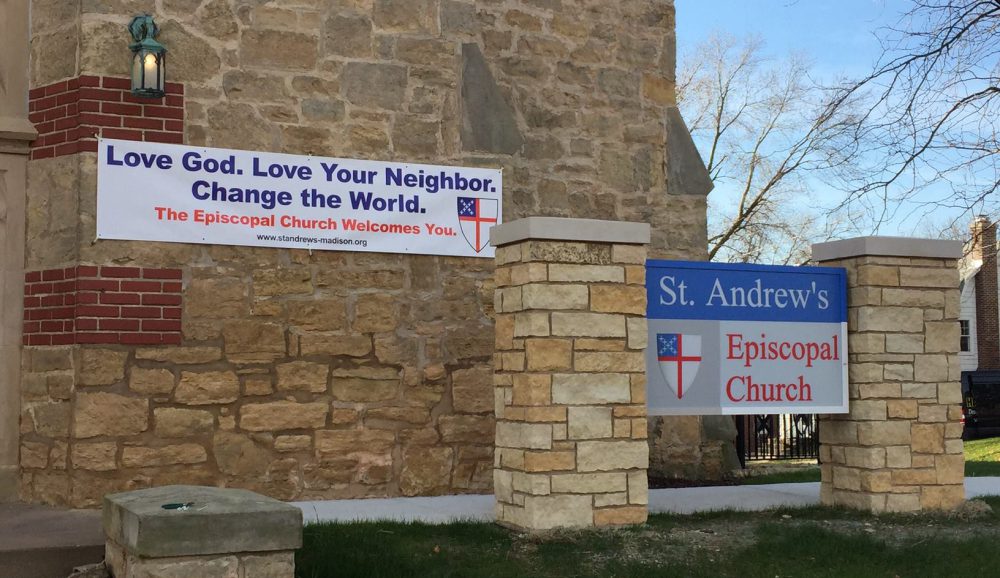
It was about three months later that I found myself responding to the sign that I had passed, without notice, on my way to and from work every day for the last seven years: The Episcopal Church Welcomes You.  It felt very much like a homecoming to me and it wasn’t long before I was there every Sunday, all morning, going to all of the services every week.


Now I wonder… If I were to ask you to trade places with me this morning, if you came up here and stood in this spot… what story would you tell?  Now I wouldn’t be asking you to tell your favorite or most memorable Christmas Eve story and I wouldn’t be asking you to relate a conversion story.  There was a different story that played a central role in the experience that I just recounted.  And that is the story that I am wondering about.

We all have them, a story, a narrative that we tell to ourselves and to other people, a story or narrative that makes sense of all of the things that we have experienced and the things that we believe.  That narrative takes all of our successes and failures, our joys and our pains, and creates a coherent, cohesive story that defines and describes who we are and what we believe.  It was my narrative, my understanding of myself and the world around me that was being challenged that night and I think it was the story of The Annunciation that made that challenge possible.  In fact, I think that it is the challenge to personal narrative that makes this story so important, so dear to us.   It is in this story that we find hope that our narrative might be re written.

Mary was probably only about thirteen years old.  She didn’t have all of the experiences, the pain, the joy the successes and the hurts to tie up in her narrative that I had accumulated over thirty some years.  But a girl of thirteen was old enough to get married in her day and I am sure that she had a narrative that she was very attached to.  Mary was betrothed to a man named Joseph who was a carpenter.  She was going to be married to a man with a trade, a man who was going to be able to provide for her and the children that she would bear to him.  Mary had something very important, she had a sense of security, and her prospects were bright, and she had vision, a plan, a narrative for the future that stretched before her.   Then it all changed in an instant.

It is fascinating the way our narrative describes us even as it begins to own us.  As I look back I see that the narrative that I claimed for myself, the story that I would have told to describe who I was, what I believe, and what was important to me that Christmas Eve was not an especially attractive one.   And I bet, at least I hope, that if I had been called upon to articulate that narrative twenty-one years ago I would have recognized its shortcomings.  But I was sure working hard to defend that narrative from all challenges and distractions.  We all do it.  We have a story that we tell about ourselves, a narrative that makes sense of all that we have learned and experienced, all that we have done or left undone, and we work to protect that narrative.  We don’t want that story called into question because that would undermine the way that we see ourselves and our actions and we might just be confronted with something we don’t like or would rather not see in ourselves.  We defend that narrative because we don’t want to change.

And yet, it is the possibility that the narrative might be rewritten that draws us to this story.  The angel comes to Mary and says, “Greetings favored one, the Lord is with you… You have found favor with God.”  Now that right there is enough to challenge your narrative.  Forget everything that you thought you knew about yourself.  Let go of all of the things that you have done, the things that you work to hide from everyone, the ways that you feel inadequate and small because you are highly favored of God.  No wonder she was afraid.  The Gospel says that, “she was much perplexed by his words and wondered what sort of greeting this might be.”  I’ll bet she was perplexed!  She was terrified because her narrative was being challenged.   Favored of God?  That meant re thinking everything!  But the angel didn’t stop there.  He went on to say that everything that she thought she knew about her future, her plans, her dreams, they were wrong too.  She was going to bear a child that would be a king and would change the world!  Mary’s narrative, the story that she told about her past, who she was, and her future, what she might become, was all wrong and was going to have to be rewritten.  There in that moment, with a light unlike any she had ever experienced filling the room, Mary bowed her head and said, “Here am I, the servant of the Lord; let it be with me according to your word.”

We all work very hard to defend our narrative.  We have a story to tell, one that has been fashioned through years of living, and we quail at the possibility that it might be wrong, that we might have to learn to tell our story differently.  At the same time we hear this story about a young girl whose life was changed, whose narrative was re written in a moment and we wonder, we wish, that the same thing could happen to us.

Someone gave me a gift this week.  They brought me something that, as I thought about this gospel, helped to pull it all together.  On Wednesday of this week someone brought me Kathleen Norris’s book Amazing Grace.  In her chapter on Annunciation, Norris quotes Thomas Merton from his work, Conjectures of a Guilty Bystander.  Merton writes about the place that he seeks in his contemplative practice as a,

“’point vierge’ at the center of his being ‘a point untouched by illusion a point of pure truth, which belongs entirely to God, which is inaccessible to the fantasies of our own mind or the brutalities of our own will.  This little point… of absolute poverty,’ he wrote, ‘is the pure glory of God within us.’” 1

A point within us which is inaccessible to the fantasies of our own mind or the brutalities of our own will as we struggle to create a story, a narrative that makes sense of all that we have experienced, learned and done…  Merton, and Kathleen Norris help us to see that is a virgin place, a place untouched, from which our story might be rewritten in a way that reveals us as the people whom God created us to be.  We all sense that space within us.  We all long to have our story spring from the glory of God, untainted by our own fantasies or the brutality of our own will.  This story of a young girl who allowed God to be born in and from that virgin place within her gives us hope that the impoverished stories that we tell about ourselves might be rewritten in a way that will make us whole.

For the last couple of weeks we have talked a lot about the need to prepare a room, to make room for Christ to be born within us.  In our collect today we prayed,

“Purify our conscience, Almighty God, by your daily visitation, that your Son Jesus Christ, at his coming, may find in us a mansion prepared for himself”

Perhaps the way to prepare that room in our hearts is to lower our defenses, to recognize out narrative as something that has changed in the past.  It has had to change in order to accommodate and reconcile new learnings, new events, new successes, new failures.  Preparing room for Christ to be born within and through us requires that we allow our narrative to be challenged by the reality that we are beloved, highly favored of God.  Preparing room in our hearts requires that we allow our narrative of what is possible, what we can and cannot do be shaped by that reality, our own favor in God’s eyes, so that we might be changed and so that the world might be changed through us.

Listen!  Can you hear it?  We are being welcomed home, “Greetings, favored one! The Lord is with you.”

Amen

1  Kathleen Norris, Amazing Grace: A Vocabulary of Faith (New York, Riverhead Books, 1998) 74.

A Sermon for the Third Sunday of Advent

This sermon focuses on the Old Testament and Gospel readings assigned for the  Third Sunday of Advent.

You can find those readings here.

He himself was not the light, but he came to testify to the light.

 “There was a man sent from God, whose name was John.”  We know a lot about this man named John.  From Luke’s Gospel we know that John was born to Elizabeth, who was past child-bearing years and thought to be barren.  We know that this miraculous birth was foretold to his father Zechariah, who was a priest of the temple, by an angel who said that John would “turn many of the people of Israel to the Lord their God” (Luke 1:16).  We know that Elizabeth, John’s mother, and Mary, Jesus’ mother, were relatives so John and Jesus were maybe cousins…

Luke also tells us that in the fifteenth year of the reign of Emperor Tiberius, when Pontius Pilate was governor of Judea and Herod was ruler of Galilee…  The word of God came to John, son of Zechariah in the wilderness.  He went into all the region around the Jordan proclaiming a baptism of repentance for the forgiveness of sins” (Luke 3:1-3).

Both Matthew and Mark note the beginning of John’s ministry saying that John appeared in the wilderness, dressed in camel hair and eating locusts and wild honey.  Both Matthew and Mark report that John’s message was so compelling that the whole countryside of Judea and Jerusalem were going out to see him.  Mark calls him the “John the Baptizer.”  Matthew calls him “John the Baptist.”

So it is very interesting that when the officials from the temple arrive and ask John who he is, he doesn’t have much to say!  With those credentials he could have said a lot…  “I am the one whose birth was foretold by an angel, born to a woman who was considered to be barren, whose cousin has begun to rock the world, and just look around you!  I am packing the house every day!”  But apparently John doesn’t tell them who he is so they have to start making suggestions on their own.  Are you the Messiah? No!  Isaiah? No! The Prophet?  No!  His interrogators get frustrated, “Come on man!  Give us something.  What are we going to tell the people who sent us?”  John finally relents, he offers a little more, but he still doesn’t tell them who he is.  He only tells them what he is.  A voice.  John tells them that he is no more than a voice, a role, a function…  “I am the voice of one crying out in the wilderness…”  Here he stands, knee deep in the muddy waters of the River Jordan, with the whole countryside coming out to see him and be baptized, and John is refusing to let these people focus their attention on him.  Instead he shifts their attention to something that everyone there was hoping, longing for.

When John quotes the Prophet Isaiah his audience would no doubt have been put in mind of the reading that we heard this morning.  After all it was this promise in Isaiah’s prophecy that had drawn them all out into this desolate place.  They had come out to hear John preach because they hoped that the oppressed were about to hear the good news, that broken hearts were finally going to be bound up, that captives would be granted liberty and the prisoners release.  They were there hoping that they would be comforted in their mourning and that instead of ashes they would be able to wear a victory garland.  When John quoted the prophet Isaiah the people of Israel would have also heard this promise of God’s Kingdom coming to fruition in their midst.

John isn’t willing to tell the people sent from the Priests and the Levites who he is because he knows that people are longing for the fulfillment of Isaiah’s prophecy and he knows that in this moment lies great danger.  Look again at our reading from Isaiah and you will see that, in this short reading, there are multiple speakers.  The first several verses are the anointed one, the one who has come to fulfill the promises of good news, binding up of broken hearts, liberty, release, and victory.  Then the voice changes and it is God speaking.  And God tells us that the fulfillment of those promises is just the beginning.  Not only will good news be procliamed, hearts mended, liberty granted and all the rest, but the ancient cities now lying in ruin will be rebuilt, and the devastations, the lost symbols of our relationship with god, will be raised up and restored.  More good news!  But there is a bit of a catch here.  Notice who Isaiah says will do this rebuilding, this restoration.  It is the people for whom the promises of good news, reconciliation, liberty, release and victory have been fulfilled who will bring the kingdom back to its former glory.  God says “they” will rebuild.  “They” will be called oaks of righteousness.  “They” will raise up.  John knows that the fulfillment of the promises for which the people long is not the end of the story, it is just the beginning, so he doesn’t want people to focus their attention on him.

It would be easier to focus on John himself than on what he is saying.  There is comfort, there is security, there is rest and peace in John.  Look!  Here he is!  It is going to happen at last and we will be saved from ourselves and from one another.  Whew!  Lets go home and celebrate with a glass of eggnog!  But when we look beyond John, to the rest of the story, to the vocation to which we are called even as the promises are being fulfilled, we see that we have a lot of work to do.  The rest and the peace for which we groan and long may not be part of our immediate future.  John refuses to flash his credentials here because he doesn’t want people to miss the fact that the arrival he is foretelling is not the end of the story.  It is a new beginning!

I think that we hear this passage from John’s Gospel today, on the third Sunday of Advent, the week before we hear the story of the Annunciation, of the Angle Gabriel’s visit to Mary, because we are in the same danger that the people of Judea and Jerusalem were in that day on the banks of the River Jordan.  We stand in this strange moment in time where we are celebrating and remembering an event that happened a long time ago, as we acknowledge and proclaim it’s currency today, as we await it’s happening again.  We stand here in Advent and remember Christ’s coming to us as a child born in a manger, as we experience Christ’s coming to us every day and moment of our lives, as we await the time when he will come again and all things will be put right and the kingdom will come fully to fruition.

We groan, we long for the good news, the mended hearts, the liberty, release and victory that is symbolized by the manger.  It would be easy to go Bethlehem and stay there, claiming the peace, comfort and rest that we need.  But it is terribly important that we listen to the next speaker in Isaiah’s prophecy, that we recognize the vocation to which God is calling us, and that we prepare ourselves to rebuild, restore and raise up the ruined cities and the devastations of our age.  We hear these readings today, on the third Sunday in Advent, before we hear the story of a young girl who opens herself to God and helps to usher in the kingdom, so that we know and understand that the Feast of the Incarnation does not, for us, mark the end, but that it indeed marks the beginning of the story.

Amen

Sermon for the First Sunday of Advent

This sermon draws on the Revised Common Lectionary readings for the first Sunday in Advent Year B, particularly on Isaiah 64:1-9 and Mark 13:24-37

You can find those readings by clicking here

Preaching without a text is always an adventure.  Sometimes what gets said “live and in person” doesn’t exactly match the text that the sermon was supposed to convey.  This is especially true when the preacher doesn’t bring their “A Game” to the crossing of the center aisle.  I think that I did a much better job of conveying these thoughts at the 10:30 service yesterday than I did at the 8:00.  So for those of you who got up early…  I beg your indulgence, and for a second chance to say what was on my heart.

Andy+

Sermon for the First Sunday of Advent: Year B

November 27, 2011

The Very Rev. Andrew B. Jones

Saint Andrew’s Episcopal Church

It begins today!  This is the first Sunday of Advent the beginning of a new church year.   Today we change the Eucharistic Prayer that we use on Sunday mornings.  We will shift to Year B in the Eucharistic Lectionary and begin to read primarily from the Gospel of Mark.  Today we begin again the familiar yearly pattern of liturgy, the “work of the people” that reflects and shapes who we are as people of God.

Today is also the day that we begin our preparation for the Feast of the Incarnation.  That might seem a strange thing to say this late in the calendar year.  I think that Home Depot had Christmas Trees on display before Halloween this year.  And the ads that we are seeing on television would have us believe that time to prepare for Christmas is running short.  The world will tell us that we are almost too late!  But the first Sunday of Advent is the day that the church begins to look forward to the coming of the Christ Child and we will spend the next four weeks preparing, and waiting.

Waiting for four weeks.  When I was a kid, and the only thing I had to do to prepare for Christmas was to use magic marker (a Flair™ for those of you old enough to remember them), in the color that I had been assigned, to mark the things in the JC Penney Christmas Catalog that I wanted most… when that was all I needed to do to prepare – those four weeks seemed interminably long.  Now that I am older those four weeks of waiting don’t seem like nearly enough time!  I have so much to do.  This being the weekend after Thanksgiving, and the weekend of the first Sunday of Advent we of course rearranged all of the furniture on the first floor of our house.  So not only do I have to bring the Christmas Tree up from hibernation in the basement, I have to figure out a whole new place to put it.  We need to find the Advent Wreath and our historic collection of Advent Calendars.  We need find our mailing list, write cards, bake cookies, buy gifts, respond to invitations, and create the spread sheet that will tell us where we need to be, which family home we are to visit and when, during the week after December 25th!  There is so much to do in only four weeks!  There are too many expectations.  There is too much pressure.  There are too many “sacred” family traditions to honor… four weeks is not enough time.

Far too often we arrive at Christmas day grinding our teeth, exhausted, wishing that it were all over, and we realize that this season of preparation, of waiting, has done us in and we have missed the very thing that we were preparing for.  We spend the last week of the season of Advent groaning under the pressure, longing for a moment of rest, some sense of peace, for a real connection with the people that we love and with the God who loves us enough to walk among us as one of us.  And then when the day has come and gone we feel cheated, unchanged, disappointed.  We just want a moment; a moment when we feel that sense of peace that passes all understanding, that sense of connection and communion with God, when we can experience the untainted hope that comes with the birth of a child, new life, new beginnings.  Is that too much to ask?  That’s not asking too much is it?

No it isn’t.  We need and should have that sense of comfort, of well being, of being loved and loving unconditionally and without reserve.   One of my prayers for this season is that we are all able to steward our resources, to guard our time and our energy, that we find some time to be quiet and to wait so that when we sit in front of the fire on Christmas Day, or when we raise our candles in the darkness and sing Silent Night on Christmas Eve, we all have the experience of Christ coming into our lives and filling us with hope and wonder.  I don’t think that is too much to ask at all.  In fact… if we take a look at the scriptures assigned for the First Sunday of Advent it becomes startlingly clear that we might not be asking for enough!

We are preparing, looking forward to the Feast of the Incarnation, for God made manifest, breaking into the world.  When the people of Israel envisioned that day they saw something so radical and transformative that the heavens would be torn open, the mountains would quake and the nations would tremble.  God’s adversaries would be defeated and justice, mercy and grace would triumph.  The world would be restored and reconciled to God.   In Mark’s Gospel we hear Jesus saying that when God breaks into the world the sun and the moon will go out, the stars will fall from the sky and the heavens will tremble.   Jesus is using apocalyptic language, language that would have been familiar to his contemporaries, to describe the world being changed, turned upside down in a way that is beyond our ability to image.  He uses metaphor to tell us that when God breaks into the world the things that we thought we knew will come to an end and a new reality will come to fruition.

Imagine a world where we all, every one of us, recognize that we are bound together as one.  Imagine a world where those who have plenty, plenty of food, water, wealth, health care, power, or status and rank, share with those who do not have enough.  Imagine a world where no one is marginalized, where no one is thought to be “disposable” and where everyone is nurtured and loved so that we all can become the people God created us to be.  What if, as we wait, as we prepare for the Feast of the Incarnation, we allowed ourselves to ask, even to expect that God’s breaking into the world will have those kinds of results?

Here on the First Sunday of Advent we do an interesting thing with our sense of time.  We sit in this interesting intersection of the past, present and future.  We are looking back to the Christ who has come, some two thousand years ago as a defenseless child in a manger.  We are proclaiming that Christ is coming to us now, here, in the present, every day of our lives.  And we are looking forward to the day that Christ will come again and that the kingdom will come to fruition, fully, in great power and glory.  We sit in this interesting intersection of time and proclaim “already but not yet.”

It is much easier to focus our attention on the already.  It is much easier to look back at the manger and to focus our attention on the event that changed the world forever.  It raises difficult questions for us when we look forward and see that the world has not finished changing, that there is more to do, and that Christ’s redemptive work is not complete.  What is taking so long?  Why wasn’t His coming once enough to reconcile all things to God?  And if He is going to come again and finish that work… what will it look like?  Will we be called to change?  Change is a hard thing.  And the kinds of changes that are described in the prophecies recorded in the book of Isaiah and in the Gospel of Mark are not easy to imagine or to contemplate.  Those metaphors suggest more questions than they do answers.   Change is hard and waiting for change, trying to prepare for change; change that we can’t predict or even imagine…  It’s no wonder that we prefer to focus on the past, to gaze on the manger and want to linger there.

I don’t know what it will look like when God breaks into the world and the kingdom comes to full fruition.  Will the sun and the moon stop shining?  Will the stars drop from the sky as the mountains and the heavens treble and quake?  I doubt it somehow.  Those images and those metaphors don’t make a lot of sense to me.  That isn’t how God works in my, in our experience.   And here is where we come full circle this morning…

Our experience tells us that God effects change, God changes the world though people: by changing hearts and touching lives.  God will change the world, and bring the kingdom to fruition though people just like you and me, through us!  And so that moment of peace, that moment of connection, that sense of communion with God through a child born in a manger; that sense of being loved that comes through God’s willingness to put God’s very self into our hands and at our disposal, that connection with all of creation that comes from being children of a loving God…  That clearly isn’t too much to ask.  It is incredibly important.  We should be asking for that!  But… it is just the beginning.

The story of the incarnation, of God in the world, revealed, made manifest in a manger in Bethlehem doesn’t end on Christmas morning or even at the conclusion of the twelve days of Christmas.  It continues through the season of Epiphany when we will hear the stories of God being made manifest to the larger world, the world beyond the manger, beyond the walls of the stable, beyond the nation of Israel into which Jesus of Nazareth was born.  We can hope and long, we can expect to be a part of that story too.  We can look forward to God breaking into the world in a way that changes everything, that restores all righteousness, and which reconciles all people to God, and which makes all creation new, if, as we hope and long for that moment of connection, that sense of communion, that peace that comes from all understanding, we see it is the first step in our being able to bring those same gifts to the rest of the world.

In our Book of Common Prayer, Eucharistic Prayer C describes the way that we should come to this table when we gather for communion.  I think that these words should also guide the way that we approach this season of waiting and preparation.  Saying this prayer and substituting the word “manger” for the word “table” might give us a whole new appreciation for the season of Advent and indeed, for the Feast of the Incarnation for which we prepare.

“Open our Eyes to see your hand at work in the world about us.  Deliver us from the presumption of coming to this table for solace only and not for strength; for pardon only, and not for renewal.  Let the Grace of this Holy Communion make us one body, one sprit in Christ, that we may worthily serve the world in his name” (BCP p. 371).

Amen

A Sermon for Thankgiving Day

This sermon draws on the readings for Thanksgiving Day, Lectionary year A

It draws especially on Deuteronomy 8:7-18 and Luke 17:11-19

You can find those readings by clicking here

The Very Rev. Andrew B. Jones

Saint Andrew’s Episcopal Church

Madison, Wisconsin

November 24, 2012

Thanksgiving Day 2012

Many of you already know that this past summer I was privileged to travel to a place with no running water, where homes are constructed of scrap wood, old plastic tarps, odd pieces of rusted and corrugated metal, all tied to simple wooden frames with whatever scraps of string or rope their owners can find.  A place where the only water is what you can collect in a cistern as the rain runs off of your rusted and patched metal roof.  A place where subsistence farmers struggle to grow enough food to feed their families and where whatever you need that can’t be grown in your own soil has to be carried up the mountain on rutted and dangerous roads, often tied to the handlebars or the rack of a motorcycle.  A place where the only electricity comes from a community generator which runs just a few hours a week because the diesel fuel that powers it is carried up the mountain on those roads in gallon jugs dangling from the handlebars of those motorcycles.

The people of Jeannette, Haiti live without.  They live without the amenities that we take for granted and upon which we depend.  And yet live they do!  There is a strength in them, a sense of hope that belies the conditions of their home.  It was remarkable that the whole week that I was there, driving through the ruin and wreckage in Port au Prince, seeing the crowds of people in Miragoane and Les Cayes, living with the people in Jeannette and witnessing the poverty that they endure, I never once felt like crying for the things that they do without.  I never felt like crying for the things that they don’t have.  But when I arrived home, having gotten on a plane in Port au Prince early in the morning, having flown through Miami into Chicago, ridden the bus into Madison, driven from the Park and Ride home and walked into my kitchen… that was the moment that I wanted to cry.

My family knew I was coming, I had texted them at every stop along the way, so when I walked into my house at 11:50 at night, every light in the house was on.  The air conditioning had the house at a cool sixty-eight degrees.  As I walked in I could see the small flat panel TV in the kitchen and the large one in the Great Room.  I could see five guitars and three laptop computers.  I was surrounded by the sings and symbols of affluence.  I never once wanted to cry for the things that the people of Jeannette don’t have.  I did want to cry for the things that I do have. And I think in that moment Moses was speaking to me.

For forty years the people of Israel wandered in the wilderness looking for the land that God had promised them.   It took a while, but in those forty years they had come to understand that their very lives flowed from the grace of the God who sustained them with manna from heaven and water from the rock.  They had come to know that all that they had, all that they were, and all that they might yet become was a gift from God.  It had been a difficult journey both physically and spiritually but they were finally, finally about to find themselves in the Promised Land and Moses knew that they were in great danger.

Moses tells the people of Israel that they are about to enter a land of plenty: water, honey, figs, olives, wheat, barley, pomegranates… they will have more than enough to be satisfied.  And therein lies the danger.  Moses is warning them not to forget whose they are and who they are, not to forget that it is in God that they live and move and have their being, that all that they have is a gift from the God who loves them.  I think that as I walked into my kitchen that night back in early July Moses was also talking to me.

I was surprised to find myself in tears that night because I was being confronted with a truth that I had lost track of; all that I have, all that I am, and all that I might yet become is a gift from God.  This morning as we gather at this table Moses is speaking to all of us.  Walking down the aisles of Whole Foods, picking up imported bottled water, extra virgin olive oil, low fat Fig Newtons and PomWonderful juice it is easy to begin to believe that we deserve the things that we have, that we have earned them, that  “the power and might of my own hands have gotten me this wealth” (Deuteronomy 8:17).  When we have all of the “things” that we need we can begin to neglect the relationship with the one in whom we live and move and have our being,

Turn now to the Gospel reading.  Jesus is approached by ten lepers who cry out, “Jesus, Master, have mercy on us!” (Luke 17:13).  Jesus tells them to go and show themselves to the priests and on the way there the lepers “were made clean.”  Now “clean” is an important word in this passage.  Lepers were “unclean.”  They had to live outside the city.  They were not allowed to come into contact with others.  They were cut off, alienated from their families, their communities, their people.  It gets even worse.  The assumption in that day was that if you contracted a disease like leprosy it was because you, your parents, your grandparents, or maybe even your great grandparents had broken the law and offended God.  So they were not only alienated from their people, they were alienated from God.  You don’t have to live like that very long before you start to become alienated from yourself.  The loathing and disgust, the judgment all build up and eventually you start to believe it.  The ten lepers who approached Jesus that day had lost everything because they were “unclean.”   When the ten lepers “were made clean” they were reconciled, restored to their community, in their relationship with God, and finally, with themselves.

One of those lepers turned around and went back to give thanks.  Now the Gospel doesn’t tell us that the other nine suffered a relapse, that their leprosy returned.  The Gospel doesn’t say anything to diminish the “quality” of their cleansing.  But Jesus does say that something new has happened to the one who came to give thanks.  Jesus says that his faith has made him “well.”

“Clean” even if we hear that word as “reconciled” sounds and feels external.  Something has happened “to” you.  “Well” sounds and feel internal.  Something has happened “in” you.  The nine who didn’t come back to give thanks were reconciled to their communities, the people in the community would have believed that they were reconciled to God, but these last words of Jesus, spoken only to the one leper who returned to give thanks, help us to see that there was something missing in their reconciliation.  They were “clean” but they were not “well.”  Perhaps the reconciliation with God and with themselves that might have happened in this moment was  incomplete.

There is an insidious danger in failing to give thanks.  When we begin to believe that we have earned, that we deserve the things that we have, that by firmly grabbing our own bootstraps and pulling upward we can acquire all that we need, that we can make ourselves clean, whole, and well we end up denying ourselves the thing that we really need most of all.  What we want, need, long for, whether we recognize it or not is Grace.  And Grace can only come from outside of ourselves and it only comes as a gift, unearned, freely given.  The moment that we begin to believe that we can earn grace, that it somehow depends upon us and what we do, it crumbles in our hands and slips from our grasp.

We gather at this table today to give thanks, just like we do every Sunday and the importance and fruits of gratitude are impressed upon our hearts, our minds and our souls.  We gather at this table today and we bear witness to the community around us and to the world that as they gather at their own tables this day, they might just have more to be thankful for than they can ever imagine.