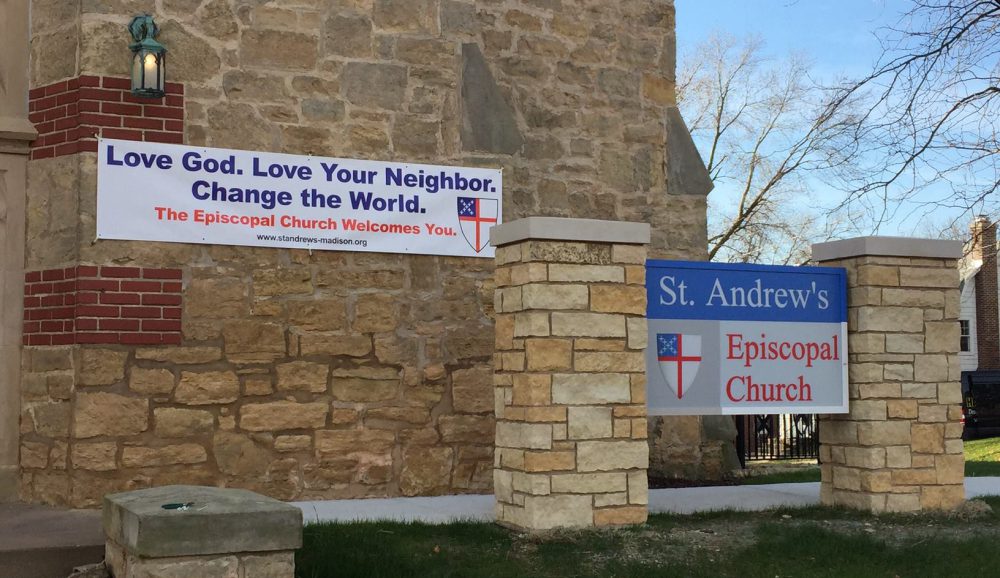
The Risk of Bared Feet: A sermon for Maundy Thursday 2018

This sermon, offered by The Rev. Andy Jones at Saint Andrew’s Episcopal Church, in Madison Wisconsin, on March 29, 2018, is build around the reading assigned for Maundy Thursday in the Revised Common Lectionary.

You can find those readings here.

Here is a recording of the sermon.

Here is a transcript of the recording.

May the words of my mouth, and the meditations of our hearts, be always acceptable in your sight, O Lord our strength and our Redeemer.

Please be seated.

Thirty-eight days of Lent are enough to heighten anyone’s sense of the holy, to attune us to the ebb and flow of the divine and moving around us.  But even without this preparation, even without the season that lies behind us, it would be hard not to miss the tension this evening.  Jesus knows that he is about to leave and go to his father.  The authorities have made their plans.  The soldiers lie in wait to arrest him.  And here in an upper room, Jesus gathers with his closest disciples to share a meal.

In the midst of the tension and anxiety that we feel all around us, it’s natural to long for something, anything to do.  And thankfully, Jesus had some very clear instructions for us this evening.  As we heard from our epistle reading this evening, this is the setting where Jesus institutes the sacrament of the last supper; telling us to remember him, do this in memory of him, every time we break this bread and drink this wine.  Then Jesus washes his disciple’s feet and tells us that we should love one another as he has loved us, that we should love one another as he has loved us.  That could be a scary moment. Here as the dark is gathering outside the walls of this place, waiting to crush in on us, loving one another as he has loved us can lead us to some very scary places indeed.  But he’s but he’s given us a way, I think, to imagine, to proceed, to participate in that love here in this act in which we are about to participate.

Jesus calls us to a life of service, to loving one another through acts of kindness and support.  Washing someone’s feet was a task that was relegated to slaves and servants in a household.  And here Jesus, the master the teacher, gets down on his hands and knees, with a towel tied around his waist, and washes the filth from the streets of Jerusalem, from the feet of his disciples.

Peter seems shocked by this reversal of status and rank and power.  “You will never wash my feet!”

I think that there’s something very important for us to hear in the humility that Jesus calls us to in this moment; to wash one another’s feet regardless of rank, or status, or position, to serve one another.  But there’s something else going on here too.

I’m not sure what it was about feet.  Jesus tells us that you may be bathed and clean but you still need to have your feet washed.  I was told earlier this week that another sermon about corns, and warts, and bunions, and twisted pinky toes, was not the thing for this evening.  So I won’t go there.

But I also imagine that it is, see that it is, our feet that carry us into all the places that we’ve been in our lives.  Our feet bear the scars and the infirmities of the wrong steps that we have taken, the rocks that we’ve stubbed our toes against, the obstacles with which we have collided, as we’ve blundered around in the dark.

Something about his feet, whether it was that bunion or the scars from the places he’d been… Peter didn’t want to reveal them to Jesus.

But here’s the thing.  If we are going to love one another as Jesus loves us then we need to be prepared serve.  We also need to be prepared to be served.  Love doesn’t exist without the willingness to be vulnerable.  love doesn’t exist without the willingness to reveal who we truly are, to reveal our faults, to reveal our past, to reveal our fears and dreams.  If we keep those things hidden under our shoes and socks then we might always doubt that the other really can love us.  Because if they knew us for who we really are, with all of our warts, and bunions, and ingrown toenails exposed, surely they wouldn’t love us.

So loving one another as Jesus loves us comes in two parts.  Love is reciprocal.  Love goes back and forth, flows from one to the other.  And purely pragmatically speaking, if no one’s willing to have their feet washed then we can’t wash anybody’s feet.  We need to be willing to be vulnerable.  We need to be willing to risk in order to love.

That may be the most important thing that we take away from this evening; that when we encounter people, when we encounter people we like, people with whom we get along…  when we encounter people whom we don’t like, with whom we disagree, with whom we don’t get along…  we need to be willing to risk taking off our shoes and socks. We need to be willing to risk vulnerability.  We need to be willing to let our guard down and enter in to a reciprocal relationship so that there’s some opportunity for us to come together and move forward.

Jesus says it is by your love that they will know that you are my disciples.  And so I ask you if we’re not willing to take that risk… then who will?

Amen.

It is Written on Our Hearts: a Sermon for the Fifth Sunday in Lent

This sermon, offered by The Rev. Andy Jones at Saint Andrew’s Episcopal Church in Madison Wisconsin, on March 18, 2018 is built on the readings assigned for the Fifth Sunday in Lent in Year B of the Revised Common Lectionary.

You can find those readings here.


It has been a difficult week.

Yesterday we said goodbye to Betsy Greene, a longtime member of St Andrew’s, Betsy was 68 years old and died after a two year struggle with a brain tumor.

On Thursday we said goodbye to Joan Smith, another longtime member of St Andrew’s.  Joan’s husband Jack died just about a year ago.  They had lived in a memory care unit for about a year and a half prior to Jack’s death and Joan has lived there by herself since he died.  Joan was 85.


But on Wednesday, on Wednesday, Mother Dorota and I stood right there, in the gate of the altar rail, at ten o clock in the morning, and we rang the Sanctus Bell seventeen times as we read seventeen names.  One sounding of the bell and one name a minute, for seventeen minutes.

A minute is a long time… ring the bell, wait about 15 seconds for the sound to fade, read the name, and spend the next 40 seconds in silence, remembering, or looking forward to, your own kids when they were 14.  Fourteen years old.  Just like

Alyssa Alhadeff

Martin Duque

Jaime Guttenberg

Cara Loughran

Gina Montalto

Alaina Petty

Alex Schachter

or when they were 15 like

Luke Hoyer

Peter Wang

or 16 like

Carmen Schentrup

or 17 like

Nicholas Dworet

Joaquin Oliver

Helena Ramsay

or 18 like

Meadow Pollack

A minute is a long time to think about their teachers:

Scott Beigel

Aaron Feis

Chris Hixon

and to wonder what you would have done in those horrifying 6 minutes….


We stood here in this space on Wednesday morning, ringing that bell, reading those names, as tens of Thousands of students walked out of over 2,800 schools across this country.

Children!  Your children, my children, our children, confronting us with the fact that we have not done enough to protect them and demanding change, demanding that we do something.  That we do… something.

It is the season of lent so those seventeen minutes, and the time we spent here later that evening in a service of Lament for our Culture of Gun Violence, were pent of time for us to hear these words…

“We confess that we have sinned against you, in thought word and deed, by what we have done, and by what we have left undone.  We have not loved you with our whole heart.  We have not loved our neighbors as ourselves” (BCP page 360).

If we weren’t careful we also found ourselves confronted by the words of the confession from Enriching Our Worship…

“We repent of the evil that enslaves us,

the evil we have done,

and the evil done on our behalf” (Enriching Our Worship 1 page 56).

It is the fifth Sunday in Lent.  We have been on this journey for a while now.  And the pain of this past week…  It’s pretty understandable that we would arrive here this morning exhausted, struggling, seeking some comfort and assurance.

The beginning of the Collect for the Fifth Sunday in Lent begins…

“Almighty God, you alone can bring into order the unruly wills and affections of sinners: Grant your people grace to love what you command and desire what you promise…”  (BCP p. 219).

Deep, deep longing and desire that the world might be changed; that our hearts, that everyone’s heart, might be changed so that we might, as a community, love God’s command and realize a world where God’s dream, that we might all live as one.

And then we hear from the Prophet Jeremiah, speaking for God when the peole of Israel are in exile in Babylon; their nation being dismantles so that they no longer recognize a home in the reports that come to them; their identity as a people being snuffed out; their customs and way of life restricted and denied…

The Prophet Jeremiah promises on God’s behalf

“I will put my law within them, and I will write it on their hearts; and I will be their God, and they shall be my people” (Jeremiah 31:33b).

God promises us – I will write it on their hearts; and I will be their God, and they will be my people.

And we hope, we long for that day when hearts are opened and god’s desire for us to love our neighbor as ourselves flows into and out of us and we live as one, in peace.

It is perhaps that hope for the realization of God’s dream and vision for all of creation, that gets us through moments like this past Wednesday.

That gets us through moments like this past Ash Wednesday, Valentine’s Day!

It is perhaps that hope that gets us through the aftermath of tragedies like the ones in

Las Vegas

Dallas

Orlando

San Bernardino

Colorado Springs

Roseburg, Oregon

Chattanooga, Tennessee

Charleston, South Carolina…

That is a horrifying list… and that only gets us back to June of 2015!

And there it is again.  Right there.  That sick feeling in the pits of our stomachs that just won’t go away, even when we turn our backs, when we try to pretend it hasn’t happened again…

Our hope might sustain us for a while…

“I will put my law within them, and I will write it on their hearts; and I will be their God, and they shall be my people.”

But hope, by itself, isn’t enough….

Because my brothers and sisters…  God has already written that law in our hearts!

That’s why we are here.  That’s why these stories hit us so hard…  Because with God’s law written in our hearts… our failure to act, to protect our children, strike us as sins of commission and omission –   things that we have done, and things that we have left undone; as a failure to love God with our whole heart and our neighbors as ourselves.

Here in the season of Lent we cannot but see these events as

the evil that enslaves us,

the evil we have done,

and the evil done on our behalf.

God’s laws, written on our hearts offer us hope, but they also call us to act!


In a Letter to the Diocese of Milwaukee, written four days after the shootings in Parkland Florida Bishop Steven Miller writes:

Lent 2018 will forever be for me marked by this tragedy not only because it occurred on Ash Wednesday, the first day of Lent, but also because one of those killed was a member of our faith community. Her name was Carmen Schentrup a young woman who was a leader in the youth group at St. Mary Magdalene Episcopal Church.  I ask you to join me when you remember all the victims of this tragedy, the living and the dead, the physically and the spiritually wounded, in praying especially for Carmen, her family, and the people of St. Mary Magdalene Church

On Ash Wednesday we prayed these words, “Accept our repentance, Lord, for the wrongs we have done: for our blindness to human need and suffering, and our indifference to injustice and cruelty.” Hearing these words in the context of the events of the day is for me a call to action.

Lent is the season in which we prepare to reaffirm our baptismal vows and identity. At baptism, we renounced the evil powers of this world which corrupt and destroy the creatures of God. We will reaffirm that identity at the Great Vigil of Easter.

I believe I cannot be faithful to that promise unless I stand up to the growing gun culture in our society and those who perpetuate it. My baptismal identity requires me to confront those evil powers and ask others to join me in calling them to account. My citizenship in Jesus’ kingdom requires that I make that way of living the model for life here on earth. If God’s will is life, not death, and we desire that God’s will be done on earth as in heaven, how can there be a place for weapons in everyday life? I think the only thing God wants us to be armed with is his word, his righteousness, and his salvation.

Please join me in working to reduce gun violence by working to make it harder to commit.

Yours in Christ,

The Rt. Rev. Steven Andrew Miller, Bishop of Milwaukee


This Saturday, March 24, all across this country, and abroad, the Bishops of the Episcopal Church will join with our children as they “March For Our Lives.”  There will be a march in Washington DC and there will be sister marches in major cities in every state of the union.  Bishop Miller will be marching with parishes from this diocese and we will be walking with our brothers and sisters here in Madison.

Right now the march is scheduled to begin on Library Mall at 10 am.  We will march to the Capital where we will hear a series of speakers and then we will march around the capital, joining our voices and standing in solidarity with the children, your children, my children, our children, we are begging, wo are demanding, that we do something, something, to protect them and to make us all safe.

I ask you to pray and to consider joining us as we march.  We will send out an email to the parish list serv later this week with details about how you can join us as we gather to march as a community, as Jesus’ hands and feet in this world; as we allow the law that God has written on our hearts to move us to action; as we work to bring about God’s will for us; as we choose life over death.

Amen.

Despite the Evidence to the Contrary: a Sermon for the First Sunday in Lent

This sermon, offered by the Rev. Andy Jones at Saint Andrew’s Episcopal Church in Madison, Wisconsin on February 18, 2018, is built around the readings assigned for the First Sunday in Lent in Year B of the Revised Common Lectionary.

You can find those readings here.


Here is a recording of the  sermon


And a transcript of the recording

May the words of my mouth and the meditations of our hearts be always acceptable in your sight, O Lord our strength and our Redeemer. Amen.

Please be seated.

So here it is the first Sunday in Lent, a penitential season, and so it’s probably a good time for me to make a little confession to you all.   Every year about this time, as the season of Lent approaches, I, Mother Dorota and I, and clergy all across the country, start to think about and look for ways to make you all uncomfortable in church.  We stop saying Alleluia, we take away the flowers, change the words of the liturgy that we’ve been using…  We try really hard to make church feel strange and just a little bit unsettling starting on that first Sunday of Lent.

But this past week as I pondered the limited resources that are available to me as I seek fulfill this goal, it occurred to me that we probably didn’t need to do anything special at all to make you all feel like you’re in the wilderness.  All you have to do is turn on the television, turn on the radio, and you see things that we use as guideposts, as markers along the way, being obliterated.  We see people hurting one another.  We see people screaming and shouting at one another and fighting over things that we would never have imagined that people would argue about in the first place.  People whom we know and love are falling sick.  People whom we know and love have died, just in this past week.  And so we are already in the wilderness.

In fact, I don’t think it’s too much of a stretch to say that life in this world is life lived in the wilderness, because this world is broken and hurting, and people all over, even we feel lost.

That, I think, can make it really difficult to remember the words that were spoken to Jesus in his baptism and the words that are spoken to us in ours.  “You are my beloved child.  With you I am well pleased.”

It’s easy, I think, to lose track of those words and that truth with all of the evidence to the contrary that’s thrust upon us every single day.  How do we remember we are God’s beloved?  I think in Jesus knows full well how difficult it is to keep track of that reality.  As he come out of the wilderness and strides purposefully in to the region of the Galilee he is proclaiming “The time is fulfilled. and the kingdom of God has come near; repent and believe in the good news.”

Jesus was walking in to a world, having just left the wilderness, that was no less broken hurting or lonely than our own. it is the human condition and his people were being oppressed by an invading army.  People were being marginalized.  People were hurting one another and fighting over details that seemed insignificant in the face of those words – you are my beloved.  With you I am well pleased.   So he knew that he was called the claim and proclaim the truth of God love.

Listen to what he says.  “The time is fulfilled…”  so all of our Scriptures, everything written, everything handed down, everything treasured by our people are pointing to this one moment when God will break into the world in a new way and set all things right.  We will be restored to right relationship with God and with one another.  And all of creation, and all people will be reconciled one to another and to God!  That’s what Jesus is proclaiming as he walks into the Galilee!

He’s also saying that “the kingdom of God has come near.”  It’s not something far-off, something up in the heavens.  It’s not something to experience after you die.  The kingdom of heaven is here and now, and we can experience it together, as a community.

Pretty radical things to say.  And especially radical in light of all of the evidence to the contrary.  How do we cling to those truths?  How do we remember those things that have the power to give us the “peace that passes all understanding” when all we have to do is walk out the door and be reminded the world is still a broken, hurting, and a lonely place to be?

Jesus says “…repent, and believe in the good news.”   Now the word repent carries a lot of baggage because it gets misused a lot.  But what it really means is to turn away from the things that are distorting our nature; that are stealing our joy, and our life. and our love.  To turn away from things that alienate us from one another, and from ourselves, and from God, and to turn back to the God who wants us to live life abundantly, joyfully, boldly, and lovingly.

Jesus says turn back to God and believe the good news, believe a better word here is trust.  Believe is a verb.  Believe means embrace, internalize, accept, know.  Trust the good news.

Trust that you are beloved of God and that with you God is well pleased.  Trust that the time is fulfilled and God’s promises are coming true.  And trust that the kingdom of God is here and now, for you and for me, and for all of us.  And do all of that despite all of the evidence to the contrary.  Not an easy thing to do.  Jesus knew that.  Jesus shows us a way to hang on to what is at the core of our being.

Before Jesus strides purposefully into the Galilee proclaiming that the time is fulfilled and the kingdom of God has come near, Jesus goes into the wilderness to be tempted by Satan.  Now I’m not suggesting that any of us do that.  That would be a difficult thing, I think, for any of us to endure.

And I also want to point out that in the other gospel accounts of Jesus is like there’s a lot of detail about what that temptation looked like and the conversation that Jesus had with the tempter.  But here in Mark’s gospel it’s very spare, a few short lines, which leaves room for our imaginations.  And in fact, I think, leaves room for our own stories.  So if we were to step into the wilderness to be tempted what would that look like for us; to be tested, what would that look like for us?

Just a couple of days ago, on Ash Wednesday, we stood in this place and listened to the Invitation to the Observance of the holy Lent, and in that invitation we hear,

“I invite you, therefore, in the name of the church, to the observance of a holy Lent, by self-examination and repentance…”

We are called during this season to look for the obstacles that we have erected between ourselves and God; the things that keep us from turning back to God; the things which we carry around in our past and in our memories that leave us hiding behind the bushes and sewing clothes out of fig leaves for fear of encountering the God who loves us.

The invitation goes on,

“I invite you to the observance of a holy Lent… by prayer and fasting and self-denial…”

to engage in a conversation with God that’s stripped of its distractions.  To find a place to be quiet, to be alone with God, to speak what’s in our own hearts and to listen.

And then finally the observance of a holy Lent

“…through reading and meditating on God’s holy Word.”

Going back to those promises.  Remembering what God has said to us.  Remembering what God has said to us through the person of Jesus Christ, and claiming them as truth.

We are God’s beloved and with us God is well pleased!

This season of Lent is a time for us to resource ourselves.  To build ourselves up, to claim those promises for our own, so that when the world tries to counter that truth with evidence to the contrary we can be strong in what we know and what we believe.

This season is a time for us strengthen and fortify ourselves with the truth; time for us to focus on what is holy, and true, and life-giving, and the beautiful, so that when the world floods us with images that aren’t any of those things we have something with which to balance them.

The world can very quickly take away the peace that passes all understanding and this season of Lent is about building ourselves up in that Peace, finding it again and claiming it for our own. I have to tell you that that’s not the end of the story.

This season isn’t so much about us, as it is about the world that would try to steal this peace from us.  Jesus hears his identity proclaimed in his baptism, and he goes out into the wilderness, and he successfully resists the temptation.  He’s strong in who he is.  And he’s also strong in what is called to do.

And so he walks out of the wilderness into a world that would deny everything that he says and is, and begins to proclaim,

“The time is fulfilled, the kingdom of God has come near; repent, and believe the good news.”

All of the peace that we find this season and in one another, and in this place, is preparing us to follow in his footsteps… and to go out those doors into a world that is broken, and hurting, and lost, and proclaim a different narrative in the one year on the evening news; to tell one another, to tell everyone we meet “You are beloved, and we are one.  And we can live together, respecting each other’s dignity, recognizing what is holy in one another, and working to serve each other and to serve God here in this place.

The season of Lent, it’s like boot camp!  We are being prepared to be sent out.  In the process of that we will find a peace that passes all understanding, and then we’re called upon to jeopardize and to risk that by going out that door.

Thanks be to God that we have one another and this place to which we can return; to be strengthened, to be filled, to be taught, to listen, and to teach one another, so that together we can bring those prophecies to realization and fulfillment.

The kingdom of God has come near.

Amen

A Moment of Shocking Clarity: Honoring the Life, Work and Ministry of The Rev. Dr. Martin Luther King Jr.

This sermon, offered on January 14, 2018  by the Very Rev. Andy Jones at Saint Andrew’s Episcopal Church in Madison, Wisconsin is  built around the Lessons Appointed for Use on the Feast of Martin Luther King, Jr.

You can find those lessons here.


Here is a recording of the sermon:


The following is a transcript of the recorded sermon:


May the words of my mouth and the meditations of our hearts, be always acceptable in your sight, O Lord, our strength and our redeemer.  Please be seated.

It catches us up short.  Startling, sometimes even frightening us when it happens.  We’re making our way through life.  Maybe we’re not paying attention.  Maybe we’re making excuses.  Maybe we are in denial.  But then a moment of clarity strikes us. Something happens and the truth becomes too obvious and to plain to ignore, and we have to finally deal with it.  We had just such a moment here in this last week.

Just a week ago, as we celebrated the Baptism of our Lord, we stood here in this place and we promised to seek and serve Christ in all persons, loving our neighbors as ourselves.  We promised that we would strive for justice and peace among all people, and respect the dignity of every human being.  All people.  Every human being.  That’s a tall task for anyone.  It’s easy to love the people who love us, who look like us, who dress like us, who believe like us.  But these vows don’t give us that option.  We have to go beyond that and love all people, respect the dignity of every human being.

Now we renew these baptismal promises all the time.  Every time there’s a baptism in this place we stand and renew our baptismal vows.  We do it when we celebrate the feast of the baptism of our Lord.  But I wonder how many of us walk out the doors of this place really thinking about what those words mean… All people.  Every human being.

I think it’s possible that we walk around ignoring the implications, pretending that we haven’t said those words, or even in denial about the words all and every.

And here we are today with this moment of clarity.  Jesus tells us that we have to go beyond all of that, and love our enemies.  It can’t be more explicit.  It can’t be clearer.  Love your enemies.  And the difficulty of what we signed up for becomes absolutely, undeniably clear.

Jesus even acknowledges that.  He says anybody can love the people who love them.  Anyone can do good for the people who do good to them.  Anyone can lend money if you expect to get it back with interest.   But you, you, we, God’s children, followers of Jesus Christ, are expected to do more!  We are expected to love all people as we love ourselves and to respect the dignity of every human being.  It’s a terribly difficult thing to do but it is our calling.

So how do we, as the church, as followers of Jesus, accomplish these tasks?  We spent some time this morning in the forum talking about ways to gather community, to draw people together, to make sure that people feel welcome and loved, so that we might link arms and work together to bring about God’s vision and dream for all of creation.  And I think all of those are powerful witnesses and testimony to the narrative that we uphold.

For a long time, I’ve held to that narrative as a chief way for us to love all people.  To proclaim that countercultural narrative to the world; that we are all created equal, that we are all one, that we are all beloved of God, is to speak against the voices in this world and this culture that diminish, demean, and denigrate.  I have thought that maintaining that narrative and proclaiming it was a great way to stand against the powers that the oppress, and dehumanize, and destroy God’s creatures.

But I had this great conversation with a very wise person whom I respect very much this week, and that person helped me to recognize that in today’s world there are so many narratives being spoken, there are so many stories, there are so many ways to interpret this world, being promulgated through platforms that we might not have imagined twenty years ago, that it’s hard for that narrative to reach people.  It’s hard for that narrative to stand out against all of the narratives that are being voiced, and people are holding, so we need to do something more.  Because anybody can tell a story.

So what is it that we need to do?  I think that when we hear people speaking in ways that diminish, demean, and denigrate, we need to speak up in that moment.  It’s not enough to acknowledge that those words are wrong.  Anybody can do that.  We need to take the extra step and say “No this is wrong!”  We need to speak up against systems that oppress, and marginalize, and destroy God’s creatures, and say that those systems are wrong.  We need to make sure that all of God’s children have what they need to flourish, and to be whole.  We need to work for reconciliation!   So when we see that there are systems in place that aren’t upholding that dream and vision for creation that God has entrusted to us, we need to work for change, to lobby for policies that uphold us all.  We need to carry our values, and our belief, and that narrative, into the voting booth.  We need to stand up and proclaim by word and example the good news of God in Christ and no wait for someone else to take action on our behalf.

Today we are using the proper’s that are assigned for the celebration of the life and ministry of the Rev. Dr. Martin Luther King who was assassinated for daring, for daring to take action against these very systems, and these very words, fifty years ago.  We may have told ourselves in the past years that we have come a long way.  And that may be true.  But we are in danger of sliding backwards.

The narrative that we uphold is being over shadowed, and it’s not being proclaimed in ways that are effective.  And so we, we, each and every one of us, this community here in this place, this city, this nation, needs to speak.  To speak.  To name what’s wrong when we see it.  To hold up what is good, and right, and life-giving.  To seek and serve Christ in all people, and to love our neighbors as ourselves.  We, we need to be active and strive for justice and peace among all people.  And respect the dignity of every human being.  It’s hard, it’s scary.  And we may have spent a lot of time in denial, and ignoring that responsibility, but my brothers and sisters this is what we have promised to do.  As followers of Jesus Christ, we have promised to walk in his footsteps, and to walk in the footsteps of prophets like the Rev. Dr. Martin Luther King, and call for peace and justice, for equality, for life giving systems and policies that govern and rule us in this community, and in the nation, and in the world.

Tomorrow at the capital we’ll celebrate.  We’ll sing songs.  We’ll hear powerful speeches.  And we’ll remember something that happened a long time ago.  But if we don’t step into that vacuum and continue that work, then that celebration is hollow.  If we don’t step into that vacuum and continue that work, then what we’re doing here this morning is just as hollow, because we are called to hard work.  We are called to do more and everybody else around us.  Because we’re not allowed to opt out of the promises that we have made.

Amen.

Denying the Claims of Empire: A Sermon for Proper 24A

This sermon, offered at St Andrew’s Episcopal Church, Madison Wisconsin, on October 22nd, by the Very Rev. Andy Jones, is built around the readings assigned for Proper 24A in the Revised Common Lectionary.

You can find those readings here.

This sermon was preached without notes from the center aisle.  What follows is a recording of the sermon delivered at the 10:30 celebration of the Eucharist and a transcription of that recording.


May the words of my mouth and the meditations of our hearts be always acceptable in your sight, O Lord our strength and our Redeemer.  Amen.

Please be seated.

Whew…  Well you couldn’t have written a better made for TV drama scene then this one.  Imagine how it felt to all of those people gathered there in that place when the Pharisees and the Herodian arrived together.  Two groups of people representing different power bases, with different interests, and different backgrounds, they never reached across the aisle to work with one another.  You know they say politics makes strange bedfellows but this was pretty shocking.  So in they come, the Pharisees and the Herodian, and everybody took a deep breath.  And then they approached Jesus.  And everyone knew that Jesus was really getting under their skin.  So something was going to happen.  And then they asked him this question that was so clearly a trap.  It must’ve sucked all the breath right out of the room.   “We know that you speak for God and that you treat no one with partiality.  Tell us what you think.  Is it right to pay taxes to the Emperor or not.”

There is no good answer to this question.  Say no and you are speaking out against Rome, and you’re liable to be charged with sedition, and we all know what kind of punishment empire metes out.  Say yes and all of the people who followed you here to this moment are likely to turn their backs on you in disappointment and disgust.  So everyone held their breath to see what Jesus would say.  And then he comes up with the perfect non-answer.  “Give to the Emperor the things that are the emperors, and give to God the things that are God’s.”

Everybody took a deep sigh a deep breath of relief.  And the Pharisees and the Herodians left amazed at Jesus’s rhetorical dexterity.  And the story moves on.  Except that there’s something else happening here.  There’s something beneath this non-answer that’s really an indictment if you think about it.

It’s only a non-answer if you believe that there are things in your life that don’t belong to God.  It’s only a non-answer if there are parts of your life that you can wall off, and stand behind, and say God’s not over here.  God’s not watching.  Or, you know, God’s not entitled to this piece of me so I’m just going to hold this in reserve, and I can do what I want with this, and I can give it to the Emperor.

The fact that they had a coin with them, there in that place, with the Emperor’s likeness and title on it, was a sign that they had somehow figured a way to bifurcate their lives and hold God in abeyance in places where they weren’t comfortable with God’s presence.

We will, in just a few minutes, when Mother Dorota invites us, we’ll all stand here around this font, with this child in our arms, we will renew our baptismal covenant. The book of common prayer holds out for days there especially appropriate for baptism and this isn’t one of them.  We baptize babies whenever there are babies to baptize.  Those four dates in the prayer book aren’t always convenient for out-of-town family, and it’s such a joyful thing to baptize people into the body of Christ, we’ll do it pretty much any time someone asks.  But the fact that this isn’t one of those four dates means that we rarely get to hear this story on the same day that we reaffirm our baptismal covenant.  That lends a certain urgency and sense of intention to what we’re about to do.

Jesus was preaching a subversive gospel: that all people are worthy of dignity and respect, that all people are beloved in the eyes of God, that all people should have what they need to thrive, and to live, and to flourish.  In the face of Empire Jesus was preaching that true power comes from giving power away, not from taking it from others.  It was a subversive gospel then and it’s a subversive gospel now.

We all know how scary it can be to bend a knee to something other empire.  The truth that Jesus taught was true at the beginning of all things.  It was truly in first century Palestine.  And its true now.  And it is every bit as dangerous to defy empire now as it was then.  Bending the knee somewhere else can get you sidelined and left out of the game.

But that’s what we’re being asked about today.  Jesus is standing here with a coin in his hand and he’s asking us “Whose face is this and whose title?”  And he’s asking us if we are prepared to bifurcate ourselves and to say there are some parts of our lives where I don’t have to pay attention to the things that I’m about to promise.  There are some parts of my life where God is not invited.  There are some parts of my life that we can hold apart.  How can that be?  When we stand in just a few moments to baptize Carolyn Elizabeth into the body of Christ, and reaffirm our promises to seek and serve Christ in all people, to respect the dignity of every human being, to work for justice and truth…  We are making the choice about where and to whom we will bend our knee.

So I hope that as we reaffirm these promises today we are cognizant of just what it is that we’re doing.  We are proclaiming a subversive gospel that seeks to turn the world upside down and to make into this… make this world into vision, God’s dream: life, light, and love.

When you come forward this morning to receive communion there will be water in this font, and having just made those promises anew, I hope that you will dip your hand into this water and remember your own baptism.  Remember the promises that you have just made.  And to know that there is no part of this world no part of our lives, that this water cannot touch.

Amen


Are You Envious Because I am Generous?: A sermon for Proper 20A

This sermon, offered on September 24, 2017 at Saint Andrew’s Episcopal Church, by The Very Rev. Andy Jones , is built around the readings for Proper 20 in Year A of the Revised Common Lectionary. 

You can find those readings here.

This sermon was preached without notes from the center aisle.  What follows is a recording of the sermon delivered at the 10:30 celebration of the Eucharist and a transcription of that recording.

Laying the Gospel Book on the altar, turning and wandering down the center aisle, and then turning to come back…

Oh!  I’m sorry…  Everybody sit down.

I just so distracted and upset I don’t know what to do.   I mean yesterday started out just like any other day.  Me and my crew showed up at the parking lot at the Home Depot early in the morning.  And Eli showed up just like he always does.  And hired us to come work in his vineyard for the day.  So we got to the vineyard and we’re out there making our way up and down the rows plucking the grapes off the arbors… and at about ten after nine Eli showed up again with the more people.  Now that’s happened before.  It’s not that unusual but usually that happens when it’s been rainy and wet and there are lots and lots of grapes and there’s an order in and we need to really get everything picked that day.  But that’s not the case right now.  It’s been dry and so there weren’t that… we could’ve handled it…

Well then, about noon, he comes back with another bus load of people.  Some of these people, you know, I just know…  They didn’t speak the language.  They didn’t know what they were doing.  I don’t know why he needed them.   And then at 3 o’clock… some of the people he brought back… some were even tall enough to reach the grapes!

We didn’t know what to think of all of this.  We have this relationship with you…  We worked for him forever.  We trust him.  He knows us.  He knows we can get the job done.  But if that wasn’t bad enough… the crew that he brought back at about quarter after five to work the last 45 minutes of the day… they could hardly make it off the bus.  They stumbled down the steps.  They struggled to get across the parking lot.  They hadn’t even picked a row worth of grapes before the bell rang and we were all called to the paymaster to pick up our day’s wages!

So me and the crew, you know we’re in good with Eli, we walked right up to the front of the line but the manager said,  “No, no, no.  Take your folks to the back of the line.  You guys are getting paid last today.”  Well we didn’t know what to make of that until we saw that those people that arrived at quarter after five… they got paid a full day’s wage!  And so we were pretty excited.  Not sure what’s going on here.  Maybe Eli’s come into some inheritance or something.  But if they’re getting paid the full day’s wage we must be in for a bonus.  This is going to be really good!  Well we got to the front of the line paid the same as the people who worked for less than 45 minutes.  Well needless to say we were pretty unhappy.   I mean, we’ve known Eli forever.  He’s always been there for us.  So how can this happen, that we weren’t treated any better than these people who showed up at the end of the day?   And then, and then Eli heard one of my guys complaining and he got right in his face and he said, “Are you envious because I am generous?”

I have to tell you, I have to tell you, I felt set up, because he could’ve avoided all of this if he just paid us first and let us go on our way.  But he made us stand in the back of that line and wait to get ours and see how well he treated the people before us… just so we could ask me that question!  I really felt set up.


Yeah.  Set up.  Here’s a situation that we can find ourselves in all too easily, that we can imagine. in the marketplace working, being called out to work, and in the end… not receiving what we believe is our due.  And all of this designed just ask us that question.  “Are you envious because I am Generous?”

That’s what parable does.  A parable gives us a story that feels very familiar, that feels very solid, where we think we can navigate our way through the narrative and the characters who are involved, and suddenly there’s this little twist… that gets you, that makes you think.  Oh!  What’s really happening here?   What’s really going on?

That’s where we are.  Here we are and people who have only worked for the last 45 minutes are being invited into the vineyard: people without the proper documents, people who don’t speak the language or know the customs, people who may not have even worked in a vineyard like this before, people with preexisting conditions, people who may need to take extra leave to bear children…

And Jesus is standing here in this moment and asking us that question.  “Are you envious because I am generous?”

There seems to be this thing within us that evaluates ourselves, that ranks ourselves, that tells us who we are based on the way we’re treated compared with other people.  And so when other people are getting something that we think we have worked to earn or deserve, and they haven’t measured up… it rubs us the wrong way.

The first time I caught a confirmation class I took the kids in that class to visit all of the downtown of mainline churches, and we looked at their architecture, and we looked at what was in their building, and asked the question “what can this tell you, what does this tell you about this community and the way they worship?”  It was a great Saturday morning!  But the next week I had older siblings of those kids and their parents confront me in the parking lot and say,

“this isn’t a real confirmation class.”

I said, “Well, what do you mean?”

“Well here’s the book that I had to memorize.  And here’s a checklist of all the things that the Bishop was prepared to test me on.  This is confirmation class lite!”

I said “Oh.  So you want me to haze them the same way that you were hazed?”  I said, “Ok.  Right here on page 3.  Answer this question…”

“Wha… Well I can’t answer that question…”

“Oh.  So it was really effective… Yeah.  Okay.”

Why is that we get so upset when someone else is getting something that we think we deserve? Now, clearly this is a parable about the marketplace, but Jesus tells parables to help us to understand something about God, and the kingdom of God, and Jesus is telling us how it is that God operates, and relates to us God’s children.   And what Jesus is saying is that it doesn’t matter when you come to the vineyard.  It doesn’t matter how you get there.  You are beloved and will receive God’s grace and love and favor just like those who have been here, part of the tribe, forever!

But I think that this parable also reaches in to our own lives in a way that we need to pay attention to, because as Jesus is describing to us the way that God behaves, he’s also describing the way that we are called to behave.

So how can we become as generous as God?  How can we let go of that piece of us that wants to grumble, complain, or be envious?  I think the solution to that is gratitude.

Gratitude…  If we think that all that we have is the result of the sweat of our own brow, our own hard work, the strength of our own back, for the twinkling of our own intellect… then we are in danger, at any given moment, of losing all of it; because the strength of our back can fail.  Our mind can betray us.  And if the only way that we have value or worth, the only way that we get what we need is through our own effort, then we are at risk of losing it at any time.  And if someone else is getting some of what we want or need through less effort than ours then that can be pretty irritating.

What if we see everything that we have, whether it be the goods we need to survive or the love we need to feel whole, as gift, something that is showered upon us because we are beloved…

I don’t think that’s too big a stretch even if were talking about the marketplace because the things that we have and the things that we are given are in large part an accident; an accident of our birth, of our complexion, of the gifts and skills that we might have, the language that we speak, the customs to which we adhere…  All of those things play into our ability to get the things that we think we need.  So if we can begin to think of them as gift… then instead of fearing their loss we can begin to rejoice in the generosity that has showered them upon us, and feel a sense of gratitude that’s not threatened when somebody else get some too.

Here this morning Jesus is telling us a parable, a parable about the marketplace and the ways that some people are included and some people excluded.  But at the same time he’s telling us a story about the kingdom of God where everyone is included, where everyone is nurtured and sustained, where everyone gets a daily wage that will nourish and support them so that they might flourish.

It is God’s dream and vision for all of creation that we are called to facilitate and to enable. By embracing a sense of abundance and gratitude, by forswearing a sense of scarcity, and by opening our arms and allowing others to enjoy the fruits of our labor, the fruits of God’s love, the fruits of a world remade, as we follow in Jesus’s footsteps.  Amen.


The Story in Which We Live, and Move, and Have Our Being

The following sermon, offered at Saint Andrew’s Episcopal Church in Madison Wisconsin, on September 3, 2017, is built around the readings for Proper 17 in year A of the Revised Common Lectionary.

You can find those readings here.

This sermon was preached from the center aisle without notes.  The following transcript is a slightly edited version of this recording:

May the words of my mouth, and the meditations of our hearts, be always acceptable in your sight, O Lord our strength and our Redeemer.  Amen.

Please be seated.

This is one of those terrifying moments for preachers, one of those days when at 3 o’clock in the morning your eyes slam open and you realize you’ve been writing the wrong sermon all week.  So this may be a little rough, but I hope that you’ll be willing to dance with me a little bit today as we work this through.

Just last Sunday in our Gospel reading, in fact it’s just the verses immediately preceding the verses we read from Matthew’s Gospel today, Jesus takes his disciples to Caesarea Philippi and asks them, “Who do you say that I am?”   Peter finally says it.  “You are the Messiah the Son of the living God.” And Jesus says to him you are the rock upon which I will build my church.  Today Jesus says to Peter  “Get behind me Satan you are a stumbling block to me.”

From rock to stumbling block, that’s quite a fall from grace.  We know that Peter wasn’t expecting a Messiah who would die on the cross and so Jesus’s words have shocked him, and upset him deeply.  I’ll tell you that I spent most of this week trying to figure out how to exonerate Peter in some way for his response.  It wasn’t until 3 o’clock this morning that it started to fall into place for me.

Peter was a person trapped by his own context, by the narrative in which he lived, and moved, and had his being.  In that narrative your armies come and conqueror mine, and then come and enslave and deport my people.  You oppress my religious liberties.  You tax me to the point of starvation.  And I suffer under this oppressive rule until somehow, I can raise a stronger army than yours, and can fight back and inflict upon you the same damage that you have inflicted on me.  It is what biblical scholar Charles Hefling refers to as the Cycle of Retributive Violence and Peter was locked into that narrative, that mentality.  He was expecting the Messiah to come as a warrior king who would defeat the armies of Rome, chase them from his homeland, and reestablish the people of Israel in their rightful place, there in the land that God had promised them.

So when Jesus, the person whom Peter has now confessed to be the Messiah, exhibits this vulnerability, what Peter sees to be weakness, and says that he is about to die on the cross, Peter has no frame of reference to help him understand or interpret those words.   He doesn’t, he can’t even begin to conceive of how this might work out.

Some 20 years later Paul is writing his letter to the Romans and he gives us some explication of Jesus’s statement that he is about to be crucified and raised, and that we, we must take up his cross and follow him.  Paul says, “If your enemies are hungry feed them.  If they are thirsty give them something to drink.  For by doing this you will heap burning coals on their heads.  Do not be overcome by evil but overcome evil with good.”

By allowing himself to be crucified at our hands Jesus steps into that cycle of retributive violence, refusing to repay evil for evil, but repaying evil only with good, and breaks the never-ending cycle that keeps us bound to conflict, pain, and suffering.

So Jesus is, in this moment, asking us to step outside of the narrative that defines us, to expand and broaden our imagination, and to see something bigger than what we are prone to see.

And I do mean prone to see.  It doesn’t take much to find that that narrative of retributive violence is still prevalent maybe even at times the dominant narrative in our culture and society.  For me to win you have to lose.  And for me to win I am entitled to diminish, demonize, and destroy you.  If you disagree with me then you’re not just wrong, but there’s something wrong with you.  And if I am to get what I want and need then I must take it from you. That narrative still rings loudly in our ears.

Paul is working some 20 years after Jesus’s resurrection to help blow open that narrative and get us to think and imagine in another way, and in our Gospel reading this morning Jesus, Jesus stands there telling us he will die on our behalf to rescue us from this cycle of violence, and begging us to heed his example and walk with him.

Paul says by feeding our enemies and giving them something to drink when they are thirsty we will be “heaping burning coals on their heads,” and I have to tell you that line always makes me giggle just a little bit.  It’s like he’s stepping outside of the narrative he’s trying to teach and succumbing to that other narrative for just a moment.

But I think what’s really happening here is telling us that if we can change that narrative others will be changed by us.  If we can love our enemies, if we can show them compassion and kindness, then it will work its grace upon them and they will be changed as well.  And this I think points to another shortcoming in Peter’s imagination and his ability to find a different narrative.  You see Peter thought that the Messiah would come to liberate, to rescue, to save the people of Israel.  And in his imagination, and in the narrative in which he operated, that meant that the people of Rome would have to be enslaved or defeated or beaten down.  What Peter couldn’t imagine was that the Messiah was coming to liberate, to save, all people.  All people.

And so as long as there are winners and losers, as long as there is us and them, as long as it’s a zero-sum game, that old narrative is still in control.

I didn’t read the collect that’s appointed for this Sunday this morning I read instead the collect for Labor Day and I think it really works in our context this morning.  “O God you have so bound us one to another, that all we do affects for good or ill, all other people.  We are one body.  And when any member of that body hurts or suffers… we all heard or suffer, even if we are inclined to think of that member as “them” or as “other.”

Jesus uses very extreme language when he’s talking to his disciples this morning, talking to us. He says if you want to save your life you must lose it.  And those who want to keep their life will have it taken from them.  Jesus is the only one who has to die on the cross to break this cycle of retributive violence, to shift to the narrative in a way that is life-giving instead of life stealing. But I think these words point to the difficulty in following this other narrative.  Because sometimes the retribution we seek, the restitution that we seek, seems just.  It seems due us.  It would seem to us, by our way of thinking, that it is right to take vengeance upon those who have hurt us.

Jesus tells us pretty clearly this morning that that’s not ours to take; that we are to love our enemies, to feed them, to give them water when they are thirsty; by our love to urge their conversion, and their stepping out of that narrative that binds us all to pain and suffering.

So here’s the question that we need to confront this morning.  Why is it that that old narrative is still so prevalent still so dominant?  Is it because we have been shy about proclaiming the narrative that has Jesus incarnate, living among us, crucified and resurrected as its core.   Have we been reluctant to name the truth that we know, and that is that we are all one people.  Or is it that we are afraid?  Because to follow in Jesus’s path requires vulnerability.  It requires a willingness to feel pain.  It requires a willingness to let go of some things that we believe might be ours or due us so that others might share in them, and have them for their own.

Jesus stands here this morning telling us that he is prepared to die to set us free.  And he asks in turn what we are willing to give up, to let go, and to do, so that we all my experience that same joy and freedom.

Amen.


Yeah, that time Jesus got woke!

This sermon, offered at St Andrew’s Episcopal Church in Madison, Wisconsin on August 20, 2017, is built around the readings for Proper 15 in the Revised Common Lectionary.

You can find those readings here.

It has been a terribly difficult week.  Things that I never thought to see in my lifetime, things that I imagine many of you had never thought to see again, have filled our newscasts and our television screens.  Swastikas have been marched through our cities.  People have been beaten, and killed, and ugly, ugly chants have filled the air.  And in the midst of all of that, as if it could get any worse, our leader has uttered unthinkable things.  How could he say that?  It leads me to wonder about who we are and where we are going.

“It’s not fair to take the children’s food and throw it to the dogs?”  How can Jesus have said those words?  This woman came to him in agony, pleading for her daughter who was being tormented by a demon.  And at first he refuses to acknowledge her presence at all.  And then he says I was sent only to the lost sheep of the house of Israel.  And he utters those words that call her a dog.

It’s not what we would expect from the person who died on the cross for all of us.  But I think we need to notice or at least acknowledge for a moment, that it’s exactly what his disciples would have expected in that moment.  It would have been outrageous, first of all, for a woman to have approached Jesus on the streets like this.  And that outrage would have been compounded by the fact that she was a Canaanite, a foreigner, someone despised just because of her origin.  And so Jesus was responding very much as a first century Palestinian man, a Jewish man, here in this moment.

So how do we reconcile those words?  How do we understand what he said?  It may be that our first tendency is to think he probably didn’t really say these things.  But think about that for a minute if you are the person proclaiming the Good News of Jesus Christ, writing a gospel narrative, an account to explain to people who Jesus was… why would you make up something like this?  You wouldn’t make up something that seems so mean-spirited and nasty and put it in your account.  So I just can’t believe that these words would have been included if Jesus hadn’t actually set them.

So the next step, the next question for me is… why these words?  Of all of the hundreds of thousands of things that Jesus must have said during his lifetime why would you choose to include this story?  Both Matthew and Mark include this in their narrative.  So somehow, for some reason they thought these words were important.  Let’s look a little bit further.

The last words of Matthew’s gospel “Go therefore and make disciples of all nations, baptizing them in the name of the Father, and of the Son, and of the Holy Spirit, and commanding them to obey everything that I have taught you.”

Here in chapter 15, where we read today, Jesus Says, “I was sent only for the lost sheep of the House of Israel.”  By the end of Matthew’s account of Jesus’s vision and understanding of his mission, and who he’s called to greet and serve has expanded to include all nations.

As we examine the gospel narratives, as we think about Jesus’s life, and we struggle to reconcile the words that he’s spoken today, biblical scholars and commentators have come to the conclusion that this is the beginning of a change in Jesus’s understanding of who he is and what his mission is about.  It might be difficult think about this but Jesus is learning.  Jesus is learning, his self-understanding, his self-awareness, his understanding of his mission and what he’s called to do, is evolving and growing as he experiences the people in the world around him.  What do you think the juxtaposition of the human and the divine would look like?  I could make up lots of templates and models but the one that we choose, the one that we recognize, is in the person of Jesus of Nazareth.  What the Scriptures tell us is that that juxtaposition of two natures doesn’t erase the human need to learn and grow through experience and exposure to other people and other ideas, and so this story marks the beginning of a change in Jesus’s thinking and understanding.

So let’s take a step back, or maybe forward, to our context today and think about learning and exposure to other thoughts and other ideas.

If you’re if you’re on Facebook, if you’re on the Internet at all you probably have seen it memes this week that show young children of all races and colors playing happily together and a caption that says something like “hatred is learned or taught.”  I believe that with all my heart, that hatred and bigotry are not a part of who we are naturally.  they an accretion, a distortion, they are like a tumor that needs to be excised.

So the implication of this meme is that we need to unlearn.  We need to unlearn the hatred, and the bigotry, and the racism that’s instilled in us by the world around us.  None of us can escape it.  It happens through the media.  It happens through people that we know.  Our own fears and concerns plant that fear of others within us.  And we need we need to unlearn those things.

But in the collect today we pray that we be given the grace to follow in the footsteps of Jesus’s most holy life.  So as we work through this moment, in this conversation unlearning isn’t enough.  We also need to do some learning.

Jesus a first century, Palestinian, Jewish, man arrived in the region of Tyre and Sidon and he encounters someone outside of his common daily routine and life.  He discovers something in that encounter.

Now this might be pushing it too far so I’m not going to say that Jesus learned something about himself and his own prejudices, but I am going to assert very firmly that Jesus learned something about her.  In this encounter, he discovered her faith, her humanity, her commonality with him.  He saw her as a person, and heard her pain, and understood her perspective and experience.  that I think is the learning to which we need to be open today; to listen to the story of the other, to hear about their experience of the world, to try and step in just for a moment to their perspective, and see the world in the way that they see and experience it every day.

There’s a word that’s recently come into use to describe this kind of learning: woke.  Getting woke means suddenly coming to the realization that other people’s experiences, their valid experience and perspective of the world, is not the same as our own, to understand it and empathize with it, and to see the world from their perspective.

So when I put this sermon online later today the title is going to be, “Yeah, that time Jesus got woke!”

That’s what we are all called to do, to get woke!  I think that’s the only way that we can find our way forward out of the mess in which we find ourselves today.  We need to get woke; to believe the stories that we are hearing from people who are different from us are in fact true.  They are their stories and their experiences. They represent their perspective.  And those experiences and perspective are every bit as valid and as important as our own.

Jesus left the Galilee and traveled north and west towards Syria to reach the region of Tyre and Sidon.  It was that movement, that journey that put him at risk of encountering the other, and to be woke, to come to understand the world in a larger way.  It is that moment that leads from him saying “I came only for the lost sheep of the house of Israel” to saying “Go therefore and make disciples of all nations.”  We too are being called to take the risk traveling beyond our comfort zones to move into places where we risk encountering the other, and where we risk being changed by those encounters.  Jesus calls us out, calls us out of our comfort zones, calls us to engage with the other, to experience their humanity, to acknowledge recognize and affirm their stories.  It’s not until we can see the world through other people’s eyes that we can truly stand with them and they with us, and the horror that we have experienced in our streets in these last weeks will begin to dissipate like shadows that are penetrated by the light.

Amen

The Sower of Seeds: A sermon for Proper 10A

This sermon, offered at Saint Andrew’s Episcopal Church, in Madison, Wisconsin, by the Very Rev. Andy Jones, on July 16th, 2017 is built on the Gospel reading assigned for Proper 10 in Year A of the Revised Common Lectionary. 

You can fund that reading here.

Here is an audio recording of the sermon.

Here is a transcript.

May the words of my mouth, and the meditations of our hearts, be always acceptable in your sight, O Lord our strength and our Redeemer.  Amen.

Please be seated.

So I just want to take a quick poll here.  Anybody who’s heard this story before raise your hand.   Anybody who thinks they can tell this story almost from memory raise your hand.  Anybody who thinks they know what this story means raise both hands!

Wow!  Parables…  Jesus sat there in the boat and taught them many things by parables.  Well the intent and purpose of a parable is to grab us with something with which we’re familiar to hook us in and then to twist it just a little bit.  Just enough to make us wonder… “What?” What does that mean?  And then to leave us wrestling and struggling, playing with those words.  And that twisting of something so common and ordinary leaves us sort of twitchy and uncomfortable until we think we have it figured out.

Now I’d be willing to bet that as I started to read that story all of you who raised your hand and said you’ve heard this before jumped right ahead to Jesus’s interpretation of the parable.  This is what falls on rocky ground, the people…  This is what falls on the good soil, the people.  You started to do that thing that we are so good at.  You started to worry about yourself.

That’s my first response to this story. I hear the story and I wonder “Well..  What kind of soil am I?”  And what do I need to do?  Do I need to fold a little organic matter in here to improve the soul level that I am?   I don’t think that’s the first thing that the people to whom Jesus originally told this story heard; even the disciples to whom he gave his interpretation.

So I’d like to ask you to do something difficult, to erase your previous history with this story.  Just set it aside.  Set aside your conclusions about what this means, and start over again.

Imagine if you will that you are a subsistence farmer.  You struggle all year long to raise enough crops to feed your family and maybe, maybe have enough left over to sell and buy things that you can’t produce on your own.  You walk in to the seed store I don’t know… in Maryland it was called Southern States.  I don’t know what it’s called here, where you go and buy agricultural supplies.  But you walk in and there’s one of your best friends, another subsistence farmer, and he’s standing there at the counter, and he’s haggling with the seed seller over the cost of seeds.

You know I need the seeds to feed my family and we had such a rough year last year.  I hardly have enough money to afford the seeds I need.  Can’t you please cut me a break?

The guy behind the counter, who’s had to pay more for the seeds that he’s selling because the guy he bought them from had to pay more for them himself, is driving a hard bargain.  Trying to get every penny he can for these seeds.  But finally, the two of them, back and forth; It’s my family that’s at stake; It’s my livelihood that’s at stake…  come to an agreement.

Your friend turns from the counter with these precious seeds, and he walks to the door into the parking lot, and he starts flinging them on the asphalt amongst the cars; there are in the antifreeze that the leaked out of somebody’s tractor;  there in the brake fluid that’s in that corner of the parking lot.  Those seeds are landing where they will never produce fruit.  You look at your friend.  You ask him “what in the world are you doing?  And he’s giggling.   He’s laughing.

He has this great smile on his face and he’s clearly enjoying himself.  And he says “Who knows? They may grow!  And won’t it be beautiful?”

That’s what’s at the heart of this story.   It’s not about whether or not we’re good soil.  It’s not about judging ourselves.  It’s not about becoming better soil.  This story is about God!  A sower with such a sense of generosity and abundance that God sows these seeds everywhere.

That wouldn’t make sense in the “real world.”  So this parable has taken something that Jesus’s hearers would’ve been completely familiar with and twisted it just a little bit to teach them something about the unexpected abundance and generosity of God.  And it’s so important that we get to this point in this story.  It’s just crucial.

So to backup just a little bit.  Just prior to this story in Matthew’s Gospel Jesus is being confronted by the religious authorities who were trying to trap him and trick him.  And people are rejecting his message, and putting him aside.  Imagine what his disciples felt like as they watched all of this happen.  Jesus tells them this story not to judge them, not to judge the people who aren’t believing, but to explain something about the human condition.

So I’m sorry I’m going to do this to you.  I’m going to take us back to that first understanding of this parable.  And I’m going to look at you like this , and I’m going to say,  “So what kind of soil are you?”

Well… what day of the week is it?  What time is it?  Have I had my third cup of coffee yet?  Did I eat breakfast?  Am I sick?  Have I just experienced a loss?

The truth is that any one of us can go from being good soil, to the path, to being rocky soil, being choked by thorns, and back again multiple times in a single day!   So Jesus isn’t about judging the kind of soil that we are here.  He’s just describing who and what we are.  And the reason that is so important is God is spreading those seeds anyway.

So you wake up in the morning, and you’re feeling pretty good, and you’ve got your first cup of coffee, and the birds are singing, and you’re there on the porch, and oh you are fertile soil tilled wide open ready to receive the seeds…  And then your kid comes downstairs and says, “Did I tell you I’m supposed to take two dozen brownies to school today?”

And suddenly that furrow slams shut.  You’re hard packed.  You’re the path where the thorns are rising up and choking you.  But God is still up there saying, “Hey!  Have some seeds!  Have a little more!”  And later in the afternoon, when the brownies are done and your kids off at school and you’re thinking “Wow! I did it! I got it!  It’s OK!”   And you start to be open again… The teacher calls and says “You were supposed to bring juice too!”   God is still spreading those seeds.

I think that’s what this parable is really all about.  After all Jesus doesn’t tell parables to help us understand ourselves. Jesus tells parables to help us understand God, and the kingdom of heaven.  So any time our interpretation of a parable stops with us… we haven’t finished working yet.  We have to go back and look and ask ourselves “What is God doing in this parable?  What does this parable teach us about God?”  That’s where the real heart the story is.

So sounds pretty good.  Even, even when I’m not the best of possible soils God is still planting seeds in me.  But there’s something even better, more exciting.

Because that sense of barrenness, that sense that we’re being choked by thorns, or that we are in the midst of a rocky field, isn’t just about our interior life.  That can be true about the way we perceive the world around us.  And so this parable is also telling us that God is strewing those seeds all around us.  Why don’t we see them?  Why don’t recognize that those seeds are landing to our right and to our left, in places where we would never imagine that God would be sowing seeds?  There they are!  They’re landing right next to us…  If only we would stop judging ourselves, being so consumed by our own place in the story, and start paying attention to God and what God is doing, we might just find that we have the energy, and the time, and the vision, to see God springing up in the least likely of places all around us.

We might even find that we have the energy to nurture and tend those tender shoots as they start to come forth.  We might find that we have a cup of cold water to spare to water that growth.

Suddenly we are liberated.  We’re set free.  God has not and God and never will abandon me, no matter how barren I feel.  And God is at work in the world all around me.  And I’m invited into this incredible adventure of tending the garden.

Hmmm.  Maybe there’s a little bit more going on in this parable than we first thought.

Getting in there and wrestling with those words, hearing them afresh, letting them grow anew… That’s our project.  That’s how we tend the word of God within ourselves, as fertile soil, working here in God’s vineyard.

Amen.


On the Road Between Jerusalem and Emmaus: A sermon for Easter 3A

This sermon, offered on April 30, 2017 at Saint Andrew’s Episcopal Church in Madison, Wisconsin, is built around the readings assigned for the Third Sunday of Easter in Year A of the Revised Common Lectionary.

You can find those readings here

This sermon was preached from the center aisle without notes.  What follows is a transcript of the recorded sermon.


May the words of my mouth and the meditations of our hearts be always acceptable in your sight, O Lord our strength and our redeemer.

Please be seated.


So I don’t know if it feels this way to you. It feels to me like it was forever ago… But in reality it was only two weeks. Two weeks ago we gathered here three times on the same weekend, Saturday night and twice on Sunday, there were beautiful flowers on the ledges up front here and in all the windows, we had extra musicians up front and the choir sounded amazing. There was a palpable sense of the Spirit in this room, and between those three services 400 people came to church here at St. Andrews. It was amazing. It was just two weeks ago.

Now I don’t know about you, and I’m sure that people say this every year, and I may have said this last year too, but this past year has seemed particularly difficult to me. And so my guess is that those 400 people came here that weekend with a lot of questions in their hearts and minds;

Wondering if the tomb was indeed still empty;

Wondering if we could continue, in the light of all that’s going on around us and the world, to put our faith, our trust in, to continue to believe in the one who came to show us that we are beloved of God and that God is well pleased with us;

Who came to teach us that we are all worthy of dignity and respect;

To show us beyond doubt that nothing could ever separate us from God’s love;

And that we will never, never be alone.

There was a lot at stake that weekend: our faith, our trust, our belief… and we came here to this place to reaffirm what long to know and believe and to trust… two weeks ago… two weeks ago.

Well, in today’s gospel story we have Cleopas and his companion, so let’s just assume for the moment that it’s Cleopas and Mrs. Cleopas, and it is the exact same day that the tomb was discovered to be empty. Not two weeks later. This is the same day and Mr. and Mrs. Cleopas received the same message that we heard two weeks ago. The women who had gone to the tomb came running back to say that the tomb is empty and we’ve seen a vision of angels who told us that Jesus has been raised from the dead!

Now a few lines before the passage we read today we hear that all of the disciples gathered together heard the women’s testimony as an idol tale. And if you go back and look at the original Greek what they really thought it was, was nonsense. Nonsense. It was so far beyond what they could imagine or believe they decided that it was nonsense. And here are Mr. and Mrs. Cleopas on that same day making the 7-mile hike from Jerusalem back to their home in Emmaus defeated and broken. When Jesus encounters them on the road they say, “but we had hoped…” “But we had hoped that he would be the one to redeem Israel.” And now their hopes are dashed. The same day!

So here we are, two weeks later, and I think it’s fair and appropriate to do a little check in… “How you doing?”   We all left here two weeks ago enlivened, lifted up – I mean we were so excited we went outside and we hunted for Easter eggs. We went home and ate chocolate Easter bunnies. We made ham and lamb and all sorts of things and had meals with the people that we love… But here is two weeks later and I’m wondering if the world around us has started to kill that buzz yet. So how you doing?

I think there’s something really important in this story that only Luke shares with us. And that is the reality that it’s hard. Even for those early disciples who were there in his presence, who heard this word from Mary and the rest of the women, it’s hard cling to that state, and that trust, and that hope, in the face of the pain and the suffering that we experience and that we see in the world around us.

Something remarkable happens in that story. Jesus encounters them on the road to Emmaus in the midst and depth of their grief but he doesn’t leave them there. And this is how he pulls them out.

He shows up and they say, “Are you the only stranger in Jerusalem who hasn’t heard the things that have happened?” And he says, “What things?” Tell me what’s on your heart. Tell me what’s bothering you. Tell me what you are struggling with. And they tell him the story… and then he proceeds to remind them of different story, a larger story, the story that describes who they are and whose they are. He digs into their sacred Scriptures and points to all of the things in those sacred stories that describe the necessity of what’s happened in the last three days.

Then they invite him in to spend the night, and they sit down at the table, and Jesus takes the bread, blesses it, breaks, it and gives it to them. So there’s a pattern, there is a rhythm there. There’s an order you should recognize.

Yesterday morning when we were here rehearsing with the choristers who are up there in the balcony supporting us in worship this morning we walked through the ordo, the order of our worship. And here’s what we talked about.

We gather together and we say, “Alleluia! Christ is risen! The Lord is risen indeed!” We declare God’s presence and we start to pay attention in a very specific and intentional way. And then we say, “Almighty God to whom all hearts are open, all desires known, and from whom no secrets are hid…” We open ourselves up. We open our lives to God, and offer what’s hurting, what’s broken, what needs to be mended and reconciled.

And then, we hear from the Old Testament the stories that describe who we are and whose we are, and we responded by saying a psalm together.

Then we hear a story from the New Testament and we respond to God’s missionary outreach through those words by singing another song.

Then we hear the story from the Gospels, the stories of Jesus’s life. And we try very hard to break those open and make those relevant to who we are here and now.

And then we will stand up and will say the Creed. Here’s what we believe about the God with whom we’ve been in dialogue and conversation.

Before you know it were taking that bread and we’re blessing it, and were breaking it, and we’re sharing it.

For Mr. and Mrs. Cleopas this was such an eye-opening moment, it was such a revelation, that they dared to make that 7 mile journey, after dark, back to Jerusalem to share with the rest of the disciples how the whole world had been changed for them by this meal that they shared with Jesus; how their eyes had been opened and they knew the risen Lord in the breaking of bread.

So a couple of minutes ago I said we needed to check in, we needed to see how everybody’s doing two weeks after we celebrated the feast of the resurrection. If you feel the never ending gray skies, and the events of the world around us; wars and rumors of wars, and all of the stuff that fills the news, bearing down on you, threatening to squash the joy that we felt on Easter day… then this is the place to be!

This is the place to be, where we can offer to God our struggles, our doubts, our fears, our pain, our loss; and our joys, and our successes, and our celebrations, and our loves. And then be in dialogue with God through our holy Scriptures; being reminded of who we are, and in whom we live, and move, and have our being… And then we participate in that sacred meal; the taking, and blessing, and giving of bread.

I think there are a couple of caveats to all of this, to this process. First of all we have to be prepared to say what things… what it is that we have on our hearts, and in our minds. We have to be prepared to open ourselves and be vulnerable. To say I’m struggling, I’m wrestling, I have doubts, I have fears. And then to engage in those Scriptures as if they were our own story. And then to come to this table ready to be fed and to be sent on that road back to Jerusalem, back to share the story, back to give to others what has been given to us.

The most important thing I think though in all of this is the sanctification, the acceptance, the embrace of how difficult this path can be. Walking from Emmaus to Jerusalem, and back to Emmaus, and back to Jerusalem. We’re bound to go back to Emmaus and have to make our way back to Jerusalem yet again.

Maybe there are some people for whom a switch is thrown, a light comes on, fingers are snapped; and all of the doubt, and pain, and struggle that we experience in this life goes away. But I haven’t met that person yet. I wish I could tell you that was my story but it’s not. The thing is we don’t have to feel bad or guilty for finding ourselves back in Emmaus.

What we need to do is come to this table, to come to this gathering and share those stories, and hold out our hands, and receive that bread, so that our eyes can be reopened, and we can be reminded; we can come back to ourselves, and go back out into the world.

So here we are this morning. I don’t know if you’re still in Jerusalem. I don’t know if you are in Emmaus. I don’t know if you’re somewhere on the road in between or even which direction you’re facing at this moment. But wherever it is that you are Jesus will meet you in that place. And you are beloved, and with you, no matter where you are on that journey, God is well pleased.

So come to this table. Be nourished and fed for the journey. Take a look around you at your companions on the way. Mr. and Mrs. Cleopas… I see a lot more people on the road than that…

Amen