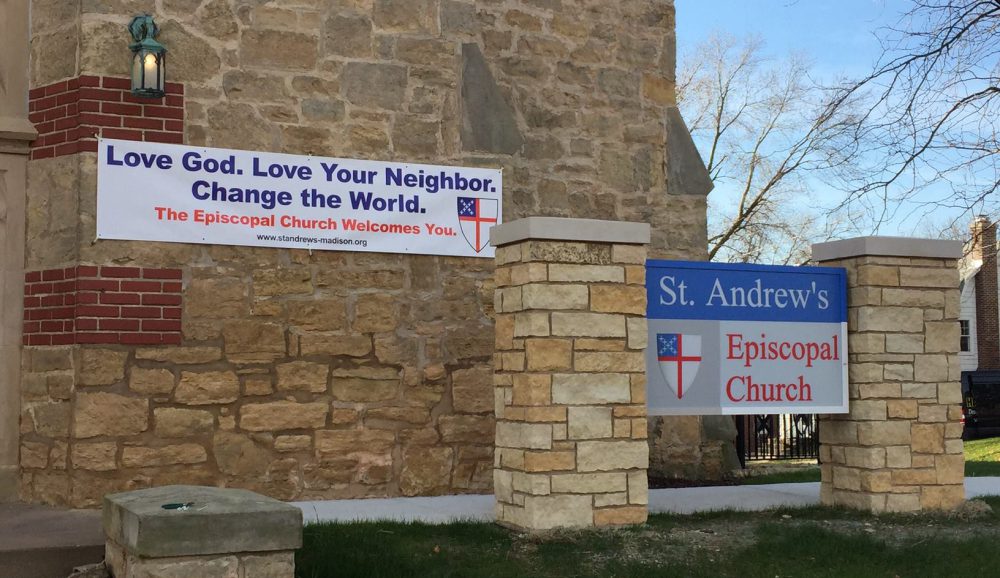
That We All May Be One: Addressing Issues of Race and Racism in Madison Wisconsin

This sermon, offered at Saint Andrew’s Episcopal Church in Madison, Wisconsin is built around the Gospel reading for the Seventh Sunday after Easter in Year B of the Revised Common Lectionary.

You can find that reading here.


It’s glorious when it happens. Just ask any preacher you know. The light in their eye, the energy in their response will tell you that this is what makes all of the late nights, wrestling with difficult texts, struggling to find the right words… these are the moments that make it all worthwhile… when the sermon just seems to write itself. It’s almost like you just need to get out of the way. You keep your fingers on the keyboard or the pen in your hand and the words just flow through you onto the screen or the page. What’s really interesting though is when the sermon writes itself and you don’t even realize that is what’s happening….

Now I suppose that sounds a little strange so I want to explain what I mean but in order to do that I have to share a secret with you. Don’t tell Dorie I told you this but… those of us who work here in the office with Dorie get a little extra grace when it comes to turning in our article for The Crossroads. So while the official due date was well past I was sitting on my screen porch with my laptop yesterday feverishly working to crank out five articles!

Once I was done I turned my attention back to the sermon I had been wrestling with all week and the words from today’s Gospel reading that had so hooked me, that had me so enthralled.

In today’s reading from the Gospel of John Jesus says, “As you have sent me into the world, so I have sent them into the world.” Jesus says that he has given us given us God’s word and that the world will hate us because of that word. Jesus is sending us out to proclaim the Gospel; that we are all one. And he knows that we will face resistance and push back. That the truth that we proclaim will put is in jeopardy. And so Jesus prays that God will protect us. Jesus prays that we will be on and he and the Father are one.

Jesus understands that the greatest danger in the resistance and push back we will receive is that we will forget, that we will become divided one against the other, that we will become alienated one from another, that we will lose sight of that basic truth; that we are all one.

Sitting there on my screen porch I suddenly realized that I had already written the sermon I need to offer you today in one of the articles that I had written for The Crossroads. So as we join Jesus in asking that as we live out our vocation, proclaiming the Gospel, we never lose sight of the fact that we are all one I would like to read you the sermon that wrote itself yesterday morning without my even knowing it.

Addressing the Racial Disparities in Madison and Dane County

This has been a dramatic and provocative week in Madison, Wisconsin. After a two month investigation and deliberation District Attorney Ismael Ozanne announced that he would not file charges in the March 6th death of Tony Terrell Robinson. The conversations around this incident have been difficult and divisive. The rhetoric on both sides has been heated and at times extreme.

As we approached the DA’s decision it was clear that, no matter how he decided, people would be hurt, angry, and even afraid. That is one of the reasons that an historic coalition of faith leaders gathered at the Park Street offices of Madison area Urban Ministries on the morning of May 8th.

We came together to formulate a response to the pending announcement that would allow all members of our community to give voice to their anger, fear, frustration and even their rage. That voice, the expression of grief is key to the work of reconciliation. There is no moving forward, there is no healing, there is no opportunity to work for constructive change, when the natural grief and anger that accompanies an incident like this one is squashed, repressed, or treated as unimportant or invalid.

The faith leaders gathered at MUM’s offices that Friday morning: Baptists, Jews, Lutherans, Presbyterians, Mennonites, Unitarians, and Episcopalians were looking for ways to encourage and facilitate the peaceful expression of these difficult emotions so that we might once again come together to address the larger underlying issues that have brought our community to this flash point of anger and frustration.

It was just two days later that the District Attorney gave forty eight hours notice that we was prepared to announce his findings.

So on Tuesday, May 12th we, the clergy and congregations of this remarkable coalition, gathered at 1125 Williamson Street, outside the house where Tony Terrell Robinson was shot, to listen to D.A. Ozanne’s 2:30 p.m. announcement.

We prayed and we stood together in solidarity, a witness to the unity that we will need to create if we are going to effectively address the systemic racism that has divided our community.

We stayed there outside the house as Tony’s family gave a press conference at the Community Justice Center up the street. We watched as teenagers, just released from school, and Tony’s friends began to assemble to express their pain, anger, and determination that Tony’s death be the catalyst for change in our community.

Then at five o’clock, when Tony’s family had finished their press conference and joined us there in the street outside the house where Tony died, we began a peaceful march through the city of Madison to the courthouse and then on to Grace Episcopal Church where we prayed, sang, and reiterated our commitment to the kinds of change that might keep us from ever finding ourselves in this place again.

We did all of this knowing that churches all over Madison, including Saint Andrew’s, were holding their doors open, creating places of sanctuary, prayer and dialog, so that members of our parishes and our neighbors in the community would have a place to go and express their own pain, grief, anger and fear.

As I participated in that march I was proud of the young people around me for their determination to demonstrate peacefully; for their commitment to justice, peace, and change; and for their willingness to raise their voices in the long standing and time honored democratic tradition of this country, demanding that they be heard, that they be recognized, and that their concerns be addressed.

I was proud of Saint Andrew’s and our brothers and sisters across the faith communities of Madison for its willingness to hold its doors open, to offer sacred space to whomever needed it, ready to extend itself no matter the decision that the DA rendered.

And I am proud to be part of an historic coalition of faith leaders and communities here in Madison that is willing to reach out across denominational, theological, and doctrinal lines to come together for justice, peace, equity and fairness. Following are some excerpts from the letter that coalition published.

“On May 8th a diverse coalition of faith leaders gathered at the Park Street offices of Madison-area Urban Ministry to formulate a unified response to District Attorney Ismael Ozanne’s pending decision regarding the investigation into the death of Tony Terrell Robinson.


While there is some internal conflict in our communities regarding the specifics of this particular incident there is broad agreement about the need to address the unjust systems laid bare in the Race to Equity Report and the Report of the Annie E. Casey Foundation.”


“At our gathering on May the 8th members of our coalition with long histories in this city marveled at our coming together; Baptists, Jews, Lutherans, Presbyterians, Mennonites, Unitarians, Episcopalians. No one could remember a gathering of the faith community that might rival the unity, determination and commitment that we are experiencing in this moment.”


“We also stand together as leaders of a broad coalition of faith communities demanding that we, as a community, respond in this moment to the larger issues of racial disparity that plague our community. We have come together to demand justice and we are not going to stand down until these issues have been addressed.”


“As we move forward as a community, as a city, and as a county we will continue to raise our voices for transparency, accountability and justice. An historic coalition of the faith community has emerged out of the current tragedy and crisis and we fully intend to continue to pressure our elected and appointed officials to address the underlying structural racism that has brought us to this moment.”

In the weeks ahead I hope to be announcing an opportunity for Madison’s faith leaders to participate in an intensive Anti-Racism Training offered by the YWCA. I am also looking for dates to bring one of the YWCA trained facilitators to Saint Andrew’s to walk us through the Race to Equity Toolkit so that we might better understand and interpret that data and gain a deeper sense of urgency around the need to transform our city.

I want to close with an important and potentially difficult point. The death of Tony Terrell Robinson and the response of this community has brought together an incredible coalition of faith leaders and communities, it has galvanized members of this city around the need for change and reform, it has brought the dangers of the disparities and inequities described in the Race to Equity and Annie E. Casey Foundation Reports into sharp focus for all of us.

We must and we will continue to demand clarity, fairness and justice in the shooting of Tony Terrell Robinson. We need to respond with compassion and care to Tony’s family, friends and community. They are suffering in the throes of unimaginable grief.

And we must acknowledge the failures that have brought us to this moment, the neglect, the indifference, and the racism that have resulted in this painful and terrible tragedy. But there is a danger in focusing our attention to narrowly on the events of March 6th and the protests and counter protests that have dominated the media coverage since that date.

The words of the Coalition of Faith Leaders call us to a broader focus:

“While there is some internal conflict in our communities regarding the specifics of this particular incident there is broad agreement about the need to address the unjust systems laid bare in the Race to Equity Report and the Report of the Annie E. Casey Foundation.”

The only way to redeem this tragedy, to find grace and hope in the midst of this painful sequence of events, is to find within ourselves the courage and strength to look beyond Tony’s death; to continue to call for systemic change; to work to change the attitudes, fears, and prejudices that alienate us one from another; to change the policies, procedures, and politics that have created the worse disparities between whites and people of color in the nation right here in Madison, Wisconsin. We can and we must stand together as one and do this work even as we promise never to forget…

What’s his name?

Tony Robinson!


Peace,

Andy+


.

Sanctified Doubt: a Sermon for the Second Sunday of Easter

This sermon, preached at Saint Andrew’s Episcopal Church in Madison Wisconsin on April 12, 2015, is built on the readings for the Second Sunday of Easter in Year B of the Revised Common Lectionary.

You can find those readings here.


It’s so, so difficult… maybe even heartbreaking to walk into a group of people whom you love, who love you, with whom you have shared your life and your trials, your joys and your successes, and suddenly find yourself on the outside. Maybe it’s something as small as they all watch the same episode of Downton Abbey last night and you missed it and so you can’t be part of the conversation. Maybe you don’t even like Downton Abbey. But that conversation is happening and you can’t be a part of it. Maybe this is the moment when all of your friends have decided to talk about their partners and how wonderful life is as a couple and you are the only single person in the group. It’s as if you suddenly have no part in the conversation, no part in the community. Or maybe you’re the only childless couple in the group and this is the day that everybody decides to talk about the miracle of what’s in the baby’s diaper this week. You can’t participate. You are not part of that conversation. The more important the issues the harder it is to speak up. Maybe you’re the only social conservative and a room full of liberals and you find your self unable and unwilling to risk saying what you think and believe. So I think we have some sense of what life must of been like for a whole week for Thomas.

Thomas shows up there in that upper room with the rest of the disciples who have seen the risen Lord, they’ve seen Jesus, and he comes into the room and they’re excited the room is filled with energy. But you weren’t there and you don’t have that same experience. I think it was a tremendously courageous thing for Thomas to do, to give voice to his doubts. Well it was either courageous or he was from Madison. I’m not sure which it is. But Thomas did. He said that unless I see the marks of the nails in his hands, and the wound in his side, and touch those wounds, I won’t believe.

It must have cost him a lot to say that there in that group of people. I’m sure he was afraid he would alienate himself from them or that he wouldn’t be able to participate in the life of this group anymore. We don’t know how that time played out. What we do know is that it wasn’t until a week later that Jesus appears again in that upper room and presents himself to Thomas. So for a whole week Thomas is wrestling with his doubts and his concerns and his lack of participation in this conversation. It must have been excruciating.

I also wonder what it was like for the rest of the disciples. They were excited, they were on fire, the room was filled with energy… and here comes Thomas the buzz kill. Thomas comes into the room… can we still talk about this? Can we be as excited as we were? Is Thomas still a part of us? Do we even still want him around? It must’ve been in excruciating week.

And then Jesus does present himself once again, there in that upper room, to the disciples. I think it’s really important for us to recognize what his goal is, what he’s doing in that moment. When he walked into that space I wonder what was going on in Thomas’ head. Did he think “I was wrong!” Was he afraid? Was he concerned? Was he filled with joy?

Jesus didn’t come into that space and say, “Thomas, you doubter… get out of here! You have no place with us!” He didn’t say, “If you can’t understand this then you need to go…”   What he did was he showed up in that space to offer Thomas what he needed. He showed up to offer Thomas what he needed despite his doubts, despite his concerns, despite his struggle.

I wish we could re-create that moment when we need it here in this place. So often I talk with people who are in the midst of some crisis, who are having some terrible loss in their life, experiencing some tragedy… and they express their doubts, and their concerns, and their fears, and their struggles to me… and they do it with an apology. It’s as if there’s something wrong with struggling, as if there’s something wrong with doubting, as if there’s something wrong being human. Because to be human, to be flesh, is it to wrestle, to strive, to struggle with God, and with our faith, and with our belief. All through our Scriptures we read about people who struggle, and test God, and are tested by God and the relationship ebbs and flows back and forth and yet God does not abandon them. God uses them to bring about God’s purposes in the world.

I don’t think today’s story is a story about doubting Thomas. I think today’s story is a story about God, and how God acts in the world, how God interacts with us. And in this moment what God is doing is sanctifying, sanctifying Thomas’ doubt.

Thomas is there with his doubts and Jesus comes to him and offers him everything he needs but doesn’t ask anything of him; doesn’t demand that he assent to the truth of his resurrection. I think that’s the key thing for us to remember. Oftentimes I hear people ask, “What does God need, what does God require, what does God demand of me?” I think the only answer to that question is to do justice, love mercy, and walk humbly with your God.

But the real way answer to that question though is to turn it, as Jesus would do if we asked him the question, and to say, “It’s not what God requires or wants from you that matters in this story. It’s what God wants for you.”

What does God want for us? God wants for us to have life and to have it abundantly, to be freed from the shame and self doubt and fear that binds us, keeps us isolated from one another, keeps us isolated from God, keeps us isolated and alienated from our very selves!

In this story we see God coming to us and saying, “Have what you need. Take from me what you will. And step into the light and live here with me.

I think it’s crucial for us to recognize that all of this happens in the context of this community that, we are imagining but to believe, was under some great stress for this week between Jesus’ appearance to the disciples and his coming again to meet with Thomas. I think that it’s a remarkable thing that Thomas is still there. After a whole week he still showing up in that upper room with the rest of the disciples. And it’s a remarkable thing that a week later the rest of the disciples are still welcoming him, at least on the surface. They’re letting him in. And so when Jesus comes to present himself to Thomas it’s not just Thomas’ doubts and fears that are being addressed. It’s the relationships that exist between everyone in the community, and this becomes a witness to the rest of the group. That to doubt is not a sin. To wrestle and struggle is not wrong. But to be together while you do it means everything.

So I don’t know if it was courageous of Thomas to give voice to his doubts and concerns or if he was just for Madison, but I know one thing for sure all the people in that room that night they were Episcopalians. Because that’s who we are. We are a people, we are a tradition, we are a group of Christians who recognize that to struggle and to wrestle with God, and with our faith, and what we believe is human, and important, and part of the relationship; that relationship that moves back and forth, that ebbs and flows, that is breathing, living, and dynamic. That’s who we are; a people bound together by the things that unite us, who are willing to set aside the differences that may divide us, because we know that what binds us and makes us one is far more important to who we are, to whom God is, and to who God is calling us to be.

When we gather here together I would be willing to bet that there are people in this room, in this community, there are people among us who struggle with some of the words of the creed, who struggle with other parts of the prayers. And yet we come together, and we say these things out loud in one another’s presence, and hope that they will shape and form us and make us one.

I’m pretty sure you’ve heard me tell this story before but it just fits so well… It’s an apocryphal story. I heard someone else tell it in the sermon so I don’t have names, and dates, and specific places…   It’s a story about a seminary professor whose family is killed in a tragic automobile accident. Daily Eucharist is required as part of this seminary’s life for all students faculty and staff. After a month this professor goes to the Dean and says, “I have to resign my post.” The Dean is shocked and asks why. The man says, “Because I can’t sit in the pew and say those prayers. I can’t be there in that place and proclaim my faith because it seems to have gone dry.” The Dean says to him, “That’s all right. You continue to teach your classes. And you continue to come to chapel. And we will say the prayers for you until you can say them again your self.”

As we make our way through this life we will all suffer loss. We will all experience tragedy. We will all encounter events that will call the deepest parts of who we are into question, and leave us wrestling, and struggling. What’s key, what’s more important than anything, is that we continue to come together, to hold one another up, and to allow ourselves to be held. Because when we gather together, here in this upper room, we can be sure that Jesus will appear and give us what we need to believe.

Look around you will find him in the faces of the people in the pews beside you, in front of you, and behind you. You’ll find him in the light streaming through these windows. You’ll find them here at this table as we gather with our hands outstretched to receive the sign and the symbol of his ongoing presence among us. You’ll find him offering his wounds, his love, his light, and his truth as we gather together as the body of Christ. This is not a story about a doubter. This is a story about a God who sanctifies our wrestling, our struggling, and our doubts and love every bit of it, as God loves us, and forms and shapes us, so that we can offer that same love to one another here in this place.

Thanks be to God!

Amen

Telling Stories and Singing Songs in the Dark: A Sermon for The Great Vigil of Easter

Alleluia! Christ is risen!

The Lord is risen indeed! Alleluia!

So what did you tell them? How did you explain to your family, friends and co-workers that you wanted, that you needed to be in church tonight?

I imagine that it might have been a pretty hard sell. It’s Saturday night and Madison is filled with attractive options: restaurants, theaters, music… The weather is finally beginning to feel like spring and people are anxious to be out and about… And I hear tell that someone is playing basketball tonight….

Funny thing is, no one asked me what I was doing tonight. I guess my family, friends, and co-workers all had a pretty good idea where I would be and what I would be doing. But if they had asked… I would have told them that I was going to be busy telling stories and singing songs in the dark.

Telling stories and singing songs in the dark… How would that have worked for you? How would people have responded to your describing this night in that way? They might have thought you were joking. They might even have laughed for a moment. But that’s when you would have had them.

“Yeah. It’s great! We light a fire and use the flames to light candles for everyone. We tell stories about our family: who we are, where we come from, and where we have been. We sing songs that describe what we hold dear and what we believe. Then, as we get to the real turning point in the story, the moment where it all comes together, we turn on all the lights, shout for joy, and share a meal together while we continue to tell our story!”

I am guessing that at this point anyone to whom you described the Easter Vigil in this way, even if they had never been to church, would be recognizing something very familiar and powerful in what you were saying. Something in your description of what we do this night would have resonated with them because there is something primal, something central to who we are, something that transcends all boundaries and divisions in the ritual telling of stories.

We engage in the ritual telling of stories all the time. We gather for marker events in the lives of individuals and groups, of communities and nations; at birthdays and anniversaries, when goals have been met or accolades won, at moments of celebration and of loss, on the occasion of important decisions or the declaration of decisions joined…

We play our music, dance our dances, relive and recreate our dramas. We dress in the way of our people. We eat the food that has fed us in the good times and the bad…

And we tell the stories that bind us together and form our identity; the stories that grind and polish the lens through which we interpret our lives and the world around us.

This is the night when we, beloved children of God, spiritual descendants of Abraham, gather to retell, to rehearse, to recollect the stories that bind us together, that define and shape our identity, that grind and polish the lens through which we interpret our own lives and the world around us. This is the night when we proclaim once again, who we are, and whose we are.

We gathered in the dark, and engaged in ritual, kindling a flame to represent the light that has come into the world. We have shared that flame among the people gathered and by its light alone we have participated in our story; claiming and proclaiming that God has created all that is, that all of creation draws its life and meaning from its creator, and that we: you, me, all people, are created in God’s image.

We have rehearsed the checkered history of our walk with the God who created us. Who created us not out of necessity or in response to any deficit within God, but out of extravagantly generative Spirit of creativity and love. We have recalled God’s promises and God’s faithfulness even when we were unable or unwilling to be faithful to God.

We have walked on dry land as the seas foamed and raged about us, finding our deliverance and freedom from slavery as God has delivered us through the waters of baptism.   We have heard once again Wisdom’s promise of a life lived in God’s joy, peace, and abundance and the promise that God will place God’s spirit with in us, that we will be God’s people and that God will be our God.

Here in a world lit only by fire we experienced the despair, the dryness of spirit and the desolation that falls upon us when we rely on ourselves alone and forget the God who creates, redeems, and sustains us.   And in a foreign land, far from home we have felt anew the vigor and life that comes when the Spirit of God fills us and breathes in us and through us once again.

And with God’s promise to restore us, a reaffirmation of God’s faithfulness and the promises that God has made to us, ringing in our ears, we stood and renewed our promises to God, binding ourselves once again to the one who comes among us to set us free, trampling down sin and death by rising victorious from the grave!

We engage in ritual story telling all of the time, at all sorts of events, and for all sorts of reasons. But this is the night when we, beloved children of God, spiritual descendants of Abraham, gather to retell, to rehearse, to recollect the stories that bind us together, that define and shape our identity, that grind and polish the lens through which we interpret our own lives and the world around us. This is the night when we proclaim once again, who we are, and whose we are.

Beloved of God, on this night, this is where we want and need to be!

Our story is compelling. It is life giving, but there are other stories, other narratives to pick from. Every day we are flooded with stories about our own self worth, about things, things that might make us whole, that might fill the hole we feel within ourselves. Every day we hear stories about the “others’ in our world, about their intent to do us harm, their desire to take what is ours, to destroy what they cannot have. Every day we hear stories that demean God’s children, that point fingers and cast blame, that divide, that alienate, that corrupt and destroy the children of God.

These stores are wrapped in rituals of their own: the Nightly News, Political Speech with all of it’s pomp and circumstance, the infallibility of the internet, Facebook… These might not strike you as rituals at first blush but look closely. They are presented with ritual and we create our own rituals around the way that we receive them.

This is the night when we, followers of Christ, must proclaim again and again, who we are, and whose we are.

We need to gather as a people, to engage the rituals, the liturgy that adds depth and meaning to the stories. We need to hear the stories as happening in the present, to live them as they are told, to recollect them. It is essential, if we are to be faithful to the vows and promises that we have made to one another and to God, that we gather in the dark, light a fire, tell stories, sing songs, and share a meal.

We tell this story not for ourselves alone but for him who died and rose for us. We tell this story to stand against the stories and narratives that demean, corrupt, and destroy. We tell this story as an offering to the world, as an invitation to life and love abundant. We, along with God’s beloved children all over the world, tell this story so that it’s light is never overcome by the darkness.

Our families, friends and co-workers may have been amused by our decision to spend this Saturday evening telling stories and singing songs in the dark, but even a short explanation of what we are all about this evening should strike a chord, might even stir some longing within them, and who knows… It might even offer you the opportunity to tell the story wrapped in the particular rituals, an early morning walk, a cup of coffee shared in a favorite place, a meal shared around your kitchen table, that mark your relationships with those people.

Alleluia! Christ is risen!

The Lord is risen indeed!  Alleluia!


Loving God, Loving your Neighbor – a Call to Political Activism

This sermon was preached at Saint Andrew’s Episcopal Church in Madison, Wisconsin on March 8, 2015.

It is built around the readings for the Third Sunday in Lent Year B of the Revised Common Lectionary.  You can find those readings here.

The law of the Lord is perfect and revives the soul. The testimony of the Lord is sure and gives wisdom the innocent. The statutes of the Lord are just and rejoice the heart. The commandment of the Lord is clear and gives light to the eyes…  More to be desired are they then gold more than much fine gold. Sweeter by far than honey, than honey in comb Psalm 19).

I wonder how many of us have that sort of relationship with the law. Laws are designed to keep us safe, to protect our rights, to protect our property, to govern the way that we interact with one another so that we can be secure and that life might be predictable. But in the end I think we usually think of the laws as constraints, of ways to manage our behavior and the behavior of others.

The people of Israel had a very different vision of the law.   The law gives wisdom to be innocent, rejoices the heart, gives light to the eyes, is more to be desired than gold, and is sweeter than honey from the comb.   How is it that they could have such a different understanding of and relationship with the law? The wonderful Old Testament scholar Walter Brueggeman gives us some insight into the people of Israel’s relationship with the 10 Commandments. He says “These commandments might not be taken as a series of rules but as a proclamation in God’s own mouth of who God is and how God shall be practices by his community of liberated slaves.” A proclamation in God’s own mouth of who God is and how God shall be practiced by his community of liberated slaves. So how can we understand the 10 Commandments in that way?

Take a look at the Commandments as they are printed in your bulletin in the first reading. I am the Lord your God brought you out of the land of Egypt out of the house of slavery you shall have no other gods before me. You shall not make for yourself an idol, no images of God to come between God and God’s people. And we are not to use God’s name in vain, either to swear by or swear with. Our relationship with God is defined in these first three commandments. And then there’s this commandment that functions sort of as hinge piece, here in not quite the middle of the list… Remember the Sabbath day and keep it holy. Set aside one day a week to bask in this relationship, in the light, grace, and mercy of God’s love, and to remember who you are and who God is.

On the other side of that hinge piece there are six Commandments that describe how we are to practice God with the people around us. You shall not murder, shall not commit adultery, shall not steal, shall not bear false witness, shall not covet… all of these proclamations in God’s own mouth of who God is and how we are to practice God. All of them are about our relationships with one another, and our relationship with God.

Mother Dorota read the summary of the law at the beginning of the service as we knelt to confess our sins and ask for God’s absolution.   The first and greatest commandment is this; you shall love the Lord your God with all your heart, soul mind, and strength. And the second is like it. You shall love your neighbor as yourself. This proclamation of who God is and how we are to practice God in the world is all about our relationships and the ways that we love one another.

It was with these words ringing in our ears and in our hearts that we gathered yesterday at noon at Christ the solid rock Baptist Church. Early in the morning an email had gone out from Linda Ketcham, the director of Madison Urban Ministry, asking clergy in Madison if they would contribute to the funeral expenses for Tony Robinson who was killed on the east side of Madison Friday night. In response to that request, as several of us were promising funds to help defray those costs, Pastor Everett Mitchell of Christ the Solid Rock Baptist Church hit “reply all” and invited the Madison clergy to join him at noon to pray together and to be in solidarity with one another and with the Robinson Family.

When I arrived I had a member of our parish with me who had asked for a ride. We met two other members of the congregation who joined us there. Leanne Puglielli who has, as she said yesterday, one foot at St. Andrews and one foot at Christ the Solid Rock was seated there waiting for us.   We said some prayers. We heard some details about the events of Friday night and Saturday morning that we didn’t know.   And then we were offered the opportunity to brainstorm together about how we might, as the community of liberated slaves in Madison, continue to “practice God” as we move forward together.

Now I’m sure that there are some people who would say that we were doing something wrong in gathering together. That what we were doing was entering into the world of politics and that the world of politics is not the place for the church. But if you strip away the pejorative baggage that gets associated with the word “politics” and think about it at its core politics is really all about the way that we relate to one another in the public square; how we are in relationship with one another, how we treat one another, and that is what the 10 Commandments are all about. God’s own proclamation about how we should “practice God” in the community is inherently a political statement.

One of the clergy stood up at that gathering yesterday and said that he thought the clergy of Madison should gather together in fellowship on a regular basis. There was a murmur of ascent in the room and as he passed me on his way back down the center aisle to his seat I stood up, extended my hand, and I said, “I’m embarrassed to have to say that I don’t know your name.” For the next half an hour we went around the room one by one and introduced ourselves and named the faith communities where we serve and worship. At the end of that period of introductions we were all profoundly struck by the number of faith communities who were represented in that place and the power that we have as the church when we stand together in that way. We wrestled with things that we might do, ways that we might address what happened on Friday night. And we knew in our hearts that together we can make a much larger difference then we can as individuals.

I think that there is a real temptation in the wake, in the chaos left behind after Tony Robinson’s shooting of Friday night to adjudicate the events of that night, to decide who was at fault, to lay blame. We will hear more about the events, more details will surface, and invariably blame will be assigned. But I think that we need to be very careful as those details emerge. This morning in the State Journal there is an article that describes four events in the last several weeks where the Madison Police Department have had guns trained on them, had bullets fired in their direction, and they did not respond with deadly force. Some of those events involved white people, some involved black people, some were in affluent neighborhoods, and some were in less affluent neighborhoods. We need to be careful that we do not paint with too broad a brush as we color the events of last Friday night.

But we also need to recognize and honor the fact that a young man, Tony Robinson, is dead. And a mother and a family and a community are grieving. And that in the wake of these events we are grieving too. I think that our grief needs to grow out of the conversation that we have been having here at St. Andrews and in Madison for the last year. The Annie E. Casey Foundation report, The Race to Equity Report, have cast light on the disparities in Madison and in Dane County. We have spoken of them often, both here in this pulpit and in conversations in the parish hall around the tables at the Sunday forum.   We know that there is an illness there is a disease in Madison and Dane County. The anger and the frustration and the rage that have erupted over Friday night’s shooting are evidence of that illness. And we dare not leave that illness unaddressed.

Another commentator that I read this week, in speaking about the 10 Commandments, had this to say, “Those who ignore the divine teachings do so at their own peril – not because God is standing over them with a hammer, but because the teachings describe the way of life. To ignore them is to wander into the ways of death instead, where God’s faithfulness can be of little help.” When we do not love God with all of our hearts, soul, mind, and strength, and our neighbor as ourselves we are wandering into the ways of death. And the event that we have seen in this city over the last several days are the fruits of that wandering.

So what can we do there will be a letter from the Madison clergy, all of the people who attended the meeting yesterday and many who could not, including our own bishop who has phoned me and is anxious to lend his support to what we are doing here in Madison. That letter will go to the media, to the Mayor, to the Chief Koval, to anyone to whom we can deliver it. It will say that the church in Madison: Episcopalians, Lutheran’s, UCC, the Methodists, the Presbyterians, Jewish congregations, the Buddhists who were there yesterday, are all standing together and demanding that the investigation into Friday night’s events be transparent and just.

And even more importantly, demanding that we address the faults in the system that have led us to a place where the city erupts in anger, and suspicion, and frustration over an event like the one we experienced Friday night.

I saw a Facebook meme the other day, there’s this picture of Jesus in the Temple overturning the tables with a whip in his hand. The people in that picture looked pretty shocked, trying to get out of his was as the coins rolled across the floor, the tables piled in a heap. The painting didn’t portray them but I imagine that even his disciples were pretty surprised at his response to what he found in the temple. It had been going on for a long time. It was part of the status quo. When you arrived at the conclusion of your pilgrimage at the Temple you were required to offer an animal without blemish as a sacrifice. And even if the animal you left home with it the beginning of your journey was unblemished it would be very difficult to keep that animal in that pristine state on that long and difficult journey. So unblemished animals were sold in the temple grounds. When you entered the temple you paid a temple tax to help with Herod’s reconstruction program and you could not use the Roman coin because it was engraved with Caesar’s image. You traded your coin of the Empire for a coin that you could offer in the Temple one with that was not idolatrous in its very manufacture. So the need for these services seemed apparent. But something had gone wrong. The synoptic Gospels Matthew Mark and Luke tell us that there was some corruption. In their Gospels Jesus as you have turned my father’s house into a den of thieves. John doesn’t say that John has Jesus say, “stop making my father’s house a marketplace.” Whatever the reason the status quo was broken and in order to change it Jesus overturned some tables. That painting that I was telling you about of Jesus with the tables turned over and people looking shocked coins on the floor and a whip in his hand… the caption said, “the next time somebody asks you what would Jesus do… tell them that turning over some tables and chasing people with whips is within the realm of possibilities!”

We are called to love the Lord our God with all of our hearts, soul, mind, and strength, and our neighbors as ourselves. That is a radically political statement… political at its core! In order to love in that way, to bring about the kingdom, the vision, the dream that God has for all of us… for Madison Wisconsin, for the county, for all of creation… we may need to raise our voices. We may even need to overturn some tables as we challenge the status quo and push on the people who have power to make the changes for which the Gospel cries. If we don’t follow Jesus into the Temple this Sunday and take up that cause, then we are not “practicing God” as his community of liberated slaves in the way that the 10 Commandments God gave to Moses on Mount Sinai calls us to live.

So fasten your girdles around you. Put on the breastplate of righteousness. Take courage; follow our Lord, as we demand that we become a community that practices God together.

Amen

Marching from Selma to Madison Wisconsin: A Sermon Honoring the Life and Ministry of the Reverend Dr. Martin Luther King Jr.

This sermon, offered at Saint Andrew’s Episcopal Church in Madison Wisconsin on January 18, 2015,  is built around the lessons appointed for use on the Feast of Martin Luther King, Jr.  You can find those readings here.

Links to Dr. King’s writings quoted in the sermon are provided in the text of the sermon.

This morning we celebrate the life and ministry of the Reverend Doctor Martin Luther King Junior  I hope that you will indulge me as I offer a short history lesson.

Born January 15th, 1929 The Reverend Dr. Martin Luther King was instrumental in the passage of the 1965 Voting Rights Act which eliminated the unconstitutional barriers used to deny African Americans their right to vote across much of the South.

In the course of his career as a civil rights activist Dr. King led the 1955 Montgomery Bus Boycott, helped to found and was first president of the Southern Christian Leadership Conference, led struggles against segregation in Albany Georgia and in Birmingham, Alabama and helped to organize the 1963 March on Washington where he gave his famous “I Have a Dream speech.

In 1965 Dr. King and the Southern Christian Leadership Conference helped to organize the Selma to Montgomery marches, depicted in a movie that is showing in theaters today and which has been nominated for an academy award for best picture, that helped to secure passage of the voting rights act.

Killed by an assassin’s bullet in Memphis Tennessee on April 4th, 1968 Dr. King was the recipient of the 1964 Nobel Peace Prize and was posthumously awarded The Presidential Medal of Honor in 1977 and the Congressional Gold Medal in 2004.

It is no wonder that tomorrow, in this towns and across the nation, on a Federal Holiday established in his honor, Dr. King will be celebrated and honored in statehouses across the nation with speeches, stories, and song. Given the importance of his work it is no surprise that in all of those gatherings children will read their winning essays describing Dr. King’s influence and impact on their lives, adults will remember those painful and turbulent days and we will all give thanks for a life and work cut terribly short.

In the public square Dr. King stands tall among the great men of this nation.   In the public square… But why is it that we are talking about him here in church? Why is it that we are suspending our regularly scheduled program and readings to remember and honor him as we celebrate the Eucharist, The Great Thanksgiving, here today?

In answer to that question I would like to invite Dr. King to speak. This is an excerpt from his sermon   “Loving Your Enemies.”

“The Greek language comes out with another word for love. It is the word agape. And agape is more than eros; agape is more than philia; agape is something of the understanding, creative, redemptive goodwill for all men. It is a love that seeks nothing in return. It is an overflowing love; it’s what theologians would call the love of God working in the lives of men. And when you rise to love on this level, you begin to love men, not because they are likeable, but because God loves them. You look at every man, and you love him because you know God loves him. And he might be the worst person you’ve ever seen.

And this is what Jesus means, I think, in this very passage when he says, “Love your enemy.” And it’s significant that he does not say, “Like your enemy.” Like is a sentimental something, an affectionate something. There are a lot of people that I find it difficult to like. I don’t like what they do to me. I don’t like what they say about me and other people. I don’t like their attitudes. I don’t like some of the things they’re doing. I don’t like them. But Jesus says love them. And love is greater than like. Love is understanding, redemptive goodwill for all men, so that you love everybody, because God loves them. You refuse to do anything that will defeat an individual, because you have agape in your soul. And here you come to the point that you love the individual who does the evil deed, while hating the deed that the person does. This is what Jesus means when he says, “Love your enemy.” This is the way to do it. When the opportunity presents itself when you can defeat your enemy, you must not do it.”

That sermon was delivered November 17, 1957 at Dexter Avenue Baptist Church in Montgomery, Alabama.

Compare those words to something that we heard just a few minutes ago…

“Jesus said, “I say to you that listen, Love your enemies, do good to those who hate you, bless those who curse you, pray for those who abuse you. If anyone strikes you on the cheek, offer the other also; and from anyone who takes away your coat do not withhold even your shirt.”

“But love your enemies, do good, and lend, expecting nothing in return. Your reward will be great, and you will be children of the Most High; for he is kind to the ungrateful and the wicked. Be merciful, just as your Father is merciful.”   (Luke 6:27-29, 6:35-36)

Here in the season of Epiphany we focus our attention on God’s presence in the world made manifest, tangible, real so that we might experience the light, grace and love that is ours for the claiming. The scriptures assigned for the season of Epiphany focus on God’s ability to affect and change the world and our lives through the work and teaching of Jesus Christ. What a lovely coincidence that Dr. King was born during this season so that we might remember him as an example of God’s grace, light and love, and ability to transform our lives and the world!

Why do we interrupt our regularly scheduled programming this morning to hear and remember Dr. King’s voice? Because Dr. Martin Luther King’s life and work manifested God’s light, love, and grave to the world for all of us to see. Because Dr. King’s voice has earned a place here with us, within these walls, among the people who seek to walk as a child of the light.

Listen again:

“We must meet hate with love. We must meet physical force with soul force. There is still a voice crying out through the vista of time, saying: “Love your enemies, bless them that curse you, pray for them that despitefully use you.” Then, and only then, can you matriculate into the university of eternal life. That same voice cries out in terms lifted to cosmic proportions: “He who lives by the sword will perish by the sword.” And history is replete with the bleached bones of nations that failed to follow this command. We must follow nonviolence and love.”

(“Give Us the Ballot” Address (1957) Delivered at the Prayer Pilgrimage for Freedom (Call to Conscience) Washington, D.C.)

Tomorrow Dr. King’s voice will be taken up all across this nation. People will work to carry on his legacy, forwarding the cause to which he gave, and for which he lost his life. There is no doubt that his image will appear on the evening news, in newspapers and on magazine covers.   On one of those covers Dr. King’s voice will ring out loud and clear.

This from the Washington Post:

“The New Yorker on Friday afternoon released a look at the cover of its next issue. Barry Blitt’s drawing, which will adorn newsstands and coffee tables next week, evokes the famous photos of the Rev. Martin Luther King Jr. as he marched from Selma to Montgomery in 1965.

On this cover, King’s arms are linked with those of Eric Garner, the Staten Island man who died after being placed in a police chokehold, and Wenjian Liu, the New York City police officer gunned down with Rafael Ramos as they sat in their squad car last month. They are joined on the cover by Trayvon Martin and Michael Brown, who were shot and killed in Florida and Missouri, respectively.”

In the last few months our nation has been wracked with pain, drawn back into a conversation that many of us would like to believe was concluded by Dr. King’s work some fifty years ago. The similarities between the circumstances and the events that have spawned our current angst and the struggle in which Dr. King was engaged are to striking to be ignored.

Jimmie Lee Jackson was a civil rights activist and a deacon in the Baptist church. On February 18, 1965, he was beaten and shot by Alabama State Troopers while participating in a peaceful voting rights march. Jackson was unarmed; he died several days later in the hospital. A Grand Jury declined to indict the Trooper who killed him.

Listen to the words Dr. King spoke in his eulogy of Jimmie Lee Jackson.

“So in his death Jimmy Jackson says to us that we must be concerned not merely about WHO murdered him, but about the system, the way of life and the philosophy which produced the murderers. His death says to us that we must work passionately and unrelentingly to make the American ream a reality.”

WHO murdered Eric Garner, Wenjian Liu, and Rafael Ramos? WHO murdered Trayvon Martin and Michael Brown? We know WHO used the chokehold. We know WHO pulled the trigger. We know which ethnic group each of them belonged to.   We know how old they are and where they grew up. We know their history and their mental health status. We know which of them were police officers and which of them were not. And we have spent hours and hours, page upon page expounding on the guilt of the WHO in each of these cases.

But Dr. King’s voice has earned a place here with us, with the people who want to walk as children of the light, and he calls to us, imploring us to be concerned

“about the system, the way of life and the philosophy which produced the murderers.”

Here is what we know about that system:

In Dane County the unemployment rate for white citizens of this country is 4.8%.  The national unemployment rate for African Americans is 18%.  And in Dane County the unemployment rate for African Americans is 25.2%, five times that of their white neighbors!

In Dane County the Median Income for whites is $63,673

Nationally the median income for African Americans is $33,233.  In the state of Wisconsin the median income for African Americans is $24,399.  And in Dane County it is $20,664, less than one third that of their white neighbors.

In Dane County 8.7% of our white citizens live below the poverty line.  While 54% of our African American neighbors live in poverty.  54%!  That is 1.5 times greater than the national statistics!  That means that in Dane County African Americans are 5 -6 times more likely to live in poverty than their white neighbors.

What do we know about the “system that produced the murders”?  We know that it is out of balance, unfair, and dysfunctional.

What do we know about the way of life and the philosophy that have produced the murders?

We know that across the country for every 1 white youth arrested 2.1 African American youth are arrested by the police.In the state of Wisconsin the statistics are 3.4 to 1.

In Dane County the arrest ration of black to white youth is 6.1 to 1!

In Dane County African American youth are arrested at a rate of 102/thousand while their white neighbors are arrested at a rate of 5.8/thousand.  That makes the detention ratio of African American to White youth 15.3 to 1!

Black Youths in Dane County make up 10% of the population age 12 – 17.  They make up 64% of the detention population for that age range.

In Dane County adult African Americans are incarcerated at a rate 15 times higher than whites in this county.

In Dane County Black people make up 4.8 % of the population aged 18-54.  They make up 44% of the detention population for that age demographic!

(Stats taken from The Race to Equity Report)

There is a strong temptation to look at these statistics and focus our attention on the WHO, to criticize and condemn the police whom we trust to protect our streets and defend our rights.   I need to tell you that when Wenjian Liu and Rafael Ramos were shot while sitting inside their patrol car in New York City Pastor Alex Gee of Fountain of Life Covenant Church called for a prayer gathering so that together we could pray for reconciliation. There were several of us from Saint Andrew’s in attendance that day and everyone there as pleased that Madison Police Chief Mike Koval was there too. Chief Koval is pulling officers off the line to institute additional training so that the kind of tragedies that have occurred elsewhere in this country do not happen here. But focusing on the WHO is a mistake. Once again we must listen to Dr. King’s voice and recognize that the policing statistics for Dane County speak more to who we are as a society than we are comfortable admitting.

The actions of the police today, much as they were in Birmingham and Selma serve to hold up a mirror to our own fears, prejudices, and complacency. These statistics represent a philosophy, a world view which either hasn’t moved much or has reverted to the repugnant attitudes and prejudices of the 1950s and 60s.

Today, tomorrow, all week, here in the season of Epiphany Dr. King’s manifestation of the teachings of Jesus Christ call upon us to listen, to take stock, and to

“work passionately and unrelentingly to make the American Dream a reality.”

We have made a start in this place; partnering with Dr. Alex Gee, Fountain of Life Covenant Church, and the Nehemiah Project we have given $5,500 to help support the BROTHER Program, working to provide African American boys with positive role models and mentoring, to work with their families to break the chain of violence, oppression and despair that surrounds them in this place.

It is now time to take the next step. We are working to address the immediate need; to address the acute symptoms of the illness witch infects our nation. We need to turn our attention to the root of the evil which has caused these wounds

“…the system, the way of life and the philosophy which produced the murderers.”

In the season of Epiphany and Lent we will be working to engage in conversations about our own place in this system; about the privilege that we take for granted, the suffering that happens all around us to which we are blind or indifferent. We will be working to acquire the tools and the understanding that will allow is to move the systems and shift the philosophy of the people who can intervene at a systemic level to move us closer to the realization of the American Dream for all of our people.

I ask you to be courageous, to respond to the call, to be willing to enter into difficult and challenging conversations with our brothers and sisters in the African American Community, to hear their stories, to embrace their reality, and to work to put an end to this stain on our nation.

Manifestations of God to the world, epiphanies, are meant to point to a reality beyond the details o the events themselves. And they are meant to cal us to change, to live lives that reflect the reality of God among us, Emmanuel. We are the church, the Body of Christ in the world. We cannot sit idly by as our brothers and sisters are dying.

I leave you this morning with a portion of Dr. King’s Letter from a Birmingham Jail, written in response to the criticism of Birmingham’s white clergy who were urging him to be quiet and to stand down.

Dr. King tells us that…

“…the judgment of God is upon the church as never before. If the church of today does not recapture the sacrificial spirit of the early church it will lose its authentic ring, forfeit the loyalty of millions, and be dismissed as an irrelevant social club with no meaning for the twentieth century.”

Heaven forbid!

Amen.

The Birthplace of Joy, Creativity, Belonging, of Love: a sermon for Christmas Eve 2014

This sermon, offered on December 24th, 2014 at Saint Andrew’s Episcopal Church in Madison Wisconsin is based on the Readings for Christmas I in the Revised Common Lectionary.

You can find those readings here


Standing there in a small cave, on the slopes outside Bethlehem, our instructor asked us to imagine that we had seen something compelling enough to cause us to leave our sheep, or to leave them in the care of the junior shepherds, and to make the trip into Bethlehem in search of a newborn child.

Something compelling?  seriously?

You mean something compelling like a light unlike any we had ever seen, an angel of the Lord speaking to us, a host of angels praising God and saying,

“Glory to God in the highest heaven and peace on earth to those whom he favors…”

It’s hard to imagine what that might have looked like. It’s hard to imagine what that must have felt like. But it’s not hard to imagine that it would have been pretty compelling. Once our hearts stop pounding, our knees stop shaking, as the adrenaline begins to settle into our bellies we are on our way, heading into Bethlehem, the sheep and all else forgotten in our excitement and anticipation.

And it’s not just the special effects, the heavenly host and the light show that have us taking to the road here in the middle of the night. As the darkness settled back in, as we have relived that spectacular and terrifying moment, the words that the angel spoke have begun to resonate in our heads…

“Do not be afraid; for see– I am bringing you good news of great joy for all the people: to you is born this day in the city of David a Savior, who is the Messiah, the Lord. This will be a sign for you: you will find a child wrapped in bands of cloth and lying in a manger.”

Those shepherds, living in the fields, keeping watch over their sheep that night,

anyone who was hearing or reading Luke’s account of this moment,

and we sitting here this evening

all recognize in the Angel’s proclamation a promise of freedom, redemption, and salvation:


“For a child has been born for us,

a son given to us;

authority rests upon his shoulders;

and he is named

Wonderful Counselor, Mighty God,

Everlasting Father, Prince of Peace.

His authority shall grow continually,

and there shall be endless peace

for the throne of David and his kingdom.

He will establish and uphold it

with justice and with righteousness

from this time onward and forevermore.

The zeal of the LORD of hosts will do this.”

Endless peace, justice and righteousness from this time onward and forevermore… No wonder we are on the move, gathering here around the manger, daring to hope that this is the one who has been promised from of old… The

“Wonderful Counselor, Mighty God,

Everlasting Father, Prince of Peace.”


But you know… now that we are here I just have to ask the question… is this the right place, the right child, the son we have been waiting for? I know that the angel said we would find him in a manger… maybe in our excitement we sort of glossed over that one detail… but I just don’t see how this could be right…

“Wonderful Counselor, Mighty God,

Everlasting Father, Prince of Peace.”

Those words, words that have been so important to us, words that have given us hope and comfort, those words evoke

power,

majesty,

might!

Authority is supposed to rest upon his shoulders and grow continually…

But this child, this son, has been born among the animals, wrapped in rags, and laid in a manger filled with hay. How can this child hope to restore the nation? Do we dare rest our hopes and dreams on him, on one born in such mean estate… where ox and ass are feeding?


Luke tells us that after they saw Jesus and told their story to Mary and Joseph,

“The shepherds returned, glorifying and praising God for all they had heard and seen, as it had been told them.”


I don’t know… Clearly they were convinced… But I think I would feel much better about it would feel about the hopes and fears of all the years being met in a child destined to become the

 “Wonderful Counselor, Mighty God,

Everlasting Father, Prince of Peace…”

…if that child had arrived with just a little more power… majesty… and might…

Resting our hopes and fears on this vulnerable little child feels too risky. It leaves us feeling vulnerable too. So how could those shepherds come away from their encounter with a child born among the animals, wrapped in bands of cloth and lying in a manger so ecstatic, so sure of what they had seen? Perhaps in that encounter they had discovered something about vulnerability that has been lost on us today.

Power, majesty, and might sound attractive when we are desperate for relief, when we long for an intervention that will make all things right, that will restore order and justice, and return us to our proper place in the world.

But power, majesty, and might are difficult things to manage in a relationship. They create an imbalance, diminish mutuality, and make love difficult, suspect, maybe even impossible. Power, majesty, and might almost always come across as saying, “I own you. Bend your knee to me.”

We don’t have to look far to see how this plays itself out… the news is filled with people who can’t seem to risk being wrong, who don’t want to risk the possibility that they might learn something from someone else, who don’t want to risk having to change… All of that risk leaves them feeling much too vulnerable. So they assume a position of power, majesty, and might… trying to force their opinion on others and demonizing anyone who disagrees with them or challenges their authority.

We don’t have to dig very deep to understand how a fear of risk and an aversion to vulnerability impact our personal lives. The fear of rejection, the fear of not measuring up, the fear of being laughed at keep us from risking, keep us from allowing ourselves to become vulnerable to another. We hide our true selves so that we won’t get hurt. The fear of risk, an aversion to feeling vulnerable leaves us estranged from one another, cut off, from the people and the world around us.

Three days ago, at the Sunday Forum we watched a TED Talk by Brene Brown, whom Wikipedia calls a scholar, author, and public speaker but who prefers to call herself a “researcher story teller.” In her research she has found that people who express a true sense of connection with the people and the world around them are people who embrace vulnerability. They believe that what makes them vulnerable also makes them beautiful. They are willing to risk, “To do something where there are no guarantees. To invest in a relationship that may not work out. To say ‘I love you’ first.” Taking risks, making ourselves vulnerable may, at times, leave us hurt or wounded but, according to Brown, “it is also the birthplace of joy, creativity, of belonging, of love…”

Hear that again… “Vulnerability is the birthplace of joy, creativity, belonging, of love.”

Those shepherds who came to the manger expecting to meet the son who was promised from of old, the “Wonderful Counselor, Mighty God, Everlasting Father, Prince of Peace…” were folk who lived pretty close to the bottom of the social order. They were looked down upon, not welcomed among polite company. It’s easy to imagine how their lives might have left them risk averse, unwilling to reveal themselves to another, avoiding moments, situations, and relationships where they might be vulnerable to more hurt, rejection, or shame…

So I am guessing that when they found the little Lord Jesus asleep on the hay, they were startled, that they were confused, maybe even a little disappointed at first. They came looking for someone with power, majesty, and might to intervene on their behalf.

And then the dawn began to break upon them…

If what the angels had told them was true, if this is indeed is indeed the one who was promised, the one who would become the “Wonderful Counselor, Mighty God, Everlasting Father, Prince of Peace…” then God has chosen to begin that work by risking, by daring to become vulnerable to and for us. In coming to us as a defenseless, dependent baby, born in a stable and laid in a manger God has risked doing “something where there are no guarantees,” Has risked “investing in a relationship that might not work out.”

No wonder we will all go home tonight glorifying and praising God for all that we had heard and seen. Gathered here at the manger we have experienced an incredible revelation of God’s nature and purpose among us.

God doesn’t come to us and speak from a position of power, majesty and might, to say “I own you,” to demand that we bend our knee…

God comes to us in the cry of a baby, holding out its arms, dependent upon us, exposed, unguarded, vulnerable, willing to be the first to say “I love you,” and to invite us into “the birthplace of joy, creativity, belonging, of love!”

“Do not be afraid; for see– I am bringing you good news of great joy for all the people: to you is born this day in the city of David a Savior, who is the Messiah, the Lord. This will be a sign for you: you will find a child wrapped in bands of cloth and lying in a manger.”

Amen

Waiting and Watching with God’s Eyes: a sermon for the Third Sunday of Advent

This sermon, offered at Saint Andrew’s Episcopal Church on December 14, 2014, is based on the readings for the Third Sunday of Advent in Year B of the Revised Common Lectionary.

You can find those readings here.

The passages quoted from the Gospel of Luke can be found here.

May the words of my mouth and the meditations of our hearts be always acceptable in your sight, O Lord our strength and our Redeemer. Amen.

Please be seated.

Here in this season of waiting the mood, the tone, for this morning’s liturgy is set right away, in our first reading; words that are filled with comfort but words which are often chosen to be read at a funeral. We hear these words from Isaiah in those moments when we are bereft, grieving, mourning, perhaps feeling defeated but definitely in pain. Hear the words again of the prophet Isaiah:

“The spirit of the Lord GOD is upon me,

because the LORD has anointed me;

he has sent me to bring good news to the oppressed,

to bind up the brokenhearted,

to proclaim liberty to the captives,

and release to the prisoners;

to proclaim the year of the LORD’s favor,

and the day of vengeance of our God;

to comfort all who mourn;

to provide for those who mourn in Zion—

to give them a garland instead of ashes,

the oil of gladness instead of mourning,

the mantle of praise instead of a faint spirit.”

(Isaiah 61:1-3a)

Here this morning, whatever it is that drives us in this season too long for God to break into the world, to break into our lives, and to make things right, Isaiah reaches out to each and every one of us with these words of great comfort. Isaiah was speaking to the people of Israel on their return from exile in Babylon when the infighting and power struggles that they were experiencing as they tried to reestablish themselves as the people of God and as a nation had devastated their spirits. They were longing for God to intervene.

Isaiah goes on and speaks to them.

“They shall build up the ancient ruins,

they shall raise up the former devastations;

they shall repair the ruined cities,

the devastations of many generations.”

(Isaiah 61:4)


Words of great hope and comfort… promises from God that God’s action and intervention in the world will transform our mourning into joy, that the losses that we have experienced will be reconciled, and that the state of our nation can and will be restored when God’s anointed, comes to set all things right. Words of great comfort…   and you would think words that a preacher would delight in delivering, standing in front of a congregation, offering this promise, this hope, this comfort. But there was a time when a preacher used these words and it all went terribly wrong.

Jesus filled with the Holy Spirit returns from his temptation in the wilderness and finds himself in Nazareth.   Here’s how that preaching moment went.

“When he came to Nazareth, where he had been brought up, he went to the synagogue on the sabbath day, as was his custom. He stood up to read, and the scroll of the prophet Isaiah was given to him. He unrolled the scroll and found the place where it was written:
‘The Spirit of the Lord is upon me,
because he has anointed me
to bring good news to the poor.
He has sent me to proclaim release to the captives
and recovery of sight to the blind,
to let the oppressed go free,
to proclaim the year of the Lord’s favor.’
And he rolled up the scroll, gave it back to the attendant, and sat down. The eyes of all in the synagogue were fixed on him”  (Luke 4:16-20).

Then he began to preach. Jesus said, “Today the Scripture has been fulfilled in your hearing” (Luke 4:21). The promises have come true here and now. God is intervening, breaking into the world to make these things a reality.   And his hometown folks were delighted.

“All spoke well of him and were amazed at the gracious words that came from his mouth. They said, ‘Is not this Joseph’s son’”  (Luke 4:22)?

Oooh! Can you hear the pride? Is not this Joseph’s son? This is our homey, right here, bringing God into the world, this is a miracle. And we’re right here on the ground floor!

In this moment, with these words, “Is this not Joseph’s son?” they’ve claimed him. And they have claimed God’s intervention on their behalf. Then Jesus starts to turn things on them a little.

“He said to them, ‘Doubtless you will quote to me this proverb, ‘Doctor, cure yourself!’ And you will say, ‘Do here also in your home town the things that we have heard you did at Capernaum’”  (Luke 4:23).

Jesus’s response to that is

“Truly I tell you no profit is accepted in the prophet’s hometown”  (Luke 4:24).

Wow! Imagine how that would’ve felt. Your hopes were high. “We are ready! We are in! We are on the ground floor!” And then Jesus says but now I’m not going to do for you the things that that you heard that I have done… And then it gets worse…

“But the truth is, there were many widows in Israel in the time of Elijah, when the heaven was shut up for three years and six months, and there was a severe famine over all the land; yet Elijah was sent to none of them except to a widow at Zarephath in Sidon”  (Luke 4:25-26).

None of the widows and orphans and starving people of Israel… He was sent to a widow at Zarephath in Sidon…. a foreigner, an outsider, a gentile! Jesus goes on to remind them of another story…

“There were also many lepers in Israel in the time of the prophet Elisha, and none of them was cleansed except Naaman the Syrian” (Luke 4:27).

…a foreigner, an outsider, a Gentile…

Now I think it’s easy to imagine and to understand the disappointment of Jesus’ friends and neighbors and family there in Nazareth. They were, after all, right there at the head of the line, about to receive the best of the best, the miracle to end all miracles, and so they were unhappy and angry.   But their response when you read it seems more than just a little disproportionate.

“When they heard this, all in the synagogue were filled with rage. They got up, drove him out of the town, and led him to the brow of the hill on which their town was built, so that they might hurl him off the cliff”  (Luke 4:28-29).

I can see being disappointed. I could see being envious. I could see being jealous, but murderous with rage? I think the truth is that Jesus was saying something even more than you’re not at the top of the list.

Imagine believing for generations that you are God’s chosen people and then hearing that your suffering, your captivity, your mourning, your grief is not at the top of God’s Christmas to do list… that someone else’s needs, someone else’s mourning, someone else’s captivity might just come first. That would be upsetting but as you ponder that and begin to think about it I think we become nervous. What if their being set free, their being released, their receiving the good news means that I have to give up or lose some of the freedom, some of the good news, some of the liberty that I enjoy? What if God coming into the world to make all things right so that we all might live together as brothers and sisters fulfilling God’s vision for all of creation means that I have to step back in the line and allow others to go first? What if it means that I have to give up some of what I have, some of my status, privilege rank, in order to let others join me at the table? That gets to be a little more difficult. It’s fine with me if others are brought to the table as long as I don’t have to give anything up to allow them to do it. And then there’s that other layer that’s unavoidable. It may take a little longer to get there. It seems like the folks in Nazareth got there pretty quickly based on their response…

What if when God comes into the world to set the captives free, and by necessity confronts the captors… What if that turns out to be me? What if God coming into the world and confronting the oppressors, and those who keep others down, who leave others in ashes mourning, and grieving… what if it turns out that I have something to do with that?

We wait in this season of Advent for God to break in it to the world to set the prisoners free, to proclaim release and liberty, to change our mourning and our grief to joy and the oil of gladness and a garland of victory flowers, and we think we know what it will take for that happen. But our vision of that moment might be only half the truth.

Jesus is holding that possibility open and asking us to stand in that uncomfortable place, and wrestle with the possibility that when God comes to set all things right we might have to change, or give, or let go.

In these last several weeks I think we have been called to stand in this place by the events that have surrounded and swirled about us. Stories from Ferguson Missouri, from Staten Island in New York, stories about our own Central Intelligence Agency leave us wondering just who are the oppressors, who are the captors, who are those who are contributing to the systems that keep people in mourning, and in ashes, grieving, despairing, and lost.

In the words of the prophet Isaiah the prisoners must be set free, the captives it must be released, the oil of sorrow, the ashes must be replaced with the oil of gladness and a garland of victory in order that the rulings may be rebuilt. The way that that prophecy runs those injustices are corrected before the nation is restored. I think that is the message that Isaiah proclaims to us this morning. If we listen to Jesus’s own interpretation of these words there is no doubt that this prophecy cuts two ways.

In our Gospel reading from the Gospel of John this morning John the Baptist stands in the wilderness baptizing and when the authorities approach him and asked him what right he has to be baptizing, who is he, “Give us answer. Tell us who you are…” John the Baptist quotes the prophet Isaiah.

“He said, ‘I am the voice of one crying out in the wilderness, `Make straight the way of the Lord,’’ as the prophet Isaiah said”  (John 1:23).

John is reminding us, all in one moment, of the prophecies of Isaiah and the fact Jesus is coming.

He also tells us, and this is I think the miracle in the paradox of the season of Advent, that he is coming and he’s already here. John says to them there is one among you whom you do not know. I am not fit to untie the thong of his sandals. That I think is the mystery of this season. We wait for one who has already come, and who will come again. And while we wait for him he stands right next to us, waiting with us. So we have the opportunity to remain awake, or to be awakened, to open our eyes, to open our hearts, to see the world with God’s own eyes: captor and captive,, oppressor and oppressed and to honestly struggled to find our own place within that equation. And then to work to move things towards the light, to bring all the nations in to the light of God’s love and grace, and to make sure that not one of God’s children is left behind or lost.

This morning when I got up, and I always do this on Sunday morning I checked the Washington Post webpage, I checked the Wisconsin State Journal, just to make sure that nothing’s happened overnight that I need to be aware of when I stand in front of you all… this morning I was devastated to read that on the campus of U.C. Berkeley three black effigies were hung in prominent locations around that campus so that they would be there present as protesters gathered to march under banners that said “Black Lives Matter.”

On this day and in this moment we are called to open our eyes, to acknowledge our place in this economy, and in this system, and in this world. And to work to bring about the transformation that Isaiah calls for. Jesus is here standing beside us, standing behind us, standing in front of us, and calling us to participate in bringing good news to the oppressed, binding up the broken hearted, proclaiming liberty to the captives and release to the prisoners… Jesus is behind us, before us, and standing beside us asking us to join him in providing comfort to all who mourn, giving them a garland instead of ashes, the oil of gladness instead of mourning… the oil of gladness instead of mourning. We look back, we look to the future, and we wait, we listen, and we look with God’s eyes.

Amen

O that you would tear open the heavens and come down: a Sermon for the First Sunday of Advent

This sermon, preached at Saint Andrew’s Episcopal Church in Madison Wisconsin on November 30th, 2014, is based on the readings for the First Sunday of Advent in Year B of the Revised Common Lectionary.

You can find those readings here


May the words of my mouth and the meditations of our hearts be always acceptable in your sight O Lord our strength and our Redeemer. Amen.

Please be seated.

It was a mess! It wasn’t supposed to be this way and they could never have imagined that this is how it would work out. Forty years ago their temple had been destroyed, the walls of their city thrown down, and conquered by the armies of Babylon, the people of Israel were taken into exile. For forty years they sojourned in that foreign place; struggling to maintain their national and state identity, trying to stay together as a people, to remember who they were and whose they were. It wasn’t easy. The temptations of a major empire and major cities were many, and many of the people fell away from the traditions and practices of their heritage, their tradition, and their past.

But Babylon had been conquered by King Cyrus of Persia and now Cyrus had signed a decree to allow the people of Israel to return to Jerusalem. This was to be a moment of restoration, of homecoming, of great joy. They would return to the land that God had promised them. They would return to the place where their Temple had stood, the place where God came to be amongst God’s people, and the world would be right again. But that’s not what happened.

The people who returned to Jerusalem, to Israel, found that in their absence the few people who had been left behind had moved into their homes.   And even worse, foreigners from other nations had moved in and brought their foreign practices with them: their idols, their gods, their faith. And so when these people who had been in exile for forty years returned to Jerusalem they found themselves embroiled in conflict. They began to fight with one another. They began to fight with the Israelites who had stayed behind in Jerusalem. They were fighting with the people who had moved in from the outside. They were fighting over power, over land rights, over possessions, over status and rank in the community. And they were fighting over ways to worship, to continue their traditions, and to continue to be the people that God had called them to be. This was not how it was supposed to be.

In the season of Advent we talk a lot about waiting. If you read the crossroads that was mailed out this last week both Mother Dorota and I talked about waiting and how difficult it is. We talked about waiting in line. We talked about waiting for downloads to come over slow Wi-Fi connections. We talked about waiting… Waiting… We’re waiting to sing Christmas carols. We’re waiting to decorate the church. No one likes to wait.

I think all of those examples tend to trivialize the kind of waiting that we are actually called to in this season of the year. We are called to wait the way that the people of Israel were waiting when Isaiah wrote the passage that we read this morning.

Having returned from Babylon, finding themselves fighting with one another, fighting with other people, Isaiah raises his eyes to heaven and issues this lament,

O that you would tear open the heavens and come down,

so that the mountains would quake at your presence–

as when fire kindles brushwood

and the fire causes water to boil—

Isaiah 24:1

The people were at the end. They knew that their own resources would not save them. They knew that there was nothing more that they could do to salvage what was left of their identity and their nation and their faith. And so they turn their eyes to God and they say, “Please. Break into the world. Help us. Change this awful mess because our hearts are broken and there’s nothing more that we know to do.”

I think that’s a place where we can find ourselves waiting. The people of Israel say in Isaiah’s passage  “You’ve done it before God…”

“When you did awesome deeds that we did not expect,

you came down, the mountains quaked at your presence.”

Isaiah 64:3

You did it then. Do it now! Step in. Intervene. Change the world so that we can live in peace…

You don’t have to look very far, you don’t have to wait very long to hear things that will put us in that same place. Turn on the news while you’re making dinner, have NPR be the first thing you hear in the morning when your alarm clock goes off, and it will well up inside. You may even say it out loud if the kids aren’t around. “Oh my God! How can this be? How can we still be fighting over these same issues? How can it be that we haven’t resolved this? How can it be that we’re still fighting with one another over rank, and authority, and possessions, and wealth, and race, and you just name the list.

We stand there and we tremble and we say “Oh my God! Please! Please…” That’s where the people of Israel are. I think we can be right there with them. The things that we’ve seen coming out of Ferguson Missouri this last week have raised this lament in my heart over and over again. But to be truly there with the people of Israel we have to take this next step. Because after Isaiah pleads for God to come down and intervene, and points out that they have a long and enduring relationship, and God has done this in the past, and you should just come on down and do it again… he turns to some serious matters:

“But you were angry, and we sinned;

because you hid yourself we transgressed.

We have all become like one who is unclean,

and all our righteous deeds are like a filthy cloth.”

Isaiah 64:5b-6a

It’s important to recognize that Isaiah is not inviting God to come down and intervene and smite Isaiah’s enemies. Isaiah is not asking God to come down and fix them, not asking God to come and change all of those people out there so that we can live in peace. Isaiah says “we.” We have sinned. All of us! We are all participating in this system, in this way of being, in this mentality. And the mess that we are in in this moment is our fault. So Isaiah is asking God to come down, and intervene, and change all of us.

After this confession in Isaiah’s lament he says:

Yet, O LORD, you are our Father;

we are the clay, and you are our potter;

we are all the work of your hand.

Isaiah 64:8

So the transformation, the intervention that Isaiah is calling for becomes even more clear. He is asking God to continue to mold us like wet clay, to shape us. To shape our hearts so that we wake up and recognize what we are doing, how we are participating in the systems that oppress people, that hurt people, and that land us all in this terrible conflict and mess. That when we finally do recognize it on NPR or the news we are called to this moment of lament. “Oh God, if only you would tear open the heavens and come down. It’s critical, critical that we acknowledge that in that moment we are asking God to change us, to come down and intervene.

Isaiah goes on to say

Do not be exceedingly angry, O LORD,

and do not remember iniquity forever.

Now consider, we are all your people.

Isaiah 64:9

In the Psalm that we read this morning there is a refrain that repeats three times.

Restore us, O God of hosts; *
show the light of your countenance, and we shall be saved.

Psalm 80:3

“Restore us.” The people of Israel were looking for restoration. Returning to Jerusalem, returning to their sacred city, and to the land that had been promised to them, wanting to be restored. What they came to recognize was that restoration would depend on God’s transforming love, and grace, and power changing them as well.

“Restoration.” Listen to the confession of sin that we will be using for the season of Advent

God of all mercy,

we confess that we have sinned against you,

opposing your will in our lives.

We have denied your goodness in each other,

in ourselves, and in the world that you have created.

We repent of the evil that enslaves us,

the evil we have done,

and the evil done on our behalf.

Forgive, restore, and strengthen us

In this season of Advent we speak to God in a voice filled with longing, with pathos, with desire. You’ve done it before. We’ve seen your work in the world. We’ve read of your wondrous deeds and acts… so powerful and transformative it was as if the mountains shook. Oh God, come now. Do it again transform me. Transform the people in my life. Continue to mold the clay from which you made me so that I might walk in your path and the world might be transformed by the love that I am then able to share. We wait in Advent for God to come.

Read the passage from Isaiah again. Read it when you get home this afternoon. It’s important to note that in that longing and in that desire there is also a sense of confidence. You’ve done this before. We have this long history together. You are our father. We are intimately connected one to another. There is no separating us. And we are all your children.

We have faith in the things for which we hope. We have faith in the God who has loved us and whom we know continues to love us.

In this season as we struggle to stay awake, to see the world as it truly is, we wait for God tear open the heavens and come down.

Amen.

Knit Together in One Communion: a Sermon for the Feast of All Saints

This sermon, offered on November 2nd, All Saints Sunday, November 2, 2014 at Saint Andrew’s Episcopal Church, by the Very Rev. Andy Jones is based on the readings for All Saints Day in Year A of the Revised Common Lectionary.

You can find those readings here.

May the words of my mouth and the meditations of our hearts the always acceptable in your sight, O Lord our strength and our Redeemer. Amen

What an amazing and powerful day, a day filled with imagery, and symbol, and sign. Every Sunday is like that in this place. We come here together. We kneel at this rail. We receive the symbol and sign of Christ’s ongoing presence among us. This is a place that lifts us into an understanding and a recognition of things that are beyond our normal reach, touch and grasp. But today is a special day, even richer if that is possible.   The symbols and the signs are all around us. Here in the center aisle there is a basket filled with our pledges to this place; our giving back to God in joy, and gratitude, and thanksgiving for the gifts that we have been given; and our commitment to the life and work and ministry of this place. That symbol that sign will be carried forward to the altar in just a little while and mother to Dorota will hold them up and ask God’s blessing on the first fruits of our labor; given back to God in joyful thanksgiving, with a sense of abundance. All of this pointing to a truth that lies far beyond that specific moment, a truth which under girds all that we are and all that we do.

There are other symbols and signs. Here is the baptismal font, a pitcher filled with water, oil, and a candle; symbols and signs that we are, by virtue of our baptism, beloved children of God. In his letter James talks about us being children of God and one body together.   This symbol and this sign, the water that we will pour, help to point us to that truth and that reality.

Eucharist, our commitment to one another and to this place, our adoption as beloved children of God through the water of baptism, all symbols and signs that point beyond themselves to a deep and fundamental truth.

That deep and fundamental truth is revealed in such a small symbol and sign today that it might go unnoticed if we didn’t point it out.   In a few moments, when we baptize Henry, mother Dorota will turn to the congregation, having asked Henry’s parents and godparents to make some promises on his behalf, she will turn to all of us and she’ll ask,

“Will you who witness these vows do all in your power to support this person in his life in Christ?”   (BCP p. 303)

Everyone here, standing, will say, “We will!”

It’s a small, word two letters, but it says so much. We! We! Not I, not she, not him, but “We!”

At the 8 o’clock service this morning I constructed this same image, I walked us right up to this moment, and you can see everybody in the room their eyes kind of sunk. Well… that’s not happening now. That’s what will happen later. And “we” won’t be there. But I assured them that they would be…  Because that word “We” means so much more than the few of us who are gathered here in this space, right now, today.   When we say “We” we are talking about all of the people of St. Andrews. And were talking about all of the people in all of the Episcopal churches in Madison this morning; gathered, celebrating our connection with the broader community, all of the Saints past present and yet to come. “We” encompasses all of us! We! “We” extend beyond time and space, beyond the walls of this place, and include the people who have given us this space, this tradition, this building, these lights, this belief that we are beloved children of God initiated into the body of Christ through the water of baptism!

“We” will stand today and “We” will reaffirm our baptismal covenant. “We” will use the apostles Creed and unlike the Nicene Creed which starts out “We believe” today will say “I believe…”  “We” will make a commitment as individuals today to God, to our faith, and to our belief and we will make that commitment in the context of “We,” gathered here together.

“We” includes all of the names that mother Dorota will read during the Eucharistic prayer; names of people who have died in the past year: members of this congregation, beloved family members who have not attended here but who are still, and even now, part of that “We.”

“We” includes the theologians, and the churchpeople, and the congregations, and the people who have gone before us. “We….” Is a mighty word indeed!

We have been talking about this day for weeks now as “Commitment Sunday,” All Saints Sunday, an honoring of the Saints: past, present, and yet to come… Commitment Sunday.

And Henry I’m sure you were nervous that all of this commitment business might steal the spotlight from you in this moment.   This isn’t Commitment Sunday this is Baptism Sunday… right? But I think there’s something really important about that word “We.”

“We” are making a commitment to support this person in his new life in Christ. “We” are making a commitment, one to another, to walk this path together. “We” are making a commitment to those who have gone before us. And “We” are making a commitment to those who will come after us. “We” say “We!” “We” are talking about something much larger, and broader, and deeper, than the hundred and forty or so of us who are gathered together in this room.

The collect for the Feast of All Saints which we read this morning… and I’m going to paraphrase here because it’s too long for me to remember this morning in this moment, says that we are “knit together in one communion, the mystical body of Christ.” Knit together through our baptism, through our faith, through the things that we have believed, things that have been handed down to us through the generations, things that we have learned about ourselves and know to be true about the people of God and about God. “We” are knit together in one Communion, the mystical Body of Christ!

Henry if that’s not exciting I don’t know what is! So we are here this morning to welcome you in to this body. And we are making a commitment to you, and to one another, to walk hand-in-hand in the light of God’s love and grace, sustaining, stewarding, and treasuring what has been given to us, and freely offering it to those who will follow us and to you here this morning.

I would ask you as you come forward for communion later this morning to reach your hand into the water in the font and to remember your own baptism. And if your memory is better than mine you’ll be able to remember this phrase, “We are knit together in one communion, the mystical Body of Christ…” a beautiful and tremendous truth that under girds and forms all that we say and do. So come forward. Play in the water. Remember your baptism. And say to yourself, and to all the saints; past, present, and yet to come, “Knit together in one communion, the mystical body of Christ.

Amen

A Sermon on The Parable of the Prodigal Son

At Saint Andrew’s we have, with our Bishop’s permission, stepped away from the Revised Common Lectionary so that we might explore three readings from the Gospel of Luke during our Annual Stewardship Campaign.

Last week Mother Dorota Pruski preached an excellent sermon
on The Parable of the Good Samaritan (Luke 10:25-37).

This week’s sermon is on The Parable of the Prodigal Son (Luke 15:11-32)


May the words of my mouth and the meditations of our hearts be always acceptable in your sight, O Lord our strength and our Redeemer.   Amen.


People of status, stature, privilege; people who have resources and power don’t come to us. They wait for us to come to them; behind their walls, behind their gates, through multiple entry rooms they sit behind their desk and wait for us to come to them. Their lack of concern, their lack of urgency reinforces and is a sign of their power over us. Well-bred people of status in first century Palestine, people of status rank and authority didn’t run anywhere. And yet in this story we have a father, a man with some means and some wealth, hike up his robes and race down the dusty road towards a son who is returning from a distant country. A son who had said to him, “I can’t wait for you to die. Give me my share of the property now! I wish you were dead.” A son who had taken resources that the family needed to sustain itself, forcing them to liquidate their herds and their land, so that they could give a share to this son who then took it to a foreign place and squandered it on dissolute living. I’m sure that anyone who saw this father racing down the road to greet his son was scandalized and scandalized yet again.


They had been furious and scandalized by the son’s behavior and the son’s departure. They probably felt bad for the father and then, after a while, began to ridicule the foolish decision he had made. His behavior, offering his son a share of the inheritance before his own death had probably reduced his status in the community. “What kind of a fool does that anyway?” And now here he is running down the road hurrying to greet this terrible son! I’m sure that their view of this father was about as low as it could get in that moment.


But we need to remember that Jesus is telling a parable here. We need to think about what’s happening and the reversal that he is putting us through in this moment.   A parable Jesus uses things that are common and familiar, with which we can identify, that we understand, to teach us about God and about ourselves. And so this isn’t really a story about an earthly father and his sons and his property. This is a story designed to help us to understand God’s care and love and compassion for us. Even when we squander the gifts that God has given us: our freedom, our liberty, the love and the compassion that God showers upon us, even if we take that off to a foreign country and squander it in dissolute living… God is anxious for our return. God wants nothing more than for us to return and be in communion, in God’s presence once again. God’s not even going to wait on the front porch and watch us come up the driveway. God will race to us in thanksgiving, in joy, and all of heaven will celebrate the return of one lost child.


There’s another piece to this parable that Jesus tells this morning. He has shown us something about God’s true nature and God’s love for us in God’s willingness to embrace, forgive, and to take us back and now Jesus continues the parable to teach us something about ourselves. There is a second son, the elder son, and he is out working in the fields when this prodigal returns. He arrives late at the party. He hears the music. He hears the voices. He knows that people are dancing. He refuses to go into the room because he’s angry. He’s bitter and he’s very, very upset.


So the same father that rushed down the road to greet the son gone into a foreign country now comes out and pleads with his elder son. “Please come in and join us. Come and be with us here in this place.” The son says “No! For all the years I’ve worked for you. I’ve done everything you asked. I’ve never disobeyed your command. And you never gave me even a young goat… and look you kill the fatted calf for this awful person!”


Okay. Here’s where we jump back in and we reassert the fact that this is a parable. Jesus is reaching out to us with a circumstance, a situation, a set of events that we will identify with, that we will recognize, that we can find ourselves in the midst of, to teach us something that’s beyond us at this moment. And the great words of reversal come from that loving father. “Son you are with me always all that I have is yours.”


If it’s God speaking those words to this angry and bitter son standing at the door suddenly we have to ask ourselves what he’s holding out for a young goat? Please! He’s with God always and all that God has is… and he wants a goat? What has happened here? I think that this elder son has failed to recognize the gifts that he’s already been given. He’s failed to recognize the gifts that are constantly being showered upon him just by virtue of his presence, his communion with God there in the vineyard as he lives out his life in light and love.


Jesus has told us this parable to teach us something about God and he’s told us this parable to hold up something about us. It is a real and present danger that we might fail to recognize that what we have is a gift.


This morning at the 8 o’clock service, as we do every week when the offering plates come up the center aisle, the acolyte or the altar server holds them up and we say, “All things come of thee O Lord; and of thine own have we given thee.” All things come of thee. It’s difficult I think to hear those words and to recognize how foundational and how important they are for our relationship with God. We don’t hold them up and say, “Here’s what I earned this week. This is mine and so I’m begrudgingly going to give you a little…” We hold them up and we say, “All things come of thee.” The share of the inheritance that might be ours has already been handed over. And we are free to work in the garden or to travel to a foreign land. But we have been given those gifts already. The younger son takes his share of the inheritance and makes some very poor choices. He goes off into a foreign country where he almost dies before he recognizes what’s going on, before he comes to himself, and returns home. The older son takes those gifts and he goes into a country that is no less distant, no less foreign, than his younger brother. By failing to recognize the gift, by failing to rejoice in what he had been given, he has allowed himself to become embittered and angry. He can’t even celebrate the fact that his younger brother who was dead is now alive!


Thinking back on this foreign country that the older son has entered was he late to the party because they didn’t go to tell him that his younger brother was there? Was he late to the party because he was working hard in the field and couldn’t tear himself away from his work? Or was he late to the party because his bitterness and his anger had so alienated him from the rest of the household that he was out there in the field grinding his teeth? The noise of those teeth grinding against one another drowned out all other sound.

We gather in this place every week for the Eucharist, the great Thanksgiving, and it is that giving of thanks, and that offering of ourselves here at this table, that keeps us in the light and love of the father who offers us the vineyard for our very own. It is a spiritual discipline and exercise to give of what we have been given. And to offer it so that it’s not the young goat that becomes the most important thing in our understanding of God’s economy. We need to give back to God because it is good for us to do so; to knowledge gift as gift, to get back with joy and thanksgiving, and to not allow ourselves to focus on the things that get in the way of our relationships with one another and with God. We won’t say those same words at the service that we use at the 8 o’clock.   We won’t hold the gifts up and say, “All things come of thee O Lord, and of thine own have we given thee.”   But we will sing a hymn that I invite you to hear in a new way this morning. Hear God calling us to share in the work of the vineyard. Hear God showering and raining gifts upon us. Hear God’s feet racing down the road to greet us when we return home. And know that it is because we live in this vineyard and serve the loving God that we give back with joy gratitude and Thanksgiving.

Amen

The Offertory Hymn at the 10:30 service is verse 3 of Hymn 705 in the Hymnal 1982

With gratitude and humble trust we bring our best to thee

to serve they cause and share they love with all humanity.

O thou who gavest us thyself in Jesus Christ thy Son,

help us to give our selves each day until life’s work is done.