A Remarkable Day and a Wonderful Opportunity: A Sermon for Thanksgiving Day

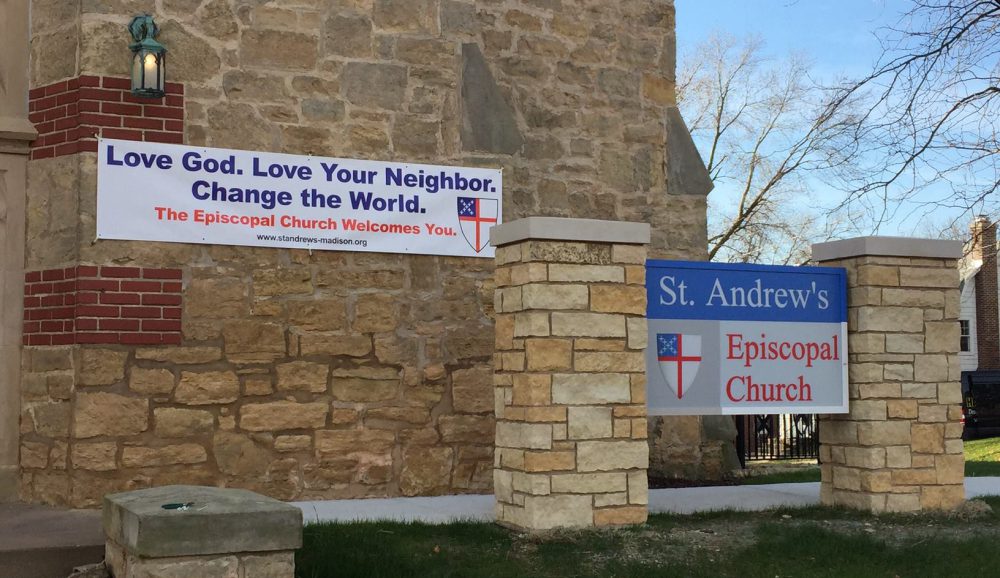
This sermon was given at Saint Andrew’s Episcopal Church on Thanksgiving Day 2013.

It is based on the Old Testament reading for Thanksgiving Day in year C of the Revised Common Lectionary.

You can find that reading here.

I think this is a pretty remarkable day.  We gather here on a regular basis to give thanks.  The word “Eucharist” in fact means “thanksgiving.”   So every Sunday and Wednesday, and many other times during the year, we are here giving thanks together.   Today we are joined in this moment of thanksgiving by people all across this country, unified, giving thanks together.   I think that’s pretty remarkable.

There is another thing that we are all doing together today.  We are telling stories.  I am pretty sure that we will all be gathered around tables later in the day today, reliving memories, recounting blessed and wonderful moments we have spent together, telling the stories of the last year, the stories that give us identity and shape who we are.  Many of us will even take turns, making our way around the table, offering something that we are thankful for before we begin to pass the food.

The telling of stories isn’t a remarkable thing for us.  We tell our story every time we gather together in this place.  But the fact that people all over this nation are unified in this opportunity, in this moment of story telling today…  I think that’s  pretty remarkable.

I think that this remarkable moment, this remarkable coincidence of joint thanksgiving and story telling creates a wonderful opportunity for us, for you and me, for the people of God, because we have a pretty remarkable story to tell.

The people of Israel thought that they were going home.  They had sojourned in Egypt, captives, for over four hundred years.  They had escaped from Egypt and the armies of the Pharaoh through the Red Sea and they found themselves in the wilderness on their way to the land that God had promised to them.  Then something happened.  They didn’t arrive right away.  Their route was not “as the crow flies.”  In fact it was a wandering, circuitous mess through the desert.  For forty years  the people of Israel circled around and missed the mark, making wrong turns, getting back on the path over an over again as they tried to find their way home.

Today, as we join them, in the narrative from the book of Deuteronomy, they are on the bank of the river, they are ready to take possession of the land that God has promised them.  The excitement must have been palpable.  Then their leader and their guide, Moses, says “Wait a minute.  I’ve got about thirty four chapters of text to deliver to you before we can enter the promised land.

Moses give them about five chapters of autobiographical history; his history with them, a stiff necked and rebellious people, whom he had wished at times were not his burden to bear.  And then for twenty chapters he reminds them of the law.   He reminds them of the things that God had called them to do and to be.  And then, in chapter twenty six, as he is wrapping up this recitation of the law he describes a ritual that they are to perform in the inner sanctuary once a year; a ritual of thanksgiving where the first fruits of the land are placed before the altar, given to God in thanksgiving for all of the gifts that God had given to them.

I think that it’s important to recognize that the land was a symbol and a sign of their relationship with God, that they were in fact God’s chosen people.  So the first fruit of the land was an especially appropriate gift to be given in thanksgiving.

The ritual that Moses gives to the people of Israel is very specific and clear about the words that are to be said at the moment when the basket of first fruits is given to God before the altar.  There are only three places in all of the Old Testament where the people of Israel are given specific words to say in a formal liturgical setting and moment.  Two of those recitations are given in this morning’s reading.

As the basket is given to the Priest who is in office at the time the people are instructed to say,

“Today I declare to the LORD your God that I have come into the land that the LORD swore to our ancestors to give us” (Deuteronomy 26:3b).

I know that the promise is true because I ma here.  And I am a member of this family, of this tribe, of this people, whom God has called out for a special vocation: to be a light to the nations.

Then as the basket is placed before the altar they are to say,

“A wandering Aramean was my ancestor; he went down into Egypt and lived there as an alien, few in number, and there he became a great nation, mighty and populous. When the Egyptians treated us harshly and afflicted us, by imposing hard labor on us, we cried to the LORD, the God of our ancestors; the LORD heard our voice and saw our affliction, our toil, and our oppression. The LORD brought us out of Egypt with a mighty hand and an outstretched arm, with a terrifying display of power, and with signs and wonders; and he brought us into this place and gave us this land, a land flowing with milk and honey. So now I bring the first of the fruit of the ground that you, O LORD, have given me”  (Deuteronomy 26: 5b-10a).

Moses is afraid, standing there on the edge of the promised land, that the people of Israel will forget the lessons that they have learned as they wandered in the wilderness.  He is afraid that as they move into this land flowing with milk and honey, and the hardships melt away, the people will forget who brought them to this place.  So he is asking them to do a very specific thing to remind themselves of who they are and whose they are.  He is asking them to give thanks and to tell the story.

Biblical scholars refer to this moment in the book of Deuteronomy as a creedal statement.  This is who we are.  This is what we believe.  And it is this story of exile, of liberation, and the story of God’s promises to us being fulfilled by our possession of this land that defines who we are as a people.  Moses knows that the way to remember who we are and whose we are is to give thanks and to tell the story.

I hope that you recognize a pattern in this reading because we are a bout to do the same thing.  We will stand in a few moments and recite the Nicene Creed.  We will say that the promises that God has made to us are true and that we are recipients of those promises.  We will say that we believe that God is.  We will make our offering here at this altar.  And before we share the meal together, before we celebrate, we will tell the story of salvation history.

Listen closely to the Eucharistic Prayer and you will hear the story of God’s work in the world’ form creation through the incarnation, crucifixion, resurrection, and ascension.  We will be telling our story as a people in much the same way that the people of Israel were called to tell their story as they gave their offerings to God in thanksgiving for what God had given them.

When I stared out this morning I said I believe we are being presented with a wonderful opportunity today as our family, our tribe, our nation gathers to give thanks and to tell stories.  Now this is something that is particularly difficult for us and I know that it might be challenging…

As we gather around the table later today, and it has been the tradition in my family for a long time to go around the table one at a time and name something that we are thankful for, what would it be like if in addition to naming what we are thankful for we also articulated where God was for us in that moment?  A secular moment, something that people all across this nation are gathering to do today, could become something more for us and for anyone who joins us at our table; an affirmation and a recognition that God is at the center of our lives.  That the things that we have come from God, are gifts from God, and that God is so deeply ingrained in who and what we are that we can’t begin to imagine that God is not there, when we are giving thanks, when we are telling our stories, when we break bread together.

Oh yeah… that wonderful opportunity?  It’s about evangelism, which is not an easy word for Episcopalians to say.   But it is a word that we need to embrace.  And this is a moment of evangelism for us.  This is a moment for us to deepen our faith, to recognize what is at the core of who we are, and to share that with one another in an intimate and familial setting.  Perhaps if we practice this enough in those comfortable moments we will even be able to do it in moments when we are not so sure how it will be received, in moments where it is a little more uncomfortable to share who and what we are.  Perhaps in that moment we will be fulfilling our vocation as heirs of the promises that were made to our forefathers and will be able to become a light to all the nations.

Amen.

Increase Our Faith!

This sermon is based on the readings for the Twentieth Sunday after Pentecost, Proper 22 in year C of the Revised Common Lectionary.

You can find those readings here

Sometimes when I stand up on Sunday morning to read the Gospel I have to work pretty hard to understand or to know how to inflect the words on the page; whether words are spoken in an adjuring way, a pleading way, a comforting way, a convicting way.  That’s why I am so happy that there is this one little piece of punctuation in today’s passage, that exclamation point that allows me to read these words, INCREASE OUR FAITH!  INCREASE OUR FAITH!  The apostles come to Jesus and they say those words, the exclaim them.  They are anxious and they are scared.

How do I know that they are scared?  Well because I read ahead, just a little bit.  Actually I read back.  This is one of those instances where I think that our lectionary doesn’t do us any favors.  They have us starting at the fifth verse of chapter seventeen rather than the first verse which gives us the context for the apostle’s plea when they get to Jesus.  Listen to what he says to them:

‘Occasions for stumbling are bound to come, but woe to anyone by whom they come! It would be better for you if a millstone were hung around your neck and you were thrown into the sea than for you to cause one of these little ones to stumble. Be on your guard! If another disciple sins, you must rebuke the offender, and if there is repentance, you must forgive. And if the same person sins against you seven times a day, and turns back to you seven times and says, “I repent”, you must forgive.

Luke 17:1-4

No wonder the apostles are so desperate for help.  No wonder they are so concerned!  They need to live together in community in a specific way, modeling behavior, so that their behavior does not decrease or harm the faith of any of these little ones… They are called to do something that is almost as impossible as having a mulberry tree uprooted and planted in the sea.  They need to be able to forgive.  Not just once.  Over, and over, and over, and over again.  Jesus is calling them to a way of life together in community that seems so foreign to them that when Jesus goes to reassure them he uses this extreme and extraordinary metaphor about a mulberry tree.

Reassure them?  That is exactly what he is doing here.  We have gone back into the text to establish the context for this exchange with the apostles.  Now we need to do a little more work and examine the Greek.

“If you had faith the size of a mustard seed…”  In the Greek there are two ways of understanding this sentence.  One hears this as a reference to something that is not fact, that has not occurred, that is not true.  “If I were you… I am not you.  But if I were, then this is what I would do…”  The other way to hear this sentence is as a statement of fact, something that has already happened, something that is in fact true.  “If you are followers of our Lord Jesus then you are…”  Jesus is saying, “If you had faith the size of a mustard seed, and you do, you could do the impossible. You could uproot this tree and you could plant it in the sea and it would thrive!”  Jesus is saying, “You have that faith, and it is only the size of a mustard seed, but it is enough!  You can forgive!  Not just once, but over, and over, and over again.  That is all that it takes.  You have enough faith to live in my light and love and to help to bring the Kingdom to realization here and now.”

I imagine that the disciples were pretty desperate when they said to him, “Increase our faith!”  It’s like saying “give us strength, help us through this moment!”  They are not just because Jesus has told them that they have to do the impossible and forgive over and over again.  They are also living in this strange and contradictory world.  Listen to what Habakkuk says to us this morning:

O LORD, how long shall I cry for help,

and you will not listen?

Or cry to you “Violence!”

and you will not save?

Why do you make me see wrong-doing

and look at trouble?

Destruction and violence are before me;

strife and contention arise.

So the law becomes slack

and justice never prevails.

The wicked surround the righteous–

therefore judgment comes forth perverted.

Habakkuk 1:2-4

He must have made the mistake of watching the news while he was preparing dinner.  How does he do it;  in a terrible world, a world that seemed intent on depriving Habakkuk of his faith, of making him believe that he was wrong?

The Psalmist is right there with him.  Lord how long will you let the evil doer prosper?  How long will you allow those who exploit others to their own advantage to benefit from their abuse?  Justice is out of whack here!  How long will you let this go on?

The desperation, the panic that the apostles felt when Jesus called them to forgive wasn’t unique to them.  The people of Israel had been feeling that stress and difficulty for a long, long time.

Jesus was calling them to live as a lamp on a lamp stand, a beacon on a hill, a light to the world that would call them to a new life and a new way of being.  That’s why in today’s passage from Luke Jesus is cautioning the Apostles, telling them how important their witness is.  He is cautioning them to live lives that are consonant with God’s vision and dream, God’s Kingdom here and now so that they would be drawing others into that light and into that way of being.  He is telling them that there are lots and lots of things in this world that will point in another direction and pull people in other ways.  “Occasions for stumbling are bound to come…”  But you, you need to be different and to show something new to the world so that things will begin to change.

“Increase our faith!”  The stress that we feel when we hear the command to forgive isn’t any different than the stress that Habakkuk and the Psalmist felt.  It isn’t any different than the stress that the apostles felt when Jesus told them that they had to forgive the same person seven times in a single day.  In fact Luke uses the word “apostles” to tell us that Jesus is speaking, not just to the disciples who were following him, but to all of us who would follow.  It is we who stand before him this day and say, “Help us!  Give us Strength.  We believe, help our unbelief! Increase our faith!”

So where does it come from, that mustard seed of faith?  It is planted deep within us.  Is our God’s gift, it is God’s grace.  It is ours!  That little mustard seed of faith needs to be nurtured.  It needs to be sustained and grown.

Paul in his letter to Timothy here talks about his rejoicing at the faith of the group gathered there together, a faith that was given to them and handed down to them by Lois and by Eunice…  I had a couple of Aunts named Eunice.  I always wondered where that name came from…   Faith that was rekindled and nurtured in community as that early church gathered to give each other strength, to hold one another up, to bear testimony and witness to the things in this world that manifest God’s goodness and light so that even in times of loss, pressure, pain, duress there was always that light shining.  That’s all it takes, that little mustard seed.

So when we begin to think that we don’t have enough, that we are not enough, that nothing that we can do could ever change the way the world is we need to remember that Jesus stand among us this morning and says “Yes you do,” and “Yes you are,” and “Yes you can.  All it takes is that little mustard seed and the nurturing and tending that happens when we come together as the Body of Christ, as a beacon on a hill, as a lamp on a lamp stand, top shine that light into the lives of people who long for what we experience when we experience here together: the light and love of Christ in the body gathered.  Amen.

And This Will Not Be Taken Away From Her: A sermon about Martha, Mary and the insidious nature of bias in our lives

This sermon is based on the readings for Proper 11 Year C of the Revised Common Lectionary.

You can find those readings here

This sermon was preached at Saint Andrew’s Episcopal Church in Madison Wisconsin on July 21, 2013.

The NPR story that is quoted in the sermon can be found here

For the full context and origin of “clutching our purses, locking our doors, or looking suspiciously at poeple in department stores” please refer to the sixth paragraph of President Obama’s remarks about the death of Trayvon Martin available here.

So with whom do you identify in this story?  Are you a Mary kind of girl, someone who receives data and information, impressions about the world around you by sitting still, quietly reflecting and contemplating what is taking place?  Or are you more like Martha, moving constantly, busy, working, receiving and accepting information, interpreting and learning about the world around you as you are in motion?

How do you pray?  Do you have a spot in your house that is set aside for quiet prayer, maybe a special chair, candle that you light, even the same music that plays as you sit and read the daily office?  Or do you pray holding the steering wheel of your car, maybe as you run, maybe even as you wash the dishes?

Historically, classically we hear this reading from Luke’s Gospel as an evaluation of two spiritualties, two ways of being in the world.  And it would seem that Jesus is pointing to one and saying that this is better than the other, passing judgment on the busy ness of Martha and her need to be in motion.  But that’s a little confusing.  Jesus does go up into the mountains alone to pray.  He goes apart from the crowd to pray on a regular basis.  But Jesus is also out there in the streets, preaching, teaching, healing, working with his disciples and he calls us again and again to be servants to all, to be at work in the world working to bring God’s kingdom to fruition.  So how can it be that Jesus is passing judgment on that kind of spirituality, that “busy” way of being?  It doesn’t quite make sense.  It is confusing.  And it’s a little worrisome if, like me, the only way that you can justify sitting long enough to watch a Packer’s game is to fold the laundry or dust the baseboards while you watch the game…  Busy all of the time.

Fortunately, or maybe even predictably, I don’t think that is really the point of this story.  I don’t really think that Jesus is making distinctions about two different ways of being in the world and calling one out as preferable.  But to understand why I think that, to understand what is really happening here we have to back up just a little bit.

Last week we heard the verses that immediately precede the story from Luke that we heard today.  Last week we heard the story of the Good Samaritan.  And in that story a lawyer stands up to test Jesus and in the course of his interrogation he asks Jesus, “Who is my neighbor?”  Jesus works through the story of the Good Samaritan to point out that “who is my neighbor” is the wrong question.  Who is my neighbor isn’t even on Jesus’ radar.  What Jesus wants this lawyer to understand is that we are to behave as neighbors to everyone in the world around us.  Who our neighbor is, who our neighbor isn’t doesn’t make sense because everyone is our neighbor and we are called to love them as we love ourselves.

Jesus is turning the social order upside down in this story.  The hero of the story, the person who actually does act like a neighbor is a Samaritan,  is someone from a despised community.  So this story about a Good Samaritan would have been shocking and upsetting to his audience.

As soon as that story ends we hear that “Jesus entered a certain village, where a woman named Martha welcomed him into her home” (Luke 10: 38).  Then something equally shocking happens in this story.  Martha’s sister sits at Jesus’ feet, like a disciple, in the front room, where only the men are allowed to gather, and she listens to what Jesus is saying.  Now that would have been just as shocking to Jesus’ audience as the Samaritan helping the wounded and bleeding man lying in the ditch.

We don’t really know how Martha said those words.  We don’t know what was in her mind.  They were sisters.  Maybe in all their lives they had never quite figured out how to cohabitate, whose job it is to do this, whose job it is to do that, how do we divide up the cores.  Maybe this is an ongoing feud between them and when Martha comes into the front room her words are laden with the baggage of her long struggle with her sister as she asks Jesus to send Mary back to the kitchen.

We do know for sure though, that when Martha walks into that room and says, “Jesus, send her back into the kitchen where she belongs” all of the men in the room said, “Yeah!  Darn straight.  It’s about time!  Get her out of here.  She’s not supposed to be in this room!”  We know that’s how they responded because in the last line of todays Gospel Jess say, “This will not be taken away from her” (Luke 10:42).

Jesus is still on the same theme, he is still working to accomplish the same goal that he had in mind when he started telling the story of the Good Samaritan.  He is turning the social order upside down.  He is asking us to see that we are all neighbors.  And he is working to help us to identify something that is even more insidious than the racial prejudice that was in play when it was a Samaritan that was at the center of the story.  Right now Jesus is talking about bias.

Bias.  It was about a year ago that I heard a story on NPR that I immediately looked up on their web site because I knew that there would come a moment when we would need to hear it together.  In this story they were talking to a sociologist who had written a book about bias and in her book she tells this story:

There was a woman who was washing dishes in her sink when she dropped and broke a crystal bowl.  The glass gashed her hand from the top of her palm to her wrist.  She rushed to the emergency room and the very fist thing that she told the surgeons and doctors who examined her was that she was, “I am a quilter and I don’t want to lose and functionality in my hand.  Please make sure that there are no nerves severed, no tendons cut.”  The Emergency room doctor told her that he was doing a perfectly “competent” job stitching up her hand.  Then a nures who knew the patient walked into the room and said, “Professor Johnson, what are you doing in the emergency room?”  The doctor who was stitching up her hand looked at her and asked, “Are you a professor at Yale?”  The patient answered, “Yes I am.”  Suddenly the room was filled with hand specialists, surgeons, neurologists and other specialists, all of them there to make sure that she retained all of the functionality of her fingers.  Something remarkable had happened because suddenly this person sitting on the stool having her hand stitched up was a person of rank and status in the community.

Bias is an insidious thing.

You know the story about the Samaritan… that seems kind of foreign to us.  Samaritans, people who had intermarried with the people of the land, whose religious practice doesn’t match our own, who worship on the mountain tops instead of in the temples…  that might seem pretty foreign to us.  That’s easy for us to hold at a distance as if it doesn’t have any relevance to or impact on our lives.  But this story is different.  Mary looks like us.  She is a member of our tribe. She is a member of our household.  And yet there is this bias that says where her place is and where it is not.  Where she belongs, and where she may not be.  And so it is this story, I think, that grabs us today.

This story call us to look deep within ourselves and identify those insidious places that don’t rise quite to the level of prejudice or bigotry, but which lurk down there, just a little deeper, at the level of bias.  This passage calls us to look within ourselves and to find those biases and to bring them out into the light so that we don’t find ourselves clutching our purses on the elevator, locking the doors of our cars, or looking suspiciously at people in the department stores. 

We are called to something more.  We are called to love the Lord our God with all of our heart, with all of our soul, with all of our mind, and with all of our strength.  And we are called to love our neighbors as ourselves (BCP page 351).

Jesus has been working very hard these last two Sundays to help us to understand that our neighbors are everyone that we encounter.

This morning Jesus says that our neighbors place is here, in the room, at his feet, with us and that this, this place, this moment, this right, will not be taken away from them.

Amen.

Who Is My Neighbor? A sermon for July 14, 2013

This sermon is based on the readings for Proper 10 Year C in the Revised Common Lectionary.

You can find those readings here

This sermon was preached at Saint Andrew’s Episcopal Church in Madison Wisconsin on July 14th, 2013, the morning after George Zimmerman was found “not guilty” in the death of Trayvon Martin.

The Good Samaritan.  Those words just roll off our tongues.  We say them so often, we hear them so often, that we probably don’t think very much about them when we hear them.  We hear that phrase used on the news for the person who stops to give aid at a traffic accident, at a fire, for anyone who goes out of their way to help someone that they don’t know.   There’s even, if you look it up on the Internet, a “Good Sams Club.”  And so if you are someone who goes out of you way to help others you can sign up and be a member of the Good Sams Club.

But I think all of that repetition and easy usage has domesticated the story that we heard this morning so that when we think of the story of the good Samaritan we probably hear a version very similar to this “Beginners Bible,” this well thumbed volume that lives on the bookshelves in my son’s room.  The version that is in this Bible goes like this:

A Good Neighbor

“I know that I should love God,”

a man once said to Jesus.

“I should love him with all my heart.

And I should love my neighbor too.

But who is my neighbor?”

Jesus told him a story.

There was a man walking along a road.

He was going on a trip.

Suddenly, robbers jumped out at him.

They hit him.

They took all the things that he had with him.

Andy they left him, hurt, lying by the road.

A short time later, step, step, step,

Someone came down the road.

It was a man who worked in God’s temple.

He could help the hurt man!

But, not, when he saw the hurt man,

He crossed the road.

He passed by on the other side!

Soon another man came.

But he passed by, too.

Then, clop, clop, clip, clop,

Along came a man with a Donkey.

This was a man from a different country.

When he saw the hurt man, he stopped.

He put bandages on his hurt places.

And he took the man to a house w

Where he could rest and get will.

Jesus finished his story.

He looked at the man.

“Who was the neighbor to the hurt man?”

Jesus asked.

“The one who helped him”, said the man.

“Then you can be a neighbor to anyone

Who needs your help,” said Jesus.

                                      The Beginner’s Bible: Timeless Children’s Stories

This is a very different version that the one that we heard from Luke’s Gospel this morning.  There are lots of details that are omitted from this reading.  I think that they are omitted because the original version, the one from Luke’s Gospel, is filled with tension, conflict, and, at its heart, an accusation.

A man, a lawyer well versed in the Mosaic Law, a master of the traditions of his community, stands to trap Jesus and he asks him a question, “What must I do to inherit eternal life?”  Now Jesus employs an age-old clerical trick, one that I am sure he learned in an Episcopal seminary, he answers the man’s question with a question of his own,  “What is written in the law?  What do you read there?”  And this lawyer, true to form, rises to the top of the class.  He gives the perfect answer, “You shall love the Lord your God with all your heart, and with all your soul, and with all your strength, and with all your mind; and your neighbor as yourself” (Luke 10:26).  And Jesus says give the man a prize, top student of the day.  But then the real tension begins.

“But wanting to justify himself, he asked Jesus, ‘And who is my neighbor”  Luke 10:29)?  Seeking to justify himself…  we know that somewhere in the back of this person’s mind he knows.  He knows that he is not living up to this commandment to love his neighbor as himself.  He can probably review the tapes and he can see moments where he has failed to love the “other.  So he asks Jesus to limit the scope of this commandment.  “Surely you don’t mean them.  Surely you don’t mean him.  You can’t possible mean her.  Love my neighbor as myself?  You must mean these folks here with me, the people with whom I have surrounded myself,  The people I have chosen as my neighbors.

I think that we need to re hear this original version of Luke’s Gospel because it is in this moment that we are convicted.  This is a story that tells us how to live according to God’s commandment and love.  We call the answer that the lawyer gave “The Summary of the Law” and we can probably all recite those words.  But in that moment where Jesus says, “You have given the right answer; do this and you will live,” there are those tapes playing in our heads confronting us with those moments when we have not quite fulfilled our vocation as the children of God by loving our neighbor as ourselves.  And so we, like the lawyer engage in a process of self-justification.

Listen to what Jesus does.  He tells the lawyer a story.  A man is beset by robbers and is left lying, bleeding in the ditch.  He is passed by, his plight ignored, by a Priest and a Levite.  Now everyone in the audience hearing this story, and certainly the lawyer, knew that if the Priest or the Levite had ventured into the ditch and touched this bleeding man they would have been ritually impure, unclean, and could not have gone into the temple to perform their sacred duties.  And so at some level, somewhere, in the back of our mind, these two people are “justified” in not loving this person as they love themselves.  All of the people listening to Jesus tell this story to the Lawyer also knew that it was a ruse that robbers frequently used; putting someone in the ditch who appeared to be injured and wounded to lure you off the road and into the brush where you could be attacked and robbed yourself.  So as the people were listening to this story they would have been checking their way down through their internal list and would have thought, “look there’s another way to let these guys off the hook.”  They would have been endangering themselves personally f they had ventured into the ditch to help.

You can hear the self-talk now…  They were on important business, probably visiting parishioners in the hospital.  They had things to do, places to be, people to meet.  They are important people and they just didn’t have time to get involved.

So they didn’t want to become impure, tainted by association, they didn’t want to risk their personal safety.  They didn’t want to interrupt their busy schedule…  The list of justifications goes on and on.  This is the moment in the story where Jesus pulls all the stops and says something really shocking to get our attention.  The person who does stop to lend aid to the man lying in the ditch is a Samaritan.

The Samaritans were people from the tribes of Israel who had intermarried with the people of the land of Canaan and whose worship practices were a mixture of the Jewish peoples practice and the practices of the people of the land.  The Samaritans and the Jews did not get along.  They despised one another.  So the task of being a neighbor falls to this despised person, who takes the time, who risks going into the brush, who becomes even more impure and unclean by tending to his bloody wounds pouring wine and oil on them.  He takes a day out of his busy schedule to stay with him at the inn.  And then he gives of his own resources to help.  Here is the accusation.

How far will we go to justify our failure to love our neighbor as ourselves.  And do we have to see someone in whom we think that behavior so unlikely that it’s almost unimaginable, to convict us of our own hard heartedness?

This Gospel reading today calls us to look within ourselves and find the places where we seek to justify our failure to love those who speak differently than we do, who dress differently, who look different, who love differently, even those who speak of God using different names and different images that we do.  The truth is that all of God’s children are our neighbors.  And we are called to embrace that reality and to live our lives in a way that demonstrates that truth to the entire world.

We have had a little too much of courtroom drama this week.  But that’s exactly what we have here in this story as this lawyer rises to challenge Jesus and to try and entrap him.   And it is we who are being convicted in the court of the Gospel of our hard heartedness and failure to love our neighbor as ourselves.

We have had a clear demonstration of the consequences of failing to love our neighbor as ourselves and we know that we cannot afford to live in guarded and gated communities; ghettos of like-minded people who look and dress just like us.  We cannot afford to live in a world where we are suspicious of those who do not look like us, dress like us, talk and walk like us.  We cannot afford to live in communities where to be “other” is to be immediately suspect.  We are called to something more.  We are called to help build a world where rather than getting out of the car, armed with a gun, to confronting a young man with a bag of skittles and an iced tea, we roll down our window and offer him a ride home in the rain.

Amen

Turning the Page to a New Chapter: A sermon for June 30, 2013

This sermon is based on the readings for Proper 8 Year C in the Revised Common Lectionary.

You can find those readings here.

This sermon was preached at Saint Andrew’s Episcopal Church On September 30, 2013, the day after Bishop Steven Miller ordained the Reverend Dorota Pruski to the Sacred order of Priests, and on the occasion of her first celebration of the Eucharist.

What a wonderful and glorious moment this is.  We have been following this story for such a long time. Clinging to every detail, paying attention to every nuance of this story, waiting and waiting for this moment to come, maybe even thinking that it might never get here.  It’s sort of like reading a great book.  You are reading and the chapter is moving along, you’ve flipped ahead and you know that there are only a few more pages left in this chapter…  but that page that is only half filled with text and has all that white space at the bottom is elusive, it’s still far out there.  The tension builds, things are moving along… “Ok only two pages to the end of the chapter, I know there going to wrap this up somehow.  There’s go to be some sort of conclusion here…”  And then it happens!  You get to the end of the chapter and everything changes.  And then you realize, “wow!  There’s still a lot of this book left!  This story isn’t over yet!”  And so the excitement and the thrill that you’ve had there in that moment as you concluded that chapter and got to all that white space at the end of the page is only heightened because you know the story will go on.

That’s exactly where we are this morning.  We come in here this morning to celebrate the ending of a chapter and the beginning of a new one and it happens with these words,  When the days drew near for Jesus to be taken up he set his face to go to Jerusalem”  (Luke  9:51).  Well that is that chapter you thought I was talking about isn’t it?  That is the beginning of a new thing that we are here to celebrate this morning… isn’t it?  It is.  Believe me.  And it is important to take a moment to think about what Luke is doing for us here in this part of his narrative.

Jesus has been ministering in Galilee.  He is at home with his people, gathering his disciples, building his support base, gathering resources, and today, with this chapter and this verse something dramatic changes.  It’s important for us to recognize that for Luke the Gospel all funnels down to that one climactic moment, when there on that Holy Hill Jesus demonstrates to us beyond the shadow of a doubt that God will love us forever.  And the people who are traveling with him are so transformed by that revelation and that moment that the Gospel then explodes form that place and that moment into all the world.  So for Luke, there is this distinct shape to the story that is Gospel.  Everything moves to this one climactic moment in history narrowing down to this one focus and then it expands exponentially, taking off into, and transforming the whole world.  This is the moment when Jesus begins his movement towards Jerusalem.

For the next ten chapters we will hear that Jesus is “on his way,”  “on his way,” “on his way” to Jerusalem.  And so Luke wants to make sure that everything that Jesus says and does is now focused on that moment.  Here we are standing at this moment of transition and Jesus encounters three would be disciples, three people from the crowd who come to him and want to follow him.  I believe that there is some instruction for us in the words that Jesus speaks to them.

The first one come to him and says I will follow you wherever you go.  Jesus points out to him that there is a cost to discipleship.  Foxes have holes, birds of the air have nests (Luke 9:58).  They have homes.  They are secure. They know their place.  But to be on the road with me means losing that security, that sense of home and of place.  It means putting those things at risk so that you might find them in me.

Then Jesus says to another person in the crowd, “Follow me” (Luke 9:59).  And the response is, “I will follow you but let me bury my father first.”  Jesus said leave the dead to bury their own dead.  Now I think that we can get into trouble if we take that line too literally.  Clearly, in the rest of the Gospel Jesus’ compassion would instruct us to care for our families, to care for our parents.  What Jesus is trying to so is help this person recognize that he needs to reorient his sense of who his family is and what comes first.  You need to make sure that the way you interact with and relate to your family is building the kingdom of God.  Jesus goes on to say, “As for you, go and proclaim the kingdom of God”  (Luke 9:60).  Don’t bury the dead out of a sense of duty, out of a sense of guilt, but care for the people around you the way that I am about to care for you as I walk this path to Jerusalem.  So it’s with a reorientation of our relationships with people, based on this path, that we are called to walk with Jesus.

Another person comes to him from the crowd and says, “I will follow you wherever you go.  But first, let me go and say goodbye to the people in my home.”  Here is the moment where we hear Jesus’ urgency.  You have recognized what is happening here.  You have seen what is changing in the world and so you need to follow now.  You need to follow now.

There is some risk in discipleship.  We risk losing things that we are familiar with and a sense of security.  There is a reorientation of our values and our relationships that comes with discipleship, and there is a sense of urgency to move now.

As this chapter of Luke’s Gospel comes to a close and we look forward to what is to come we find ourselves this morning in a very similar place.  Saint Andrew’s will celebrate its Centennial a year from now.  We will have been in this place for one hundred years.  We are in the process of looking back at where we have been, who we have been, what we have done, and dreaming and visioning for our next century, looking into the future trying to discern who it is that God is calling us to be.  And above all else we need to make sure that as we move in to this new period of our life together we are on the same road that Jesus walks.  We need to make sure that we are on our way to Jerusalem.

So the advice that Jesus gives to the three people for m the crowd who confront him this day he also give to us…  As you look to your future, as you move into your second century, there is some risk.  You may have to let go of some of the things that allow you to feel secure, some of the things that make you feel at home.  You may need to let go of some things and to change.  Jesus also tells us that this will not be easy and we will need to make sure that our relationships with one another and with this place are guided by our relationship with God in Christ Jesus, that they are guided by the love that God reveals to us in the person of Jesus hanging on a cross.  And we are reminded that as we move forward we should do so with a sense of urgency that hastens our feet, that keeps us on the path and that moves us towards the goal with intentionality and with a sense of mission.

There are lots and lots of story lines here this morning and lots and lots of chapters that are coming to and end, lots and lots of chapters that are beginning.  Each and every one of us here today has our own story to write.  But there is one that we  want to hold up and celebrate on this day and it is the one that you thought I was talking about when I started speaking this morning.

I used the words “the Holy Hill” to describe Golgotha, the place outside the walls of the city of Jerusalem where Jesus was crucified.  That is code language for some of us sitting in the room today because that’s the language that we use to describe Virginia Theological Seminary, in Alexandria Virginia.  I am not sure that we would say that we were crucified there.  But we made sacrifices.  Dorota moved away from family and friends, from a life in Milwaukee, to a place thirteen, fourteen hours away.  She has face those reorientations of relationships, of filial responsibility, has moved with a sense of urgency to arrive here in our midst today.  And we thank God for people who are in her position of leadership, who have walked the path before us, and who are willing to walk the path with us as we make our way towards Jerusalem.

Dorota and her experience of discipleship will help to form and shape us in the years to come.  And we, you, will help to form and shape her at the same time.  The difficulties that Jesus describes, the difficulties associated with the path of discipleship are real.  And they are formidable.  But we can face them and we can move forward in spite of them because we do it as a community, because we do it together.  And when one of us stumbles there is another to hold us up and to help us to walk.

So today, as we come to the conclusion of a chapter and look forward to the beginning of another, I would like to invite you to imagine that last page of the chapter that we have been on.  There is only a third of the page that is covered with text.  There is a white field at the bottom of that page where something might be added.  As we move into this next chapter of our common life together on the road to Jerusalem I would like to invite you to imagine what story you will add, what words you will write on that page, what images, what pictures, what dreams, what joys, what struggles and what triumphs you will add to the story of our journey together.

Amen.

Coming Out From Amongst the Tombs: a sermon for the fifth Sunday after Pentecost

This sermon is built on the readings for Proper 7 in year C of the Revised Common Lectionary.

You can find those readings here


We are a people shaped and formed by stories: stories that define who we are as individuals, stories of our childhood and our growing up, stories that define who we are as families and communities, stories that define who we are as a people and as a nation.  And a people that are defined by its stories cannot help but revere its greatest storytellers.  People who can shape our lives and out thoughts and our understanding of the world by their use of words and their ability to convey a moment in time, a space, or relationships draw our praise and our esteem.

Luke, the gospeller from whom we heard this morning, is one of our greatest storytellers, a true craftsman.  But some two thousand years after he wrote his stories down, after his community recorded their experiences with Jesus of Nazareth it might be a little difficult for us to appreciate his true craft.  Our culture, our society is so different that we might miss the subtleties of his mastery.  It will be well worth our while to go back and examine his artistry and to see just what it is that Luke is telling us in his story this morning.

Jesus and his disciples are in a boat and they travel across the lake, the deep waters.  Now for the people of Israel chaos lurked beneath the surface of the water, there was the threat of extinction there, the unknown, the unknowable, powers that moved without our understanding…  And so to be out on the deep water was a scary thing.  Luke’s original audience would have appreciated the danger to Jesus and his disciples and their trepidation would have increased when they heard Luke say, “opposite Gallilee.”  Luke is making sure his audiences knows that Jesus and his disciples are traveling into the land of the Gentiles, a place that was unknown and unclean, a place that was hostile and unsafe.  As if that weren’t bad enough our “landing party” reaches the other side  and they find themselves amongst the dead, among the tombs, where a madman, a man possessed, screeches and howls.  This man refuses to wear clothes, he has been repeatedly bound by shackles and has  broken free, bloodied and bruised by his struggles against the chains.  The demoniac swirls across the beach and confronts Jesus and his disciples.  Luke’s audience must have been terrified.  If this were a contemporary movie the sound track would be thrumming.  The walls of our surround sound theater would shaking with the noise and we would be filled with dread as Jesus looks into this man’s eyes and asks him his name.  Then the bombshell drops.  This person is so tormented by the voices screaming within his head that he has lost track of his own identity.  With no name to share the demons speak on his behalf, “’What is your name?’ He said ‘Legion,’ for many demons had entered him.”  Luke’s audience would have been shaking with fear around the table or around the campfire as this story was told.

Having brought us right to the brink Luke now begins to unwind the conflict and pull us back from the edge.  Jesus who has stilled the waves on the lake, who is working to help people to understand who he is, who in this section of Luke’s story is demonstrating his power and authority casts the demons out.  They go into a herd of swine that rushes down the hill, across the field and off the cliff into the lake where they are drowned… still a scary moment, but in the end all has come out well and we can relax.  The man who had been lost among the dead has been set free from the demons that beset him and the demons have been vanquished!

Luke has done a fabulous job of drawing this picture for us, of pulling us into the conflict, of establishing the tension and then resolving it.  He has established Jesus as the Son of the Most High God; even the demons know him by name.  But Luke is not finished with us yet.  It is here in this moment where everything shifts, Luke’s true mastery is revealed, and we see that story that we have just heard is really a set up for what is about to happen.

The swineherd run into the town and they tell people what has happened.  Everyone comes rushing out to see for themselves and they find the man who had been naked, mad, and living among the tombs, clothed, in his right mind, and sitting at Jesus’ feet.  Luke tells us that this was the moment that people became afraid.  I think that is really key for us.  They are not afraid because the swine have run off the cliff into the water.  They aren’t afraid because their way of living has been destroyed or because their meat supply for the coming season is gone.  That’s not why they are afraid.  They are afraid because this person who had been lost, whom they had chained and set guards over, who had been cast out, and who was living apart from them amongst the dead had been restored to them.  They are afraid because they are being confronted by a new and challenging reality.

In the letter to the Galatians we hear Paul say, “there is no longer Jew nor Greek, there is no longer slave nor free, there is no longer male and female; for all of you are one in Christ Jesus.”

The people of that region knew how to manage the reality that they had been living with.  They had a way of keeping themselves safe from people who were mad, who were dangerous, who were “other.”  First they tried to chain him but that didn’t work.  They set guards over him and that didn’t work.  Then his alientation became so great that he removed himself from their presence and was living amongst the dead… For the people of the region, his community, it was a safe and comfortable arrangement that allowed them to ignore him, to shun him, to live as if he didn’t matter.  Jesus has come into their midst and turned their safe and manageable world upside down.  This is the true import of today’s story.

It would be much easier and more comfortable for us to focus on the healing of the demoniac and the casting out of the demons.  That part of the story holds out great hope and promise and it doesn’t call us to behave or to think differently.   But if we have read the scriptures and don’t find ourselves challenged in some way then it is likely that we haven’t heard the whole story.  The demoniac who has been healed says to Jesus, “Please take me away from this place.  Let me be with you.  You have restored me to health, reconciled me to myself, and restored my identity.  Let me come with you where I will be safe, and loved, and secure.”

Jesus says “yes” to this same request over and over again in the Gospels.  He heals people and they ask to follow him and he says, “Sure.  Come along.”  But this time he says, “no.”  He tells the demoniac, now healed, “Return to your home, and declare how much God has done for you.”  Jesus gives him a vocation, he calls him to be an evangelist, but much more than that he calls him to be a manifestation of the new reality in Christ Jesus.  Day after day this person, now restored, will confront the people who had cast him out, who had set him aside.  He will challenge their understanding of the social order, the hierarchy, and the ways in which they had set themselves over and against one another.  This person will live in their midst and force them to confront a new way of being.

There is no longer Jew nor Greek, there is no longer slave nor free, there is no longer male and female; there is no longer black, white Asian, Hispanic; there is no longer gay or straight, there is no longer union or management or even heaven forbid… Republican and Democrat!  There is no distinction that stands in the light of God’s love.

Luke is trying very hard to shock us into a new reality.   Luke’s goal is to have us leave this place this morning, proclaiming how much God has done…  for us.  We come from a variety of backgrounds, a variety of places.  We come into this place with different stories; stories that create and form our personal identities; stories that create the identities of the families from which we hail; stories that create and form us as Christians, as children of God and as people of the Light.

God calls us to leave this place proclaiming that good news and by our lives to demonstrate and make manifest this new reality.  We are all one.  We are all one in God’s sight and we are called to recognize, to live out, to manifest that dream and vision for all of creation; helping to bring it to fruition here and now.  Amen.

Into the Wind: A Sermon for The Day of Pentecost 2013

This sermon draws on the readings for the Day of Pentecost in Year C of the New Revised Common Lectionary. You can find those readings here.

Here is a link to an audio file of the sermon.  The text that follows is a transcription of the recorded sermon with only minor grammatical and syntactical edits.

Jesus said, “Do not let your hearts be troubled, do not let them be afraid.”  He says, “Peace I leave with you.  My peace I give to you. “  I will send to you the Advocate, the…

The Advocate?  The Advocate?  That word has caught me up several time s this week.  Shouldn’t he say “Comforter?”  That’s what we just sang, “O Comforter draw near.”  And In fact, if you go back and look in the King James Version it doesn’t say “Advocate,” it says “Comforter.”

Comforter would make sense.  We are reading form the Farewell Discourse as Jesus is preparing his disciples for his departure, trying to teach them how to live in the world after he is gone, trying to prepare them for life without him.  And so a comforter would be sorely needed.

So why is it that we don’t use that word in our reading today?  In the New Revised Standard Version of the Bible which we are now using the word is “Advocate” and then there is an asterisk that says , “or ‘helper.’”  Comforter, Advocate/Helper…  Those words feel very different.  Sometimes I think I would prefer the comforter, but then the kind of comforter that we seem to have heard about this morning is one that bursts into the room with a sound like the rush of a violent wind and sets our hair on fire!  Well… it wouldn’t burn for very long… but that would be pretty uncomfortable!

So what is it about advocates, helpers, advocacy there is a very different feel there.  Comforters, that’s what you need when you are mourning, when you are grieving, when you are hurting, and troubled and what you really need to do is to sit still and be held.  An advocate or a helper implies that there is some sort of conflict going on, that there is motion, that there is movement.  And so what Jesus says is I will send to you something that will set your hair on fire and send you out into the streets speaking words you never imagined you were capable of and doing things that you could never have dreamed were possible.

The piece from the book of Acts that we read this morning preceded this wonderfully long sermon that Peter gives.  He goes on for hours and hours and hours, and hours and hours and hours… and add more than three thousand people to the church that day.

There is something compelling, something impelling about the coming of the Holy Spirit.  She pushes us to move.  Now arriving with a sound like the rush of a violent wind and with tongues of flame… those may be difficult things for us to envision, difficult for us to grasp… so I have been struggling all week for a metaphor to help us to sort of feel where this is.  And this is what I came up with.

Do you all know who Jim Cantore is?  He’s the hurricane guy on the Weather Channel.  And where do you always see him?  He’s out there on the Outer Banks of North Caroline.  And the wind is blowing the rain so that it is flying sideways and the hood on his windbreaker is whipping back and forth and making so much noise that it almost drowns out his microphone and before you know it he’s leaning into the wind like this and he’s saying, “Bill the wind is really starting to blow now.  We’re up to about a hundred and twenty miles and hour!”  And he’s struggling, leaning, working really hard not to get blown away by that wind.

Part of the problem is that he is trying to stand still.  That wind wants more than anything to make him move and he is trying to keep his feet in the same spot and not let that wind change his position at all.

So another part of the visual here…  We are still on the beach.  The hurricane is coming.   And there up on the flagpole at the marina is a flag that somebody forgot to take down.  The wind is blowing a hundred and a hundred and twenty miles an hour and that flag is trying to stay in place up there on the pole… And what happens to it?  It gets shredded.  It gets torn to pieces.

So here we are with this wind, the Spirit of Truth Jesus calls it, blowing through all of creation, blowing through the church and we are at risk of being shredded by that wind.

The way to avoid being shredded is to move.

So here we are again.  We are still here on the Outer Banks.  Imagine what it would be like if when we felt that wind coming we lifted our anchor, we let go our moorings, we pulled in the sheets and tightened the sails, and we pointed ourselves into that wind.  The wind starts buffeting the front face of the sail.  The sail starts luffing a little bit so we pull the sheets in little tighter, and now there’s a vacuum out in front of that sail because the wind is moving so fast in front of it, and we  start moving, pulled forward into the wind.  Into the wind.

The way to avoid being shredded by the wind, by the violent wind, the spirit of truth, the Holy Spirit, is to be willing to pull up our anchor, to let go of our moorings, and to see where God is calling us.  When we respond in that way, when we risk letting go of what’s familiar, our slip there at the marina where the restaurant is up there on the second floor and the showers are down there around the corner, and we have all the things we need to scrape the hull and keep the boat clean and sparkly, and venture into deep water…  we know that this is the place where we will find God.  That is where God is, at the heart, at the center of that wind.  And when we are willing to point our bow in that direction and be drawn in we will be in a position to help build the kingdom of God wherever that wind takes us.

The wind is blowing.  And you can apply that metaphor to all sorts of arenas in our lives all sorts of settings, all sorts of contexts…  The wind is blowing through the church.  It is also blowing right here in this place.

Think for a moment about where we are.  We are about to welcome a full time Associate Priest.  We are about to celebrate our centennial, a moment when we can look back on our history; to see where we have been, to assess where we are, and choose whether or not to let go of those moorings and move into deep water again.   We do all of this with a gift from a long time committed beloved member of this parish that will help us to go to places that we might not have dreamed.

The wind is blowing.  And God is in the center, in the eye of that storm,  And the wind that is blowing from God has the power to draw us forward, as long as we are willing to move, to pull up our anchor, to let go of our moorings, to shift our feet, and to let God sail the boat.

This is a moment of great excitement… Yea I said that right?  Excitement…  It can be terrifying.  It can be terrifying.   But listen to what Jesus says, “Do not let your hearts be troubled, do not let them be afraid.  My Peace I give to you.  And I don’t give as the world gives.

It takes much more energy and it is much more difficult, and it is completely unproductive to work so hard to lean into that wind and not move your feet, to cling to that anchor line, to cling that flagpole and try desperately to hang on.

It is life giving, it is energizing, and it is who we are called to be, to let g, to go with God, who fills our sails and draws us forward, calling us to that new reality that is ours if we dare.

Amen.

A Sermon for Ascension Day

The readings for this day offer us some interesting images….

In the Acts of the Apostles we read:

“When he had said this, as they were watching, he was lifted up, and a cloud took him out of their sight” (Acts 1:9).

From the Gospel of Luke we read:

“While he was blessing them, he withdrew from them and was carried up into heaven” (Luke 24:51).

Hmmmm….  Rising up into heaven on a cloud or slowly fading into the mist…  Do either of those images work for you?  How about Albrecht Durer’s wood cut showing the disciples gathered around looking upward, with Jesus’ feet just visible inside the frame at the top of the image?  Does that work any better for you?

There is a real risk that the difficulty that we experience with these images will keep us from exploring the meaning behind them.  That would be very sad because the truth that lies behind the details of today’s readings is incredibly powerful and exciting.

To get to that truth I am going to have to ask your indulgence, maybe even your forgiveness.  It is now the 6th week after Easter, we have had some seventy and even eighty degree days.  We have finally shaken off the snow and things the buds on the trees are beginning to grow.  But to understand the value, the meaning of the Ascension I am going to have to take you back into the dark of winter….  Because we can’t really understand what is happening in the Ascension without also thinking about what happens in the incarnation.  So let’s go back to December and think for a minute about Christmas.

Christmas is filled with images of its won.  Joseph and an expectant Mary traveling to Jerusalem, a young couple bedding down in the straw among the animals, angels singing in the night, and a child wrapped in swaddling cloths and laid in a manger.  There are so many truths behind, below, surrounding, buttressing the details of this story that it would take page upon page just to list them and volume upon volume to unpack and explain them.  But there is piece of this complicated event that stands out to us as we look back from our vantage point here at the Ascension.

Jesus, Emmanuel, God Among Us…  God comes into the world in the person of Jesus Christ and our understanding of creation is changed.  God, by definition is holy, set apart, other…  God is light, life, pure.  God is “clean.”  All of those terms serve to set God apart from us.  The world, the place that we inhabit is profane.  It is transient, dark, filled with death, and “unclean.”   There is a chasm that is fixed between us and God that cannot be traversed.

There are religious and philosophical traditions that hold that the world is an illusion; that in order to see the Truth, or to experience enlightenment we have to escape or transcend the veil that is this life and move beyond the profane to the eternal, timeless, the holy.

We have an incarnational faith.  We believe that God is present, manifest in the world.  One of the important truths that swirl around the details of the Christmas story is a clear declaration of the validity, the intrinsic worth, the beauty of this world.  This is the place where God comes to live in the person of Jesus of Nazareth.  And whether you believe that the Feast of the Incarnation is a celebration of the moment when the world was redeemed by God’s presence, or that it celebrates the moment when that eternal truth was made evident, manifest through the birth of a child in a manger, the bottom line is the same.  God abides here, with us, in us, in all of creation and somehow, that indwelling, that presence has not sullied God’s nature, has not darkened the light that is God, has not made God unclean.  Instead the world this place, we are sanctified by God’s presence.  Our understanding of creation is shaped and formed by the Incarnation.


So why have I taken us back into the cold months of winter just when we are finally breaking free and spring is filling the air with activity, life and growth?   Because the Ascension is the reciprocal movement that mirrors the Incarnation.  In the Incarnation we express the truth that God dwells in and among us.  In the Ascension we are expressing the truth that we dwell within God.

Jesus, in bodily form, ascends into heaven, into the very heart of God.  Our nature, our flesh, becomes a part of God.  And it isn’t some purified, cleaned up, sanitized version of our nature that crosses that great chasm.  Jesus rose from the dead with the wounds, the signs of his crucifixion, still there in his hands and side for Thomas to see and touch.  The truth that this story is trying to help us to grasp?  Our nature and our life, our experiences, our pain and suffering, our brokenness, even our sense of alienation and abandonment are a part of God’s experience!  How do we understand or wrap our minds around that possibility?  God doesn’t just observe our suffering from the sky box, doesn’t just read about it in the book of life, doesn’t listen to dispassionate reports from a host of heavenly angels.  God experiences our lives, our joy and our pain, our successes and our failures, our sense of connection and our loneliness.  That is an astounding proposition.  It would seem to run contrary to those classical definitions of God that I referenced earlier.  So how do we wrap our minds around this?  Perhaps the only way is to explore images like Jesus being lifted up in a cloud, or fading into the mist, or his feet withdrawing from the frame above our heads…  Maybe given our limited language and imagination that is the best that we can do…

God’s Resounding Yes: A Sermon for Easter Day 2013

This sermon, preached at Saint Andrew’s Episcopal Church in Madison Wisconsin on Easter Day 2013, is built around the readings for Easter Day in Year C of the Revised Common Lectionary.

You can find those readings here.

I wonder when it happens…  when our response to the world around us becomes fixed… when the way we respond to the world around us begins to gel, to set, to harden…

I am sure that there are folks among us this morning who have studied this, who can tell us how the stress that our mothers endure affects us in the womb, how the birth experience shapes us, how the way that our early needs are met defines how we will trust, or not trust, the people and the world around us.  I know that all of these things impact our responses to the people and events in our lives.  I know that our outlook on the world is impacted and shaped by more variables than we can count and that we are all unique and wonderful individuals in or own right.

But this morning I am concerned with something that seems to be pretty universal, part of the human condition, something that we recognize in ourselves, that we know we would be better off without, and that is so hard to overcome that we will spend our entire lives struggling against it.

I believe that this tragedy begins when we are very young, during that awful period known to parents as the terrible twos.

Yup!  That’s when it happens.  The terrible twos… when we develop our obsession with the word “No!”

“No!”  it feels so powerful.  It startles the people around us, causes them to pause.  It even makes them a little uncomfortable.  And when we say it often enough we can cause quite a stir.  Everyone else seems to be saying it all of the time.  It seems like everywhere we go, every time we reach out to try something new, every time we experiment with the freedom we are beginning to feel, people are shouting it at us… “No!  Don’t touch that!  No! Don’t do that!  No! Don’t go there…”  This must be how the world works.  And if you are going to keep saying “no” to me then I am going to say “no” right back at ya!”

It happens so early.  We don’t yet have the resources or the sophistication to recognize what is happening to us.  And before we know it… It’s too late.  “No” becomes a habituated response.  It becomes familiar, predictable.  It is what we know…

So we are really ill prepared to defend ourselves from the “no” that surrounds us when our circle becomes larger and we fall under the influence and spell of the larger world.

“Can I join you?”

“No!  You don’t look like us!”


“Can I try this?”

“No!  You will just fail anyway!”


“Can I go there?”

“No!  You’ll just get into trouble!”


“Can I have some of that?”

“No!  There isn’t enough to go around, and you haven’t earned it yet!”


“But aren’t I important?”

“Are you kidding?  Who are you?  No!”


“Am I not then worth loving?”

“No!  Not until you measure up and give me what I want…  No!”

“No” rains down on us from people we trust, people we respect, even people we love.  So we don’t even recognize the fact that “No” is the tool that Madison Avenue uses to sell us their soap, “No you aren’t quite acceptable…  But if you buy what we are selling you will be just fine…”

We don’t recognize what is happening when “No” and the threat of “no” are what the powers that be use to keep us in line.  “No!  But you shouldn’t be complaining…  I am just protecting you from their bigger and even more oppressive ‘no.’  You should count your lucky stars that you only have to endure the ‘no’ that I am offering!”

Two thousand years ago, there was another word spoken.  It was spoken very quietly, by a young girl, who whispered the word in response to and unlikely and seemingly impossible request.

The word grew a little louder when, in a city that was lining up to be counted, cataloged and taxed by a foreign occupying power, a child was born in the lowest of all places.

This word grew in volume as an itinerate preacher began to wander the countryside, speaking primarily to those upon whom the world’s “no” had wreaked the greatest damage

It reached a crescendo as this word began to challenge the “no” in very public and threatening ways…

Jesus, Emmanuel, God among us, is God’s Word; God’s resounding “Yes” uttered, spoken into being, and proclaimed, in the face of the world’s “no.”

“Yes!  You can join us!  You don’t even need to ask.  Because you are already a part of us!”


“Yes!  You can try that!  And if it doesn’t work out…  we will find something else… together!


“Yes!  You can go there!  And I will go with you on your journey!”


“Yes!  You can have some of this!  There is way more than enough to go around!”


Yes!  You are important!  You are precious in my sight and there is no other like you!”


“Yes!  You are worth loving!  And I have loved you even before you were able to love me in return!”

Can you feel it?  It’s palpable!  God’s “Yes.”  Something like that could change the world!

It could… but the “no” doesn’t give up easily.  In fact, the “no” has such a deep hold on us that, as attractive as the “yes” may be… we find ourselves backing away, distrusting the very thing we long for, yet find so hard to imagine.

God whispers yes to a young girl named Mary.

God says yes in a lowly stable in Bethlehem.

God walks the dusty roads of Palestine saying yes, yes, yes!

But we turn away from the Word of God and cry “No!” as we nail him to a tree.

That “no” is still ringing in Mary’s ears as she approaches the tomb this morning.   It is screaming at the disciple Jesus loved and at Peter as they run to see what has happened.  That “no” is so loud and strong that Mary, weeping at the tomb after Peter and the other disciple have left, doesn’t recognize the voice, the Word, when it begins to speak to her again.

Then something incredible happens.  The Word, God’s “yes” calls to her by name…  Mary…  Yes!

It’s hard.  The “No” has not gone away, has not completely loosed its grip on us.  That voice is still ringing, screaming in our ears.  Sometimes the “no” even finds voice on our own lips.

It is our longing that brings us here: our longing for a different voice, and different word, a yes that might just change us and change the world; a yes that will proclaim that love is more powerful than death.

The “no” will never silence the yearning.  And this morning, as we stand weeping at the tomb… we hear it again.  That still small voice, whispering to us… calling us by name… and saying, “Yes!”

Alleluia!  Christ is risen!

The Lord is risen indeed!  Alleluia!

Remember Who You Are. Remember Whose You Are: A Sermon for the Great Vigil of Easter

This is an icon depicting Saint Andrew.  It was reproduced for us by a local icon writer and I have a box full of them in my office.

I keep a supply of these on hand because every spring, when members of our congregation graduate from High School and prepare to go off to college, we acknowledge their accomplishments, congratulate them and their parents for the work that they have done, and send them out into the world, to new adventures and experiences, with our blessings and our prayers, and we give them one of these icons.

I don’t know how many of you have been in that place, of sending someone you love off into the world, but as someone who has a son leaving for college this year, I know that I want to send him off with something more than blessings and prayers…

I want to send him off with some very clear instruction to help him navigate the path that lies before him and to keep him out of trouble!

So this year, the words that I always write on the back of these icons when we give them to our graduating seniors seem especially poignant to me and I know that my hands will be shaking when I write them on the icon that Suzanne and I will hand to Jacob this year.

Remember “who” you are.

Remember “whose” you are.”

Remember who you are…  When we send Jacob out into the world we will want him to remember all of the things that we have taught him.  We want him to remember the things that we have learned together, through trial and error, and through common experience.  We want him to remember us and the times that we have laughed, cried, and loved together.  Remember who you are…  We want him to remember the things that have shaped and formed his identity as a part of our family and as a part of the community that defines our common life.

Remember whose you are…  We will want him to remember that he is loved beyond measure.  That no matter how far from home he travels we are still bound to one another by our common history, by our common origin, and by a love which can never be stretched beyond the breaking point.  Remember whose you are…  Remember that you are ours, you are mine.  And always remember that we, that I am yours.

So that’s pretty close, pretty personal isn’t it?  And it is one thing for me to be writing those words, words that carry all of that subtext and meaning, to my own son.  It is another thing for me to be writing them to other people’s kids…   Interesting isn’t it?  That for as long as I have been writing those love notes on the backs of those icons… no one has ever complained.

I, and at this moment I am going to dare to say “we,” write those love notes on the backs of these icons and give them to our children because we hope that these words will become icons in and of themselves.  We hope that they will open a window on a fundamental truth that has the power to help us all navigate our way through life and to keep us in communion with one another and with God.

That truth is that:  We are called to remember…  who we are, and whose we are…  And we are called to remember together, in conversation as families, as communities of faith and hope,  and as the people of God.

We are called to remember together, in conversation…

We have these conversations spontaneously during special moments, at marker events in our lives; we have these conversations when the family has gathered for a holiday, for a birth, a wedding or a funeral.  We have these conversations around the dinner table, sharing a meal, telling stories around the fireplace or around campfires in the dark.

In these moments the stories seem to well up with in us, flowing naturally, coming from a place deep within, from our core sense of what is important and what we love.

In these moments the stories seem remarkably “present,” real, and true.  In these special moments the stories cease to be about people and places, moments and events in our past.  They become the story of who we are here and now.  In a wonderful and powerful way they tell our history, and at the same time define our present, and shape our hopes for the future.  The stories, even if they are about people who came long before us, become our story, our reality, our truth.

We shared a marvelous example of the power of story just this past week.  On Maundy Thursday we gathered for the twelfth time as a parish to experience our spiritual heritage and roots by participating in a Seder meal.  During the course of that powerful ritual we heard the story of the Exodus, the Passover, and the flight from Egypt.  We remembered God’s deliverance of the people at the Red Sea, his giving of the Law at Mount Sinai, and the giving of the Temple as a place where God’s presence would reside in the world.

We rehearsed and gave thanks for a people’s history, their combined experience and shared heritage, and then we prayed this blessing:

In every generation each one ought to regard himself as though he had personally come out of Egypt, as it is written:  “And on that day you will explain to your children, “This is what the Lord did for me when I came out of Egypt.'”  (Exodus 13:8)  It was not only our ancestors whom the Holy One, praised be He, redeemed from slavery, but us also did He redeem.  Therefore it is our duty to thank, praise, laud, extol, bless, exalt and adore Him who did all of these wonders for our ancestors and for ourselves.  He has brought us forth from slavery to freedom, from sorrow to joy, from mourning to festive day, from darkness to a great light, and from bondage to redemption.  Let us then sing before Him a new song.

Regard yourself as though you had personally come out of Egypt.  It was not only our ancestors, but us also…

Remember who you are.  Remember whose you are…  Remembering is integral to our identity, to who we are, and it is an essential part of whose we are.

Every Sunday we gather in his place and we read from our sacred scripture, from our history, from our story.  And every Sunday we claim those stories as our own.  We remember or perhaps more precisely, we recollect them.  They are not stories about people long ago and far, far away.  They are stories about us; about our hopes and dreams; about our successes and failures, about our faithfulness and our infidelities.  And they are above all stories about our relationship, our walk, with the God who continually creates, redeems, and sustains us, who loves us beyond all measure, who never ceases to call us into covenant, and who is faithful even when we are not.  They are stories that are both humbling and uplifting.  Stories that tell the truth about who we are and that give us hope because of whose we are.

This is the night, when our Lenten observance is ended, when we gather around the font, the water of baptism that binds us and makes us the church and we reaffirm our commitment to Christ, to the church, and to one another as we tell our story and remember who we are and whose we are.

And so we sing…

It is truly right and good, always and everywhere, with our whole heart and mind and voice, to praise you, the invisible, almighty, and eternal God, and your only-begotten Son, Jesus Christ our Lord; for he is the true Paschal Lamb, who at the feast of the Passover paid for us the debt of Adam’s sin, and by his blood delivered your faithful people.

This is the night, when you brought our fathers, the children of Israel, out of bondage in Egypt, and led them through the Red Sea on dry land.

This is the night, when all who believe in Christ are delivered from the gloom of sin, and are restored to grace and holiness of life.

This is the night, when Christ broke the bonds of death and hell,  and rose victorious from the grave.

How wonderful and beyond our knowing, O God, is your mercy and loving-kindness to us, that to redeem a slave, you gave a Son.

How holy is this night, when wickedness is put to flight, and sin is washed away. It restores innocence to the fallen, and joy to those who mourn. It casts out pride and hatred, and brings peace and concord.

How blessed is this night, when earth and heaven are joined and man is reconciled to God.

Holy Father, accept our evening sacrifice, the offering of this candle in your honor. May it shine continually to drive away all darkness. May Christ, the Morning Star who knows no setting, find it ever burning–he who gives his light to all creation, and who lives and reigns for ever and ever. Amen            (The Exultet BCP p. 286-287).