Unknown's avatar

About Andy Jones

A retired Episcopal Priest living in Madison, Wisconsin.

A Sermon for the Fourth Sunday of Advent

This sermon draws on the Gospel reading assigned for the Fourth Sunday of Advent in Year B of the Revised Common Lectionary

You can find that reading here


I wasn’t going to go.  I knew that everyone else would, and that I would be home alone for a while, but I wasn’t going with them.  After all, I had gone off to school.  I had taken classes like: Intro to Logic, The Greek Mind, Existentialism, Plato and Aristotle, and Modern Philosophical questions, so I just didn’t see the need.  To top it all off, while I had been away at school studying all of those esoteric subjects my parents had separated and divorced.  The people at the parish where I grew up had responded very poorly, taking sides, telling stories, making it all much worse for me and for my family.  So there was no way that I was going to go to church on Christmas Eve.

We were going to spend the night at my father’s house on Christmas Eve so we packed our bags, loaded presents into the car, and I put on my most comfortable pair of jeans and an old denim shirt.  As usual, when we crossed the mountains just west of Frederick the pre sets on our car radio wouldn’t turn up anything but static so we began to run through the radio dial looking for something to listen to.   What caught our attention was a radio drama.  The voice actors were great, delivering their lines with emotion and enthusiasm.  There were some well done sound effects that made you feel like you were present in the story.  But the thing that drew us in, that captured us, was the story itself.  We spent the second half of that drive listening to a radio play of The Annunciation, the story that we just read from Luke’s Gospel, about an angel’s amazing announcement to a young girl.

We were so caught up in the story that when we arrived at my father’s house before it was over we didn’t want to turn it off and go inside.  So we sat in the driveway in our car and listened while my family, my father and my brother and sisters stood in the windows of the house and waved at us, flicking the outdoor lights on and off in an attempt to get us to come inside.  We finally decided that they probably thought we were having a fight so we had better go in and let them know we were ok.  We reluctantly turned off the radio and went in.

The evening proceeded in a very predictable way.   We gathered in the living room for hors d’oeuvres and drinks, then moved to the dining room table for dinner.   Some time later, after a wonderful meal and a delicious desert, people began to leave the table and get read for the walk to church.  That was when something unexpected happened.  I found myself saying to my father, “You know I wasn’t going to go to church so I didn’t dress up… do you have a tie that would go with this shirt?”  With a twinkle in his eye he disappeared and came back with a tie that almost went with the denim shirt I had chosen for the evening.  Then I did something really out of character.  I asked him if he would tie the tie for me…

We walked the several blocks to the church there in Shepherdstown and  about half way into the service I was shocked to find tears running down my face.  I was surprised, and a little frightened to find myself responding to the liturgy in this way but somehow I didn’t really want the tears to stop and I wasn’t concerned about hiding them from anyone.  My father must have noticed because as we were walking back to his house after the service he sidled up to me, elbowed me gently in the side and said, “Pretty powerful stuff there huh?”  That was when I wanted to hide.  I mumbled something affirmative and we walked the rest of the way home in silence.

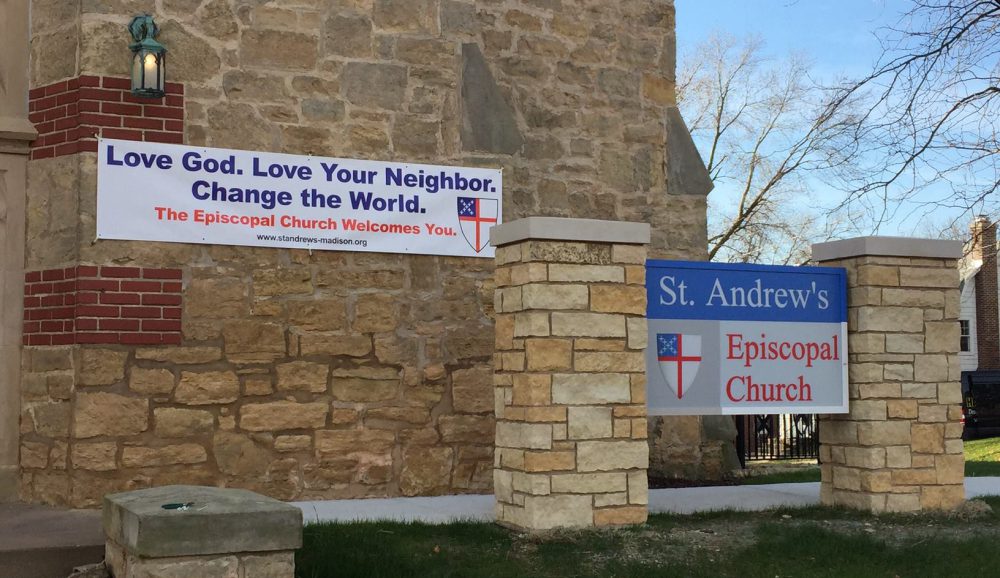
It was about three months later that I found myself responding to the sign that I had passed, without notice, on my way to and from work every day for the last seven years: The Episcopal Church Welcomes You.  It felt very much like a homecoming to me and it wasn’t long before I was there every Sunday, all morning, going to all of the services every week.


Now I wonder… If I were to ask you to trade places with me this morning, if you came up here and stood in this spot… what story would you tell?  Now I wouldn’t be asking you to tell your favorite or most memorable Christmas Eve story and I wouldn’t be asking you to relate a conversion story.  There was a different story that played a central role in the experience that I just recounted.  And that is the story that I am wondering about.

We all have them, a story, a narrative that we tell to ourselves and to other people, a story or narrative that makes sense of all of the things that we have experienced and the things that we believe.  That narrative takes all of our successes and failures, our joys and our pains, and creates a coherent, cohesive story that defines and describes who we are and what we believe.  It was my narrative, my understanding of myself and the world around me that was being challenged that night and I think it was the story of The Annunciation that made that challenge possible.  In fact, I think that it is the challenge to personal narrative that makes this story so important, so dear to us.   It is in this story that we find hope that our narrative might be re written.

Mary was probably only about thirteen years old.  She didn’t have all of the experiences, the pain, the joy the successes and the hurts to tie up in her narrative that I had accumulated over thirty some years.  But a girl of thirteen was old enough to get married in her day and I am sure that she had a narrative that she was very attached to.  Mary was betrothed to a man named Joseph who was a carpenter.  She was going to be married to a man with a trade, a man who was going to be able to provide for her and the children that she would bear to him.  Mary had something very important, she had a sense of security, and her prospects were bright, and she had vision, a plan, a narrative for the future that stretched before her.   Then it all changed in an instant.

It is fascinating the way our narrative describes us even as it begins to own us.  As I look back I see that the narrative that I claimed for myself, the story that I would have told to describe who I was, what I believe, and what was important to me that Christmas Eve was not an especially attractive one.   And I bet, at least I hope, that if I had been called upon to articulate that narrative twenty-one years ago I would have recognized its shortcomings.  But I was sure working hard to defend that narrative from all challenges and distractions.  We all do it.  We have a story that we tell about ourselves, a narrative that makes sense of all that we have learned and experienced, all that we have done or left undone, and we work to protect that narrative.  We don’t want that story called into question because that would undermine the way that we see ourselves and our actions and we might just be confronted with something we don’t like or would rather not see in ourselves.  We defend that narrative because we don’t want to change.

And yet, it is the possibility that the narrative might be rewritten that draws us to this story.  The angel comes to Mary and says, “Greetings favored one, the Lord is with you… You have found favor with God.”  Now that right there is enough to challenge your narrative.  Forget everything that you thought you knew about yourself.  Let go of all of the things that you have done, the things that you work to hide from everyone, the ways that you feel inadequate and small because you are highly favored of God.  No wonder she was afraid.  The Gospel says that, “she was much perplexed by his words and wondered what sort of greeting this might be.”  I’ll bet she was perplexed!  She was terrified because her narrative was being challenged.   Favored of God?  That meant re thinking everything!  But the angel didn’t stop there.  He went on to say that everything that she thought she knew about her future, her plans, her dreams, they were wrong too.  She was going to bear a child that would be a king and would change the world!  Mary’s narrative, the story that she told about her past, who she was, and her future, what she might become, was all wrong and was going to have to be rewritten.  There in that moment, with a light unlike any she had ever experienced filling the room, Mary bowed her head and said, “Here am I, the servant of the Lord; let it be with me according to your word.”

We all work very hard to defend our narrative.  We have a story to tell, one that has been fashioned through years of living, and we quail at the possibility that it might be wrong, that we might have to learn to tell our story differently.  At the same time we hear this story about a young girl whose life was changed, whose narrative was re written in a moment and we wonder, we wish, that the same thing could happen to us.

Someone gave me a gift this week.  They brought me something that, as I thought about this gospel, helped to pull it all together.  On Wednesday of this week someone brought me Kathleen Norris’s book Amazing Grace.  In her chapter on Annunciation, Norris quotes Thomas Merton from his work, Conjectures of a Guilty Bystander.  Merton writes about the place that he seeks in his contemplative practice as a,

“’point vierge’ at the center of his being ‘a point untouched by illusion a point of pure truth, which belongs entirely to God, which is inaccessible to the fantasies of our own mind or the brutalities of our own will.  This little point… of absolute poverty,’ he wrote, ‘is the pure glory of God within us.’” 1

A point within us which is inaccessible to the fantasies of our own mind or the brutalities of our own will as we struggle to create a story, a narrative that makes sense of all that we have experienced, learned and done…  Merton, and Kathleen Norris help us to see that is a virgin place, a place untouched, from which our story might be rewritten in a way that reveals us as the people whom God created us to be.  We all sense that space within us.  We all long to have our story spring from the glory of God, untainted by our own fantasies or the brutality of our own will.  This story of a young girl who allowed God to be born in and from that virgin place within her gives us hope that the impoverished stories that we tell about ourselves might be rewritten in a way that will make us whole.

For the last couple of weeks we have talked a lot about the need to prepare a room, to make room for Christ to be born within us.  In our collect today we prayed,

“Purify our conscience, Almighty God, by your daily visitation, that your Son Jesus Christ, at his coming, may find in us a mansion prepared for himself”

Perhaps the way to prepare that room in our hearts is to lower our defenses, to recognize out narrative as something that has changed in the past.  It has had to change in order to accommodate and reconcile new learnings, new events, new successes, new failures.  Preparing room for Christ to be born within and through us requires that we allow our narrative to be challenged by the reality that we are beloved, highly favored of God.  Preparing room in our hearts requires that we allow our narrative of what is possible, what we can and cannot do be shaped by that reality, our own favor in God’s eyes, so that we might be changed and so that the world might be changed through us.

Listen!  Can you hear it?  We are being welcomed home, “Greetings, favored one! The Lord is with you.”

Amen

1  Kathleen Norris, Amazing Grace: A Vocabulary of Faith (New York, Riverhead Books, 1998) 74.

A Sermon for the Third Sunday of Advent

This sermon focuses on the Old Testament and Gospel readings assigned for the  Third Sunday of Advent.

You can find those readings here.

He himself was not the light, but he came to testify to the light.

 “There was a man sent from God, whose name was John.”  We know a lot about this man named John.  From Luke’s Gospel we know that John was born to Elizabeth, who was past child-bearing years and thought to be barren.  We know that this miraculous birth was foretold to his father Zechariah, who was a priest of the temple, by an angel who said that John would “turn many of the people of Israel to the Lord their God” (Luke 1:16).  We know that Elizabeth, John’s mother, and Mary, Jesus’ mother, were relatives so John and Jesus were maybe cousins…

Luke also tells us that in the fifteenth year of the reign of Emperor Tiberius, when Pontius Pilate was governor of Judea and Herod was ruler of Galilee…  The word of God came to John, son of Zechariah in the wilderness.  He went into all the region around the Jordan proclaiming a baptism of repentance for the forgiveness of sins” (Luke 3:1-3).

Both Matthew and Mark note the beginning of John’s ministry saying that John appeared in the wilderness, dressed in camel hair and eating locusts and wild honey.  Both Matthew and Mark report that John’s message was so compelling that the whole countryside of Judea and Jerusalem were going out to see him.  Mark calls him the “John the Baptizer.”  Matthew calls him “John the Baptist.”

So it is very interesting that when the officials from the temple arrive and ask John who he is, he doesn’t have much to say!  With those credentials he could have said a lot…  “I am the one whose birth was foretold by an angel, born to a woman who was considered to be barren, whose cousin has begun to rock the world, and just look around you!  I am packing the house every day!”  But apparently John doesn’t tell them who he is so they have to start making suggestions on their own.  Are you the Messiah? No!  Isaiah? No! The Prophet?  No!  His interrogators get frustrated, “Come on man!  Give us something.  What are we going to tell the people who sent us?”  John finally relents, he offers a little more, but he still doesn’t tell them who he is.  He only tells them what he is.  A voice.  John tells them that he is no more than a voice, a role, a function…  “I am the voice of one crying out in the wilderness…”  Here he stands, knee deep in the muddy waters of the River Jordan, with the whole countryside coming out to see him and be baptized, and John is refusing to let these people focus their attention on him.  Instead he shifts their attention to something that everyone there was hoping, longing for.

When John quotes the Prophet Isaiah his audience would no doubt have been put in mind of the reading that we heard this morning.  After all it was this promise in Isaiah’s prophecy that had drawn them all out into this desolate place.  They had come out to hear John preach because they hoped that the oppressed were about to hear the good news, that broken hearts were finally going to be bound up, that captives would be granted liberty and the prisoners release.  They were there hoping that they would be comforted in their mourning and that instead of ashes they would be able to wear a victory garland.  When John quoted the prophet Isaiah the people of Israel would have also heard this promise of God’s Kingdom coming to fruition in their midst.

John isn’t willing to tell the people sent from the Priests and the Levites who he is because he knows that people are longing for the fulfillment of Isaiah’s prophecy and he knows that in this moment lies great danger.  Look again at our reading from Isaiah and you will see that, in this short reading, there are multiple speakers.  The first several verses are the anointed one, the one who has come to fulfill the promises of good news, binding up of broken hearts, liberty, release, and victory.  Then the voice changes and it is God speaking.  And God tells us that the fulfillment of those promises is just the beginning.  Not only will good news be procliamed, hearts mended, liberty granted and all the rest, but the ancient cities now lying in ruin will be rebuilt, and the devastations, the lost symbols of our relationship with god, will be raised up and restored.  More good news!  But there is a bit of a catch here.  Notice who Isaiah says will do this rebuilding, this restoration.  It is the people for whom the promises of good news, reconciliation, liberty, release and victory have been fulfilled who will bring the kingdom back to its former glory.  God says “they” will rebuild.  “They” will be called oaks of righteousness.  “They” will raise up.  John knows that the fulfillment of the promises for which the people long is not the end of the story, it is just the beginning, so he doesn’t want people to focus their attention on him.

It would be easier to focus on John himself than on what he is saying.  There is comfort, there is security, there is rest and peace in John.  Look!  Here he is!  It is going to happen at last and we will be saved from ourselves and from one another.  Whew!  Lets go home and celebrate with a glass of eggnog!  But when we look beyond John, to the rest of the story, to the vocation to which we are called even as the promises are being fulfilled, we see that we have a lot of work to do.  The rest and the peace for which we groan and long may not be part of our immediate future.  John refuses to flash his credentials here because he doesn’t want people to miss the fact that the arrival he is foretelling is not the end of the story.  It is a new beginning!

I think that we hear this passage from John’s Gospel today, on the third Sunday of Advent, the week before we hear the story of the Annunciation, of the Angle Gabriel’s visit to Mary, because we are in the same danger that the people of Judea and Jerusalem were in that day on the banks of the River Jordan.  We stand in this strange moment in time where we are celebrating and remembering an event that happened a long time ago, as we acknowledge and proclaim it’s currency today, as we await it’s happening again.  We stand here in Advent and remember Christ’s coming to us as a child born in a manger, as we experience Christ’s coming to us every day and moment of our lives, as we await the time when he will come again and all things will be put right and the kingdom will come fully to fruition.

We groan, we long for the good news, the mended hearts, the liberty, release and victory that is symbolized by the manger.  It would be easy to go Bethlehem and stay there, claiming the peace, comfort and rest that we need.  But it is terribly important that we listen to the next speaker in Isaiah’s prophecy, that we recognize the vocation to which God is calling us, and that we prepare ourselves to rebuild, restore and raise up the ruined cities and the devastations of our age.  We hear these readings today, on the third Sunday in Advent, before we hear the story of a young girl who opens herself to God and helps to usher in the kingdom, so that we know and understand that the Feast of the Incarnation does not, for us, mark the end, but that it indeed marks the beginning of the story.

Amen

The Mission of the Church: An Important and Powerful Sermon by The Rt. Rev. Mary Glasspool

The Rt. Rev. Mary Douglas Glasspool was elected eighth bishop suffragan of the Episcopal Diocese of Los Angeles on December 5, 2009, after having served nine years as canon to the bishops of the Episcopal Diocese of Maryland. The second woman to be elected bishop in diocesan history, she was ordained to the episcopate on May 15, 2010.

I had the great pleasure of working with Mary Glasspool when she was the Canon to the Ordinary in the Diocese of Maryland.  I knew her to be a caring and sensitive pastor, a tireless advocate of the Church, and an extremely powerful preacher.  Mary is a gift to the church.

In this sermon, delivered at the Diocese of Los Angeles’ Convention, Mary issues a call to to action, not just to the Diocese of LA but to the whole church, in in doing so does a wonderful job of telling our story, describing the church, and showing us at our very best.

I hope that you will take fifteen minutes and let The Right Reverend Mary Glasspool speak to your heart.

Watch her sermon here.


Episcopalians and the Bible: A Brief Excursus

A nasty Virus and preparations for the celebration of Saint Andrew’s Day have left my creative well a little dry.  I will continue my discussion of Episcopalians and the Bible in a few days.  In the meantime I would like to offer some material, resources and thoughts, from friends of mine to keep you thinking about the way that we read and understand our sacred texts.

The first is a post by Kathleen Henderson Staudt who was an adjunct professor at Virginia Theological Seminary when I was a student there.   Her post appears on The Episcopal Cafe and is titled: Bible Reading Episcopalian: Who Knew?

The second resource is a link to the Episcopal Church’s on line Visitor’s Center.  More specifically it is a link to a page of “An Outline of the Faith: commonly called the catechism.”   The catechism is a great place to start if you are exploring the Episcopal Church.  It addresses different aspects of our faith in a question and answer format.  This link will take you to the section that begins with the question: “What are the Holy Scriptures?”

The New Church’s Teaching Series, published by Cowley Press, has two great volumes on our approach to scripture.  Opening the Bible, written by Roger Ferlo, another of my professors at VTS, is a wonderful resource  as is Engaging the Word, by Michael Johnston.  (Please note that I have provided links to Amazon.com as an easy way to identify these books, not as an endorsement of Amazon)

Finally, if my post on reconciling reason and experience with scripture and a conversation about the creation stories in the book of Genesis have you intrigued you should check out:

A Catechism of Creation: An Episcopal Understanding
prepared for study in congregations
by the The Committee on Science, Technology and Faith

Until next time,

Andy+

Sermon for the First Sunday of Advent

This sermon draws on the Revised Common Lectionary readings for the first Sunday in Advent Year B, particularly on Isaiah 64:1-9 and Mark 13:24-37

You can find those readings by clicking here

Preaching without a text is always an adventure.  Sometimes what gets said “live and in person” doesn’t exactly match the text that the sermon was supposed to convey.  This is especially true when the preacher doesn’t bring their “A Game” to the crossing of the center aisle.  I think that I did a much better job of conveying these thoughts at the 10:30 service yesterday than I did at the 8:00.  So for those of you who got up early…  I beg your indulgence, and for a second chance to say what was on my heart.

Andy+

Sermon for the First Sunday of Advent: Year B

November 27, 2011

The Very Rev. Andrew B. Jones

Saint Andrew’s Episcopal Church

It begins today!  This is the first Sunday of Advent the beginning of a new church year.   Today we change the Eucharistic Prayer that we use on Sunday mornings.  We will shift to Year B in the Eucharistic Lectionary and begin to read primarily from the Gospel of Mark.  Today we begin again the familiar yearly pattern of liturgy, the “work of the people” that reflects and shapes who we are as people of God.

Today is also the day that we begin our preparation for the Feast of the Incarnation.  That might seem a strange thing to say this late in the calendar year.  I think that Home Depot had Christmas Trees on display before Halloween this year.  And the ads that we are seeing on television would have us believe that time to prepare for Christmas is running short.  The world will tell us that we are almost too late!  But the first Sunday of Advent is the day that the church begins to look forward to the coming of the Christ Child and we will spend the next four weeks preparing, and waiting.

Waiting for four weeks.  When I was a kid, and the only thing I had to do to prepare for Christmas was to use magic marker (a Flair™ for those of you old enough to remember them), in the color that I had been assigned, to mark the things in the JC Penney Christmas Catalog that I wanted most… when that was all I needed to do to prepare – those four weeks seemed interminably long.  Now that I am older those four weeks of waiting don’t seem like nearly enough time!  I have so much to do.  This being the weekend after Thanksgiving, and the weekend of the first Sunday of Advent we of course rearranged all of the furniture on the first floor of our house.  So not only do I have to bring the Christmas Tree up from hibernation in the basement, I have to figure out a whole new place to put it.  We need to find the Advent Wreath and our historic collection of Advent Calendars.  We need find our mailing list, write cards, bake cookies, buy gifts, respond to invitations, and create the spread sheet that will tell us where we need to be, which family home we are to visit and when, during the week after December 25th!  There is so much to do in only four weeks!  There are too many expectations.  There is too much pressure.  There are too many “sacred” family traditions to honor… four weeks is not enough time.

Far too often we arrive at Christmas day grinding our teeth, exhausted, wishing that it were all over, and we realize that this season of preparation, of waiting, has done us in and we have missed the very thing that we were preparing for.  We spend the last week of the season of Advent groaning under the pressure, longing for a moment of rest, some sense of peace, for a real connection with the people that we love and with the God who loves us enough to walk among us as one of us.  And then when the day has come and gone we feel cheated, unchanged, disappointed.  We just want a moment; a moment when we feel that sense of peace that passes all understanding, that sense of connection and communion with God, when we can experience the untainted hope that comes with the birth of a child, new life, new beginnings.  Is that too much to ask?  That’s not asking too much is it?

No it isn’t.  We need and should have that sense of comfort, of well being, of being loved and loving unconditionally and without reserve.   One of my prayers for this season is that we are all able to steward our resources, to guard our time and our energy, that we find some time to be quiet and to wait so that when we sit in front of the fire on Christmas Day, or when we raise our candles in the darkness and sing Silent Night on Christmas Eve, we all have the experience of Christ coming into our lives and filling us with hope and wonder.  I don’t think that is too much to ask at all.  In fact… if we take a look at the scriptures assigned for the First Sunday of Advent it becomes startlingly clear that we might not be asking for enough!

We are preparing, looking forward to the Feast of the Incarnation, for God made manifest, breaking into the world.  When the people of Israel envisioned that day they saw something so radical and transformative that the heavens would be torn open, the mountains would quake and the nations would tremble.  God’s adversaries would be defeated and justice, mercy and grace would triumph.  The world would be restored and reconciled to God.   In Mark’s Gospel we hear Jesus saying that when God breaks into the world the sun and the moon will go out, the stars will fall from the sky and the heavens will tremble.   Jesus is using apocalyptic language, language that would have been familiar to his contemporaries, to describe the world being changed, turned upside down in a way that is beyond our ability to image.  He uses metaphor to tell us that when God breaks into the world the things that we thought we knew will come to an end and a new reality will come to fruition.

Imagine a world where we all, every one of us, recognize that we are bound together as one.  Imagine a world where those who have plenty, plenty of food, water, wealth, health care, power, or status and rank, share with those who do not have enough.  Imagine a world where no one is marginalized, where no one is thought to be “disposable” and where everyone is nurtured and loved so that we all can become the people God created us to be.  What if, as we wait, as we prepare for the Feast of the Incarnation, we allowed ourselves to ask, even to expect that God’s breaking into the world will have those kinds of results?

Here on the First Sunday of Advent we do an interesting thing with our sense of time.  We sit in this interesting intersection of the past, present and future.  We are looking back to the Christ who has come, some two thousand years ago as a defenseless child in a manger.  We are proclaiming that Christ is coming to us now, here, in the present, every day of our lives.  And we are looking forward to the day that Christ will come again and that the kingdom will come to fruition, fully, in great power and glory.  We sit in this interesting intersection of time and proclaim “already but not yet.”

It is much easier to focus our attention on the already.  It is much easier to look back at the manger and to focus our attention on the event that changed the world forever.  It raises difficult questions for us when we look forward and see that the world has not finished changing, that there is more to do, and that Christ’s redemptive work is not complete.  What is taking so long?  Why wasn’t His coming once enough to reconcile all things to God?  And if He is going to come again and finish that work… what will it look like?  Will we be called to change?  Change is a hard thing.  And the kinds of changes that are described in the prophecies recorded in the book of Isaiah and in the Gospel of Mark are not easy to imagine or to contemplate.  Those metaphors suggest more questions than they do answers.   Change is hard and waiting for change, trying to prepare for change; change that we can’t predict or even imagine…  It’s no wonder that we prefer to focus on the past, to gaze on the manger and want to linger there.

I don’t know what it will look like when God breaks into the world and the kingdom comes to full fruition.  Will the sun and the moon stop shining?  Will the stars drop from the sky as the mountains and the heavens treble and quake?  I doubt it somehow.  Those images and those metaphors don’t make a lot of sense to me.  That isn’t how God works in my, in our experience.   And here is where we come full circle this morning…

Our experience tells us that God effects change, God changes the world though people: by changing hearts and touching lives.  God will change the world, and bring the kingdom to fruition though people just like you and me, through us!  And so that moment of peace, that moment of connection, that sense of communion with God through a child born in a manger; that sense of being loved that comes through God’s willingness to put God’s very self into our hands and at our disposal, that connection with all of creation that comes from being children of a loving God…  That clearly isn’t too much to ask.  It is incredibly important.  We should be asking for that!  But… it is just the beginning.

The story of the incarnation, of God in the world, revealed, made manifest in a manger in Bethlehem doesn’t end on Christmas morning or even at the conclusion of the twelve days of Christmas.  It continues through the season of Epiphany when we will hear the stories of God being made manifest to the larger world, the world beyond the manger, beyond the walls of the stable, beyond the nation of Israel into which Jesus of Nazareth was born.  We can hope and long, we can expect to be a part of that story too.  We can look forward to God breaking into the world in a way that changes everything, that restores all righteousness, and which reconciles all people to God, and which makes all creation new, if, as we hope and long for that moment of connection, that sense of communion, that peace that comes from all understanding, we see it is the first step in our being able to bring those same gifts to the rest of the world.

In our Book of Common Prayer, Eucharistic Prayer C describes the way that we should come to this table when we gather for communion.  I think that these words should also guide the way that we approach this season of waiting and preparation.  Saying this prayer and substituting the word “manger” for the word “table” might give us a whole new appreciation for the season of Advent and indeed, for the Feast of the Incarnation for which we prepare.

“Open our Eyes to see your hand at work in the world about us.  Deliver us from the presumption of coming to this table for solace only and not for strength; for pardon only, and not for renewal.  Let the Grace of this Holy Communion make us one body, one sprit in Christ, that we may worthily serve the world in his name” (BCP p. 371).

Amen

A Sermon for Thankgiving Day

This sermon draws on the readings for Thanksgiving Day, Lectionary year A

It draws especially on Deuteronomy 8:7-18 and Luke 17:11-19

You can find those readings by clicking here

The Very Rev. Andrew B. Jones

Saint Andrew’s Episcopal Church

Madison, Wisconsin

November 24, 2012

Thanksgiving Day 2012

Many of you already know that this past summer I was privileged to travel to a place with no running water, where homes are constructed of scrap wood, old plastic tarps, odd pieces of rusted and corrugated metal, all tied to simple wooden frames with whatever scraps of string or rope their owners can find.  A place where the only water is what you can collect in a cistern as the rain runs off of your rusted and patched metal roof.  A place where subsistence farmers struggle to grow enough food to feed their families and where whatever you need that can’t be grown in your own soil has to be carried up the mountain on rutted and dangerous roads, often tied to the handlebars or the rack of a motorcycle.  A place where the only electricity comes from a community generator which runs just a few hours a week because the diesel fuel that powers it is carried up the mountain on those roads in gallon jugs dangling from the handlebars of those motorcycles.

The people of Jeannette, Haiti live without.  They live without the amenities that we take for granted and upon which we depend.  And yet live they do!  There is a strength in them, a sense of hope that belies the conditions of their home.  It was remarkable that the whole week that I was there, driving through the ruin and wreckage in Port au Prince, seeing the crowds of people in Miragoane and Les Cayes, living with the people in Jeannette and witnessing the poverty that they endure, I never once felt like crying for the things that they do without.  I never felt like crying for the things that they don’t have.  But when I arrived home, having gotten on a plane in Port au Prince early in the morning, having flown through Miami into Chicago, ridden the bus into Madison, driven from the Park and Ride home and walked into my kitchen… that was the moment that I wanted to cry.

My family knew I was coming, I had texted them at every stop along the way, so when I walked into my house at 11:50 at night, every light in the house was on.  The air conditioning had the house at a cool sixty-eight degrees.  As I walked in I could see the small flat panel TV in the kitchen and the large one in the Great Room.  I could see five guitars and three laptop computers.  I was surrounded by the sings and symbols of affluence.  I never once wanted to cry for the things that the people of Jeannette don’t have.  I did want to cry for the things that I do have. And I think in that moment Moses was speaking to me.

For forty years the people of Israel wandered in the wilderness looking for the land that God had promised them.   It took a while, but in those forty years they had come to understand that their very lives flowed from the grace of the God who sustained them with manna from heaven and water from the rock.  They had come to know that all that they had, all that they were, and all that they might yet become was a gift from God.  It had been a difficult journey both physically and spiritually but they were finally, finally about to find themselves in the Promised Land and Moses knew that they were in great danger.

Moses tells the people of Israel that they are about to enter a land of plenty: water, honey, figs, olives, wheat, barley, pomegranates… they will have more than enough to be satisfied.  And therein lies the danger.  Moses is warning them not to forget whose they are and who they are, not to forget that it is in God that they live and move and have their being, that all that they have is a gift from the God who loves them.  I think that as I walked into my kitchen that night back in early July Moses was also talking to me.

I was surprised to find myself in tears that night because I was being confronted with a truth that I had lost track of; all that I have, all that I am, and all that I might yet become is a gift from God.  This morning as we gather at this table Moses is speaking to all of us.  Walking down the aisles of Whole Foods, picking up imported bottled water, extra virgin olive oil, low fat Fig Newtons and PomWonderful juice it is easy to begin to believe that we deserve the things that we have, that we have earned them, that  “the power and might of my own hands have gotten me this wealth” (Deuteronomy 8:17).  When we have all of the “things” that we need we can begin to neglect the relationship with the one in whom we live and move and have our being,

Turn now to the Gospel reading.  Jesus is approached by ten lepers who cry out, “Jesus, Master, have mercy on us!” (Luke 17:13).  Jesus tells them to go and show themselves to the priests and on the way there the lepers “were made clean.”  Now “clean” is an important word in this passage.  Lepers were “unclean.”  They had to live outside the city.  They were not allowed to come into contact with others.  They were cut off, alienated from their families, their communities, their people.  It gets even worse.  The assumption in that day was that if you contracted a disease like leprosy it was because you, your parents, your grandparents, or maybe even your great grandparents had broken the law and offended God.  So they were not only alienated from their people, they were alienated from God.  You don’t have to live like that very long before you start to become alienated from yourself.  The loathing and disgust, the judgment all build up and eventually you start to believe it.  The ten lepers who approached Jesus that day had lost everything because they were “unclean.”   When the ten lepers “were made clean” they were reconciled, restored to their community, in their relationship with God, and finally, with themselves.

One of those lepers turned around and went back to give thanks.  Now the Gospel doesn’t tell us that the other nine suffered a relapse, that their leprosy returned.  The Gospel doesn’t say anything to diminish the “quality” of their cleansing.  But Jesus does say that something new has happened to the one who came to give thanks.  Jesus says that his faith has made him “well.”

“Clean” even if we hear that word as “reconciled” sounds and feels external.  Something has happened “to” you.  “Well” sounds and feel internal.  Something has happened “in” you.  The nine who didn’t come back to give thanks were reconciled to their communities, the people in the community would have believed that they were reconciled to God, but these last words of Jesus, spoken only to the one leper who returned to give thanks, help us to see that there was something missing in their reconciliation.  They were “clean” but they were not “well.”  Perhaps the reconciliation with God and with themselves that might have happened in this moment was  incomplete.

There is an insidious danger in failing to give thanks.  When we begin to believe that we have earned, that we deserve the things that we have, that by firmly grabbing our own bootstraps and pulling upward we can acquire all that we need, that we can make ourselves clean, whole, and well we end up denying ourselves the thing that we really need most of all.  What we want, need, long for, whether we recognize it or not is Grace.  And Grace can only come from outside of ourselves and it only comes as a gift, unearned, freely given.  The moment that we begin to believe that we can earn grace, that it somehow depends upon us and what we do, it crumbles in our hands and slips from our grasp.

We gather at this table today to give thanks, just like we do every Sunday and the importance and fruits of gratitude are impressed upon our hearts, our minds and our souls.  We gather at this table today and we bear witness to the community around us and to the world that as they gather at their own tables this day, they might just have more to be thankful for than they can ever imagine.

Episcopalians and the Bible: Does Reason and Experience Trump Scripture?

In my last post I talked about the validity of reason and experience and why they are a legitimate part of the equation as we seek to deepen our faith and understanding.  Critics of the church, and, with a nod to Henry Peter’s comment on my last post I am including in the word “church” folks of all denominations and traditions who read the Bible the way that we do, would say that this is where we undermine or deny the authority of the Bible.  Let’s take a look at why we say that our critics are wrong.

We are not challenging the authority of the scriptures, those works that are included in our sacred canon.  What we are questioning is the interpretation of those scriptures that has become “canonized,” that for some has become as sacred as the scriptures themselves.   How does that work?  We have to start at the beginning.

We read the creation stories in the book of Genesis and we wonder.  How does this material align with what I have learned in school?  How does it align with that we have learned about the history, the geology, the biology of the earth?  If we accept a plain sense reading of those passages, if we take them literally, we seem to have a real problem.  There is a disconnect, a dissonance, between what the Bible, to which we grant authority, says and what our minds, our reason and experience of the world says.  So what to do?  Do we throw out one or the other?  Do we just turn our heads with an uncomfortable smile on our faces and ignore the fact that these two important parts of our lives don’t work together?   I think that to walk away from this moment of disquiet is to deny or undermine the authority of both our reason and our scripture.  We are in essence saying that the scriptures are not worth our time and attention and that we are willing to ignore them when to examine them head on would cause discomfort.  To walk away from this moment of disquiet is to infect our faith with an intellectual dishonesty that will undermine it and lead to its irrelevance in our own lives and in the life of the world.  We must ask the question, “Can our experience of the world be reconciled with what the scriptures tell us?”  In this case they can.  Here is how that might look.

When we look at the two creation stories in the book of Genesis we begin to realize that they share things in common with other ancient traditions and stories from the Near East.  The people who told the stories that are now written down in the Book of Genesis were responding to a very human need to explain our origins and beginnings.  It is also important to acknowledge the reality that these stories were told by generations and generations of people, sitting around their campfires at night.  They told them to one another and they told them to their children.  “Where did we come from Mommy?  Well dear, in beginning God made…”  Biblical scholars do not believe that Moses wrote the first five books of the Hebrew Bible.  They are the product of whole communities, generations of people, who were trying to explain things that they knew to be true, that their experience of the world told them must be true, and they were using the cosmology, the images and metaphors, and the language that was available to them to tell that story.

Further analysis of the text helps us to see that these ancient people weren’t as interested in telling us how the earth was made as they were in telling us about our relationship with the one who created it.  We don’t learn from the Book of Genesis how all of the stuff really came to be.  If we are reading the book of Genesis as a science textbook, even if we read it as a science textbook that would have related the ancient Near East’s understanding of the physical world,  we are going to be very disappointed.  That is because the book of Genesis was never intended to be a scientific treatise on the creation of the physical world.  It was a book that describes who we are in relationship to one another, to the created world, and to the God who created us.  And it is a book that talks about those fundamental relationships by telling stories.

When we approach the stories in Genesis in this way we are not challenging the authority of the scriptures.  We affirm the nature and depth of the relationships that the scriptures depict.  We affirm the deep sense that somehow, in ways that we cannot articulate, God is responsible for who and what we are.  And that reality establishes our relationship with God and with one another.  What we have let go of is an interpretation of these scriptures that tells us that God created the world in seven days, that the dry land holds back the deep and turbulent waters of chaos, and that the moon the sun and the stars are suspended in a dome that holds back the waters above us.

So have we allowed reason and experience to trump the scriptures?  Here is the final test.  Can we read the scriptures, the stories of creation in the book of Genesis in the way that I have described and still be faithful to the text?  Have we distorted the meaning of the text to suit our own needs or can we read them in this way, with integrity, and still find that the scriptures are powerful, authoritative and life giving?  The answer to this final question is “yes.”

Of course the stories of creation in the Book of Genesis are an easy place to start.  While there are clearly people who still want to claim that the Earth was created in seven days, witness the Creation Museum in Petersburg, Kentucky, most people are not so comfortable letting go of the years of accumulated science that has shaped our understanding of the physical world around us.  So demonstrating the interpretive shift that allows us to reconcile our reason and experience with scripture is, in this case, more of a relief than a challenge.   There are however, other understandings that our reason and experience have revealed to us, that have challenged and are challenging historic, canonized, interpretations of scripture that I would like to deal with.  I mentioned them in my last post and in my next post I will address the fact that for the Episcopal Church, and for progressive Christians of all traditions and denominations, ordained ministry is no longer reserved to men alone, and that we no longer view homosexuality as a sin.  One revealed truth that is not so contemporary, another that continues to shake some parts of the church today.

I look forward to your comments and responses.

Peace,

Andy+

Episcopalians and the Bible: Don’t Check Your Brain at the Door!

You may have seen comedian Robin Williams’ Top Ten Reasons to be an Episcopalian. Williams lists as the number 7 top reason, ” You don’t have to check your brains at the door.”  Well if you ask me, his number seven reason should be listed much closer to the top.  I think that the Episcopal Church would agree because they used it in a national ad campaign!

Ours is an “incarnational” faith.  In other words we believe that God is present and discernable in the world.  God is made manifest in the world around us.  God is incarnate in the world.

That means that the things that we have learned about and through the world around us are a valid part of the equation when we seek to understand God, the scriptures, and who we are and the lives that we are called to live.

Some religious traditions and philosophies will tell you that the world is an illusion that we need to rise above, that it is a veil and a distortion from which we need to break free.  Other traditions and philosophies will tell you that the world is completely corrupt and that anything, any understanding, that comes from the world around is us bound to destroy us.

The Episcopal Church and Anglicanism affirm the reality and the relevance of the world around us and the reality and the relevance of the lives that we live.  The things that we have learned over the centuries, from the social and physical sciences and from one another are legitimate, and valid parts of the ongoing story of God and God’s beloved creation.

Sometimes Episcopalians are accused of abandoning the Bible, of rejecting the scriptures in favor of a social or popular gospel.  Sometimes Episcopalians are accused of rejecting the “authority” of the scriptures.”  If you look closely what you will discover is that it is not the authority of the scriptures that is being questioned but the authority of an “interpretation” of the scriptures that is being questioned.  That questioning often arises because of something that we have learned from the world around us or from one another.

We no longer believe that the earth is flat, or that all of the planets circle the earth.  We no longer believe that slavery is an appropriate state for those who find themselves enslaved.  We no longer think that ordained ministry should be reserved for men alone.  We no longer think that homosexuality is a sin.  There are lots of place where our increased understanding of the world around us, and our discernment of God through the world, has moved us to abandon previously held interpretations of the scripture and to re think what we have thought in the past.

I started with a line that the Episcopal Church borrowed from Robin Williams.  I will end with one that I think we should borrow from our brothers and sisters in the United Church of Christ.  “God is Still Speaking.”  The final argument for believing that God is still speaking, that revelation is ongoing, and that the things that we are learning need to be incorporated into our faith, our understanding of God and the world, comes from the Gospel of John.

“I have said these things to you while I am still with you.  But the Advocate, the Holy Spirit, whom the Father will send in my name, will teach you everything and remind you of all that I have said to you” (John 14:25-26).

“I still have many things to say to you, but you cannot bear them now.  When the Spirit of truth comes, he will guide you into all the truth (John 16:12-13a NRSV).

God is still speaking and we will undoubtedly continue to discover ways and places where we have been wrong, where our understanding and interpretation needs to change.  S don’t check your brains at the door.  Bring your experience, your understanding of the world, and the things that you have learned to the table and add it to the mix.  Help us to increase our understanding by broadening and diversifying our collective perspective.    Help us as we work together, guided by the Holy Spirit, to discern God’s voice and live as faithful people in a world that is moving, living, breathing and alive!  Come experience the Episcopal Church!

Weeping and gnashing of teeth… the sequel: Episcopalians and the Bible

This past Sunday, instead of preaching a sermon on the Gospel assigned for the day I gave the Annual State of the Parish Address.   There were quite a few people who told me they were disappointed that I had not used that time to address a part of Matthew’s Gospel that they have often struggled with.  I would like to take a moment to respond to their concerns and to use this moment to talk about the way that we, as Episcopalians, read the Bible.

Here is the passage that had people so unsettled:

Jesus said, “For it is as if a man, going on a journey, summoned his slaves and entrusted his property to them; to one he gave five talents, to another two, to another one, to each according to his ability. Then he went away. The one who had received the five talents went off at once and traded with them, and made five more talents. In the same way, the one who had the two talents made two more talents. But the one who had received the one talent went off and dug a hole in the ground and hid his master’s money. After a long time the master of those slaves came and settled accounts with them. Then the one who had received the five talents came forward, bringing five more talents, saying, `Master, you handed over to me five talents; see, I have made five more talents.’ His master said to him, `Well done, good and trustworthy slave; you have been trustworthy in a few things, I will put you in charge of many things; enter into the joy of your master.’ And the one with the two talents also came forward, saying, `Master, you handed over to me two talents; see, I have made two more talents.’ His master said to him, `Well done, good and trustworthy slave; you have been trustworthy in a few things, I will put you in charge of many things; enter into the joy of your master.’ Then the one who had received the one talent also came forward, saying, `Master, I knew that you were a harsh man, reaping where you did not sow, and gathering where you did not scatter seed; so I was afraid, and I went and hid your talent in the ground. Here you have what is yours.’ But his master replied, `You wicked and lazy slave! You knew, did you, that I reap where I did not sow, and gather where I did not scatter? Then you ought to have invested my money with the bankers, and on my return I would have received what was my own with interest. So take the talent from him, and give it to the one with the ten talents. For to all those who have, more will be given, and they will have an abundance; but from those who have nothing, even what they have will be taken away. As for this worthless slave, throw him into the outer darkness, where there will be weeping and gnashing of teeth’ ” (Matthew 25:14-30 NRSV).

 It was the last two sentences of this passage that had people upset.  To all those who have more will be given?   And to those who have nothing even what they have will be taken away?  Outer darkness and weeping and gnashing of teeth?  Wow!  Those are difficult words to hear.  Jesus is using a metaphor to describe the Kingdom of Heaven and if the master in this story represents God, then this passage might be cause for some real concern.  At least it would if this passage represented all that we knew about God.  Fortunately for us it does not.

Episcopalians see the Bible through an interpretive lens that is formed from the broader scriptural witness.  In other words, we don’t try to base our understanding of God on single passages of scripture but on the picture of God created by the whole of our canonical texts, from the two stories of creation contained in Genesis to the strange and poetic apocalyptic language of the Revelation to John. Bounding the story with the creation narratives and John’s treatise on the evils of empire make it clear that using the larger story, the broader narrative, to develop an understanding of God is by far the more difficult approach, but as Episcopalians, and as Anglicans, we understand that it is this larger narrative that provides the more comprehensive understanding of the God in whom we live and move and have our being.

Using a single passage of scripture to interpret the rest of the book is called “proof texting.”  Proof texting, using single or a few passages of scripture to paint a picture of God has allowed people to use the Bible to justify slavery, the war, the oppression of women, and the marginalization and a whole host of peoples whom we describer as “other.”  The truth is, we can find individual passages of scripture that will allow us to make almost any point, to further any agenda, to advance almost any cause that we want.  Episcopalians know that using the narrative created by the whole of our scriptural witness helps to prevent us from misusing our holy texts for our own purposes.

So back to the weeping and gnashing of teeth…  I really don’t believe that the most shocking part of this passage is the whole bit about taking the one talent away and giving it to the slave who had ten talents.  I think that the really shocking and scandalous part of this parable is when the slave says to his master,   “Master, I knew that you were a harsh man, reaping where you did not sow, and gathering where you did not scatter seed; so I was afraid…”  This is the moment in the story when we should be outraged.  After all the master in this metaphor represents God and we know that what this slave has said is completely untrue… right?

Let’s go back and think some more about the big picture, the narrative description of God that is created by the totality of our scriptural witness.  There may be some passages of scripture that seem to indicate that this slave has given an accurate account of God, but those passages are few and far between.  And, when taken in the context of the larger story, the passages that describe God in the way that this slave describes God merit some further investigation and study because they just don’t make any sense.

There are lots of ways that people express the “big picture” narrative description of God as represented in the Bible.  There are lots of themes and ideas that need to be covered in that description.  But when I am asked to distill the message of the Bible into a clear concise statement I will say that God loves is so much that God came among us as one of us, allowed us to do our very worst, and continues to love us anyway, proving that nothing, not even the deepest darkest truth about what we are capable of, will ever separate us from the Love of God.  This, I believe, is the message of the cross and the crucifixion.  God knows exactly what evil we are capable of and despite that deep knowing God will never abandon us.

This narrative description of God has the power to change our lives.  It is also this knowledge of God that should make us suck in our breath in shock and say to this slave, “No!  You are wrong!  Don’t you get it?  You have been given a gift by a loving and generous master!  How can you say such a thing?”  Reading this text through the interpretive lens that is formed by the broader scriptural witness has the potential to change our response to this passage.  It has the potential to redirect our questions.  But there is still that whole business about weeping and gnashing of teeth…

The parable doesn’t really tell us what the three slaves did in the time between their master’s departure and return.  It only tells us what each of them produced in that time.  Here is how I picture the life of our “wicked and lazy slave” unfolding from the moment he received that fateful gift.  He takes this immense fortune home and buries it in the back yard, in the bare spot under his kids swing set to that no one will know that the earth has been disturbed.  Then every night, as he stands at the kitchen sink doing the dishes he looks out into the yard to make sure that the treasure is still there.  Pretty soon he starts going home at lunch time to check on his buried talent.  He is so worried that someone will discover it and that he might lose some of it that he finally leaves his job so that he can sit at the window and monitor it.  His family gets so fed up with his behavior that they leave him.  They even take the stray dog that sometimes kept him company during his long vigil!  Throughout this whole ordeal he loses weight, his hair begins to thin and turn grey.  He is tired all the time, can’t think straight, and always seems to be ill.  He loses everything that he had.  He didn’t have much to begin with, but even what little he had is lost.  What had been intended as a gift turns into a curse and in the end, owns him. He spends his days alone, in the darkness, weeping and gnashing his teeth…

In the end his master didn’t have to punish him at all!

In the end, the parable was really a metaphor to describe something that is all too easy to imagine.