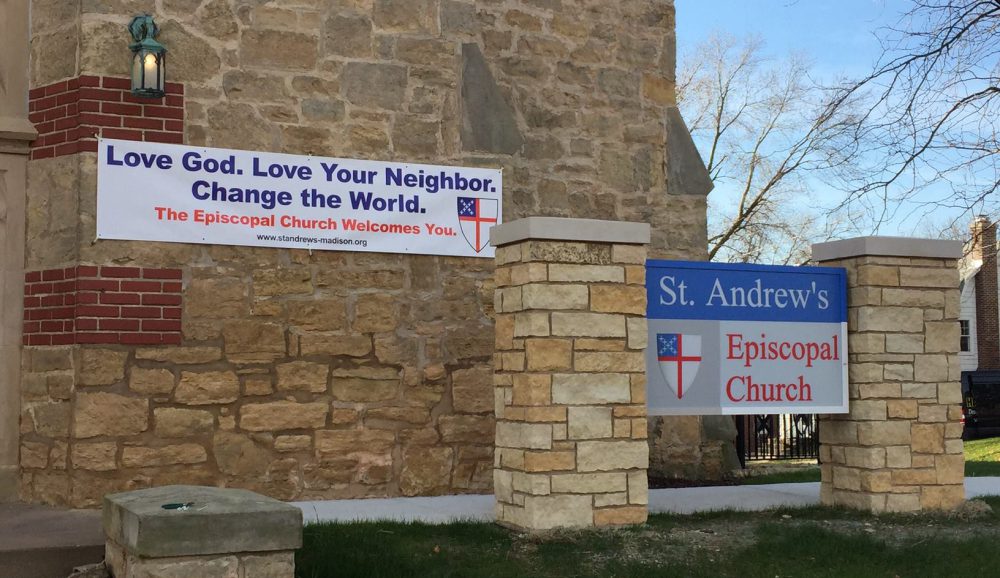
Saint Andrew’s Episcopal Church 2016 State of the Parish Report

Good morning.

This morning as we gather for our Annual Meeting and to hear the State of the Parish Report our hearts are heavy with news from around the world. We have been shocked by events in Paris France, and, although somehow our media has not given them equal coverage, by similar events in Beirut Lebanon and Baghdad Iraq.

We have business, mandated by our by laws, to which we must attend this morning but before we do that we need to take a moment to attend to our true vocation as the church.

The Lord be with you.

And also with you

Let us pray.

A prayer for Paris, Beirut, and Baghdad

November 13, 2015 by Presbyterian News Service Leave a Comment

God of mercy, whose presence sustains us in every circumstance,
in the midst of unfolding violence and the aftermath of terror and loss,
we seek the grounding power of your love and compassion.

In these days of fearful danger and division, we need to believe somehow that your kingdom of peace in which all nations and tribes and languages dwell together in peace is still a possibility.

Give us hope and courage that we may not yield our humanity to fear..,
even in these endless days of dwelling in the valley of the shadow of death.

We pray for neighbors in Paris, in Beirut, in Baghdad, who, in the midst of the grace of ordinary life–while at work, or at play, have been violently assaulted, their lives cut off without mercy.

We are hostages of fear, caught in an escalating cycle of violence whose end can not be seen.

We open our hearts in anger, sorrow and hope: that those who have been spared as well as those whose lives are changed forever may find solace, sustenance, and strength in the days of recovery and reflection that come. We give thanks for strangers who comfort the wounded and who welcome stranded strangers, for first responders who run toward the sound of gunfire and into the smoke and fire of bombing sites.

Once again, Holy One, we cry, how long, O Lord? We seek forgiveness for the ways in which we have tolerated enmity and endured cultures of violence with weary resignation. We grieve the continued erosion of the fabric of our common life, the reality of fear that warps the common good. We pray in grief, remembering the lives that have been lost and maimed, in body or spirit.

We ask for sustaining courage for those who are suffering; wisdom and diligence among global and national agencies and individuals assessing threat and directing relief efforts; and for our anger and sorrow to unite in service to the establishment of a reign of peace, where the lion and the lamb may dwell together, and terror will not hold sway over our common life.

In these days of shock and sorrow, open our eyes, our hearts, and our hands to the movements of your Spirit, who flows in us like the river whose streams makes glad the city of God, and the hearts of all who dwell in it, and in You.

In the name of Christ, our healer and our Light, we pray, Amen.

by Laurie Ann Kraus
Coordinator, Presbyterian Disaster Assistance

This is the ninth time that I have had the great pleasure and privilege of standing before you to offer the State of the Parish Report, to call out our achievements and strengths, to name our challenges, and to articulate a vision and goals for our future. I really do love this moment because, if we look beyond the requisite numbers and statistics, the State of the Parish Report is an opportunity for me to tell our story, the story of “We.”

I am going to offer some numbers and statistics in the next few minutes, but standing here in the pulpit, as we prepare to celebrate the Eucharist, it is the story that I want to share. The numbers will have to wait for a just a bit.

It’s awfully tempting to be anxious. The Barna and Pew Research Groups, trusting polling firms, have told us that the mainline is on the decline. Fewer people declare affiliation with the church every year, attendance and membership are on the decline, churches are closing their doors and selling their property all across the country.   But I wonder… Numbers are useful but they can be deceiving. How you ask the questions, how you present the results can have a big impact on the story that those numbers tell.

I wonder if across the church people aren’t doing what we have done over the last several years, trying to make those numbers more useful we have tried to be more honest about who is here and who is not; removing from our active roster folks who haven’t been here for a long time, adult children of parishioners who are married and living out of state, people who have drifted away and haven’t been seen for the last three years. We still have those names in our books but we list them as inactive. Our membership numbers seem to have declined but the truth is that they are just more accurate. Our core membership numbers remain remarkably constant.

Average Sunday attendance is another number that gets a lot of attention but which needs some interpretation. Is ASA really a measure of vitality and membership? It used to be that regular church attendance meant showing up every Sunday. It was almost obligatory in our culture and society that you be in church on Sunday morning. What we know about ourselves is that “regular” attendance means something different today than it use to. Even our most committed and involved members find it hard to be here every Sunday. Kids sports take place on Sunday morning, families are spread across greater distance and we have to travel to be together. “Regular” Sunday attendance for many of us is now once or twice a month. So is Average Sunday Attendance really a measure of church vitality and strength.

The pollsters will tell us that fewer people are claiming affiliation with the church an that the number of people who do make that claim are at dangerously low levels. But we know that if all of the people who used to claim that they were affiliated with a church, if all of the people who told the pollsters that they were “regular” church attenders, actually showed up on a Sunday morning parishes across the country would need to set up overflow seating in their parish halls and parking lots.

Numbers can be useful but they can also be misleading. A better measure of congregational vitality, of the health of a church can be found in their story. Here is the story that we have to tell about ourselves.

For the last year we have gathered to celebrate. A parish in its one-hundredth year on the near west side of Madison we invited the community to celebrate with us: Special events, concerts, beautiful original settings of the mass, parties, and a picnic marked the joy and the love we share in this place.

In that year of celebration we came together to help secure our future. Dreaming if what we might be, of the ways that God might use us in our second century we raised close to 1.4 million dollars to renovate, repair, and restore our campus. Faced with some difficult choices, the need to prioritize our needs, interests and dreams we engaged in a process that was transparent, open, collaborative, and fair. That process led to a remarkable moment. The Vestry, after months of prayerful listening found came to consensus around the scope and cost of a project that will allow us, and those who come after us, to continue God’s work here at 1833 Regent Street for the next one hundred years.

This is a challenging time for the church. The context in which the church pursues its mission to share the good news of God in Jesus Christ is changing at a remarkable pace. There are those who believe that we cannot survive, but looking around me I have to say that the reports of our death have been greatly exaggerated!

This is my ninth state of the Parish Report, my ninth opportunity to tell the story of “We,” my ninth opportunity to call out our achievements and strengths, to name our challenges, and to articulate a vision and goals for our future.

So here is another story that needs to be told this morning.

Fifteen years ago, when Patrick Raymond was in his third year as Rector of Saint Andrew’s, he and the Vestry knew that one full time ordained person could not support all of the ministry, programming, worship, and community that this congregation needed and wanted. The Rev. Pat Size joined the staff in 2001 and helped to establish and manage a Pastoral Care Ministry, a Healing Prayer Ministry, and created an Adult Formation Program called Journey in Discipleship.

When Pat left Saint Andrew’s at the end of 2003 to become the Missioner to the Hispanic Congregation at Grace Church Saint Andrew’s turned to the Rev. Deacon Susan Mueller for help. Susan had come to Saint Andrew’s as a Deacon in 2001 and in 2003 she joined the staff as a part time Pastoral Associate.

Susan retired from her position at Saint Andrew’s in 2010 after nine years of ministry among us, seven of them as a member of the staff. We were very concerned about our ability to lure a candidate with those qualities and skills to Madison for a part time position. Fortunately we didn’t have to look very far to find the right person.

Leigh Vicens graduated from Virginia Seminary in 2009 and returned to Madison to finish her PhD in Philosophy. Ordained a Deacon that spring Leigh came to Saint Andrew’s as a part time intern, paid a nominal stipend by the Diocese of Milwaukee in July of 2009. When Susan Mueller retired Leigh joined the Saint Andrew’s Staff as part time Pastoral Associate.

Leigh finished her doctoral degree and accepted a  teaching position at Augustana College in Sioux Falls S.D. in 2012. We bade her farewell in June of that year. We were once again faced with the prospect of looking for someone with very special personal circumstances that would allow them to come to Madison and join us for a position that was only half time.

Our concern was compounded by the fact that we were losing two members of our staff that June. Kate McKey, who had served as our part time Youth Minister for the past three years, was also leaving.

After prayerful consideration and deliberation we decided to roll both the half time associate position and the Youth Minister position into a single, full time, clergy position. We wanted to be able to draw gifted and qualified candidates to Madison to join our staff. We understood that a full time clergy person would be in a position to fully invest in the people in, and the life of, our community. And we wanted to create a position that would allow the right candidate to become a long term member of our community allowing them to form and nurture deep and effective relationships with the community and people of Saint Andrew’s. We knew that this change would be a financial stretch for the parish but we were convinced that this was the right strategy for our future together.

I had met Dorota Pruski as a member of the Diocesan Commission on Ministry in 2009 when she came before us for her final interviews in the discernment process. I remember remarking to my colleagues on the commission that, in four years when she finished her seminary training, some parish was going to be very lucky to have her serving among them. When I ran into her in Indianapolis at the 2012 General Convention I was again impressed by her poise, her thoughtfulness and now by her understanding and articulation of the complex issues facing the Episcopal Church and the broader Anglican Communion. Dorota was just finishing her second year at Virginia Theological Seminary and I jokingly asked her if there was any way that she could graduate a year early. She laughed, said no, and then asked why I was asking. I told her that I was looking for full time help “now.” She laughingly replied by asking if I could wait a year and I said, “I could but I would be dead!” The Rev. Shannon Kelly, a mutual friend and former Chaplain at Saint Francis House was part of the conversation and she laughed and asked, “Why don’t you just get some interim help for a year?” Later that day I forwarded the job description to Dorota saying that if she was interested I would love to have a conversation.

A conversation over lunch led to a conversation with the Bishop and with our Diocesan Deployment Officer. Those conversations led to conversations with the Vestry. Dorota came to visit Saint Andrew’s that August, worshiping with us, meeting with the Vestry, having lunch, dinner and breakfast with leaders of the parish, members of the Youth Group and their parents and finally on Monday afternoon another lunch with me. That fall Dorota was the only member of her seminary class to begin their senior year with a signed letter of agreement, a parish having called and anxiously awaiting her arrival!

Three years later we see the wisdom and the fruits of the decisions that we made in 2012. I told Dorota when we first talked at that General Convention in in Indianapolis that I wasn’t looking for an employee. I was looking for a partner in ministry, someone who would share fully in the exercise of priestly ministry and in the life of the community. The unique partnership that we share is a powerful manifestation of character and ethos of this place. We are a collegial and collaborative community, working together to support one another as we discover our individual and corporate gifts, callings, and vocations. People who experience Saint Andrew’s for the first time often marvel to me at the genuine care and affection that we have for one another, that this is a congregation of people that truly like one another. They feel the depth of our connection and they want to be a part of the communion that they feel here. None of that happens by accident!

Having Mother Dorota with us, a second full time priest, allows us to do and be more than we could be if I was the only full time member of the staff.  We have more hours to devote to the many and varied programs and ministries that bring us together in fellowship as we work to live out our vocation.  We have more hours available for pastoral care, to visit people in the hospital, to take communion to people in their homes, to sit together listening and caring deeply for one another as we journey together.  Having two full time priests on staff means that we have double the hours to meet with parishioners, forming and nurturing relationships, and to recognize and facilitate potential relationships between members of the community who may not realize that they have dreams, concerns or vocations in common. Having two full time Priests means that we have double the hours to meet with ecumenical partners and leaders in the larger Madison Community, with the Diocese of Milwaukee and with the Episcopal Church at large.

Having two full time Priests, one from column A (look deferentially at Dorota) and one from column B (gesture towards self), means that we have a priestly presence at the altar and in the pulpit that reflects and represents the diversity of our life, our parish, and of creation. That diversity at the altar and in the pulpit, the affirmation that it offers to the people who walk through our doors is an important symbol of who we are, what we believe, and how we care for one another in this place. That diversity of voices at the altar and pulpit also makes each of our voices stronger – Dorota and I learn from one another and make each other better. So the whole is greater than the sum of its parts.

It is clear that the decisions that we made in 2012, to call a second full time priest to join us, to wait a year while Dorota finished her seminary training, to invest in someone who could then invest in us were the right decisions.  We are today more than we could have been without her.  There is an important lesson in all of this.  When faced with difficult questions we consistently make good decisions for the life, vitality and future of this community.  We have another decision to make and we need to make it now.

We knew when we called Dorota that adding a second full time priest to our staff was a financial stretch.  Combining our half time Pastoral Associate and our part time Youth Minister positions left us $36,000 short of funding a full time Priest.  The Diocese of Milwaukee’s program for underwriting the salary of newly ordained clergy softened that blow to the budget by $12,000 a year for the first two years, but we knew when we adopted this strategy that we needed to grow our revenues in order to support this new position on the staff.  Since deciding to add a second full time priest in 2012 our pledges have increased by about $15,000. We are growing our revenues but we are, as the cost of maintaining our programs, our building and our staff increases, falling further behind.  We are projecting that we will end 2015 with a deficit for the third year in a row.  The Vestry has worked very hard to be responsible stewards of the gifts that we receive.  We have cut programming and maintenance budgets each of the last three years, trimming costs to the point that there is nowhere left to cut but the human resource line.  So now, waiting for the final pledges for 2016 to come in, working to develop a budget for next year, we are once again, faced with some very difficult decisions.

The draft budget being presented today projects yet another year-end deficit. It allows us to fund our Associate Priest position for all of 2016. The Executive Committee of the Vestry: the clergy, Junior and Senior Wardens, and Treasurer, will be urging the Vestry to adopt this budget, buying us another year to grow into the strategy we adopted in 2012, to stabilize our current staffing model, and to keep our current clergy team here at Saint Andrew’s.

The Stewardship Committee asked us all to prayerfully consider increasing our giving to Saint Andrew’s this year by at least 5%. A 5% increase would allow us to fund next year’s budget at this year’s funding level. That will help but we all know that everything will cost more tomorrow than it does today. That is why the Stewardship Committee asked those of us who can to prayerfully consider increasing our giving by 20%. That level of increase will help us to restore some of the cuts we have made to our program budget and to begin to restore the financial reserves that we have used to cover our expenses for the last several years.

We made the right decision in 2012, committing to a second full time Priest in our community and to waiting for Mother Dorota to finish her seminary training. Today we can do and be more than we could have without her. Today we are faced with another decision. Increasing our giving will represent a decision to continue with the strategy for growth that we adopted in 2012, to do and be more than we could be with a single full time priest on staff. Not increasing our giving will represent a different decision.

Given our history, I am confident that in the year ahead we will make the right decision for the life, vitality, and future of this community.

Amen.

Sunday at General Convention: A Great Sermon With a Little Back Story

A fabulous sermon by Presiding Katherine Jefferts Schori is even better when you know a little back story. For the last three days people have been wearing purple scarves in solidarity with a movement at convention called “Breaking the Episcopal Glass Ceiling.”

In the 26 years since Barbara Harris, the first woman consecrated Bishop in the Episcopal Church, was consecrated we have consecrated 254 Bishops in the Episcopal Church. Only 21 of them were women.

Those purple scarves where around our necks, in our hearts, and in our minds, and I hope that now they are in yours, when you read the Presiding Bishop’s translation of the words Jesus’ speaks to the little girl he had raised form the dead – “Talitha cum.”

There is another point in her sermon that will benefit from a little back story… 12 years of hemorrhaging… 12 years ago, at the 74th General Convention of the Episcopal Church we affirmed the election of V. Gene Robinson as Bishop coadjutor of the Diocese of New Hampshire…

Here is a link to the readings assigned for this morning.  Please note that we used the readings in track 2

Here is the link to Bishop Katherine’s sermon

11707779_10152915762891437_402344658700301288_o


General Convention – Zero Minus Two and Counting

If you look at the official web site for the General Convention you will see that it is scheduled to run from June 25th through July 3rd. The truth is that everyone is here already and the “work” of convention has already begun.

This morning deputies and Bishops lined up starting at 9 am to be certified (some of us have been certifiable for a long time but that is another story) to register and to receive the iPads that are going to make this a nearly paperless convention. It turns out that it is cheaper to rent an iPad for every Bishop and Deputy than it is to print the reams of paper that have traditionally been handed out during the week and a half of convention. You could see impromptu tutorials in iPad navigation happening all over the convention center as we all work to become accustomed to this “innovation.”

The Exhibit Hall was open at 9 am this morning with displays from vendors, Episcopal Seminaries, outreach organizations and ministries. I walked through the Exhibit Hall about six times today, not because I was looking for something to buy (didn’t spend a cent) but because every time I went into the space I ran into someone else I know but haven’t seen for a while: seminary classmates, colleagues form other dioceses, people with whom I correspond regularly on Facebook but have never met in person. The Episcopal Church isn’t really that big, we are very much like a family, and General Convention is our family reunion.

Legislative Committees began their work today, beginning to sift through the resolutions and proposal that fall under their purview, establishing schedules for open hearing and working sessions that will help to craft the resolutions that finally come before the floor of convention. And as all of this work was happening our iPads were magically populated with files, calendars, resource documents and draft resolutions.

The Deputation from the Diocese of Milwaukee met for an hour tonight to look at the legislative sessions scheduled for 7 am and 7 pm tomorrow, making notes about who would cover each of these sessions that they might report back to the larger group. The day will begin before seven am and will go close to ten o’clock tomorrow night and there isn’t much down time in the schedule between those legislative meetings and hearings tomorrow.

At 9 am both houses, The House of Bishops and the House of Deputies, will meet in joint session to hear presentations from Presiding Bishop The Most Rev. Dr. Katherine Jefferts Schori and from the President of the House of Deputies, the Rev. Gay Clark Jennings.

At ten o’clock the houses will adjourn to their respective halls for a two hour orientation and then at 1:30 we all will reconvene to meet the four candidates for Presiding Bishop. All of that will happen tomorrow, prior to the first “official” day of General Convention.

Check back tomorrow for “General Convention – Zero Minus One and Counting” and then again on Thursday for “General Convention – Day One!”

Peace,

Andy+

There are lots of resources for following General Convention on the Diocese of Milwaukee Deputation’s web site and regular updates will be posted to our facebook page.

A Sermon for Wednesday in Holy Week

Andy Jones's avatarA Mad City Episcopalian

This sermon, given at Saint Andrew’s Episcopal Church on April 17, 2014, is based on the Gospel reading for Wednesday in Holy Week. 

You will find that reading here.

Here on Wednesday in Holy Week we sit riveted as the pace of the unfolding drama picks up speed. Today we hear a story that is part John’s account of the Last Supper. We hear the story that sets the machinery of the world into motion and that will finally result in Jesus hanging dead on the cross on Good Friday. It is story of terrible juxtaposition. We have the beloved disciple, the one whom Jesus loved leaning against his breast as the Disciples share this last meal together; and we have Judas, one of the twelve, leaving to summon the temple guard to the place where Jesus will be arrested. This juxtaposition heightens the anxiety we feel when we hear…

View original post 1,858 more words

A Sermon for the Last Sunday after the Epiphany

In this sermon, delivered three years ago this past Sunday, I make reference to an article by Pastor Alex Gee of the Fountain of Life Covenant Church and his experience as an African American male here in Madison, Wisconsin.

The conversation that began three years ago is still going on, gaining momentum, and beginning to bear some fruit. And yet the call to action in this sermon preached three years ago is no less relevant, no less urgent than it was then.

As we enter the season of Lent, a time when the church calls us to a season of self examination and repentance, we need to be listening to the voices that call out to us demanding justice, freedom, and the right to live their lives as full members of our community, beloved of God, made in God’s image, our brothers and sisters in Christ.

Andy Jones's avatarA Mad City Episcopalian

Last night I went to bed early and set my alarm clock to allow me to sleep in a little.  I had a sermon ready to go and so I assumed I would sleep well.  After a very restless night I awoke convicted by the idea that I had prepared the wrong sermon.  The events of the last two weeks, things I had read, conversations that I had participated in, all came together to help me to see that I needed to say something different about today’s Gospel reading.  at the conclusion of the 8:00 service I knew that I had not quite gotten it right.  It was coming together but wasn’t done yet.  The sermon that follows is what I said at the 10:30, as best I could reconstruct it at 4:30 this afternoon when I finally got home.

This sermon draws on the Gospel reading for the Last…

View original post 2,389 more words

The Cycle of Death and Resurrection: an intro to the seasons of Lent and Easter

This reflection is published in the Lent/Easter edition of Saint Andrew’s quarterly newsletter The Crossroads


“24Very truly, I tell you, unless a grain of wheat falls into the earth and dies, it remains just a single grain; but if it dies, it bears much fruit” (John 12:24).

Seeds are amazing little things. Hard, dry, often looking very much like small stones. Very little about them suggests the potential that lies within. It takes a great deal of imagination and even faith to plant that grain of wheat in the ground where it will become rain soaked, soft, and eventually die. After all, we could take that same grain of wheat and eat it now or grind it along with others to make bread that will fees us today. It seems such a risk to cast that seed upon the ground not whether or not it will bear fruit. It is difficult to let go of the resources we hold in our hands in order to grow those resources for an unknown and uncertain future. But is that what Jesus is talking about in this passage from the Gospel according to John? Well… sort of…

Here in the twelfth chapter of John Jesus is talking about his own death. He tells his disciples, “The hour has come for the Son of Man to be glorified. Very truly I tell you, unless a grain of wheat falls into the earth and dies, it remains just a single grain; but if it dies, it bears much fruit” (John 12:23-24). I am sure that the disciples were aghast at the thought of losing their friend, teacher, and guide. I am sure that their first response was to hold onto what they had, to cling to the security of a resource in hand. And to be honest, I am not sure that Jesus’ poetic and metaphoric rationale for his death was very comforting. It was going to take a great deal of faith to let go, to see him hung on a tree and buried in the ground, sealed in the cave.

Reading this passage in this way might make it seem contextually bound and of little import to us. Jesus is addressing his Disciple’s concerns in a way that doesn’t really apply to us who have never enjoyed his physical corporeal presence. But, and we should have heard this coming, Jesus doesn’t stop there…

“Those who love their life lose it, and those who hate their life in this world will keep it for eternal life… (John 12:25).

We already understood that Jesus isn’t really talking about seeds and now we come to understand that he isn’t just talking about himself. Jesus is inviting us to accompany him on a journey that, to his Disciples, was shrouded in mystery, metaphor and poetry, but which to us is all to clear. He is inviting us to join him on a journey to Calvary and the cross. If we cling to the life that we know, the resource in hand, we will lose it. But if we are willing to let go of that life we will experience a life beyond our imagining, a “new existence, in which we are united with all the people of God, in the joy of fully knowing and loving God and each other” (BCP p. 862, The Catechism on “Christian Hope”).

But what does Jesus mean when he says that we need to hate our life? What does he mean when he uses the analogy of a grain of wheat that must fall into the earth and die? Does Jesus mean that we need to join him on the cross, that our journey with him must find its conclusion on some literal Calvary surrounded by mocking soldiers and crowds?

We need to acknowledge that there have been, and continue to be, people who are faced with the terrible choice between renouncing their faith and losing their life. There are people today who are persecuted and murdered because they refuse to turn their back on the God who has created, redeemed and sustained them. That any of God’s children, no matter how they envision the God of all should be killed for their beliefs is surely an abomination in God’s eyes and something that we all need to renounce and struggle to end. Thanks be to God that for most, if not all of us here today, that is a choice we will never have to make. So have we reached another place where this passage is so contextually bound that it doesn’t have anything to say to us as we live out our lives as part of the religious majority in a country where our freedom to worship and practice our faith is guaranteed by our social contract? We already know that Jesus wasn’t really talking about seeds. And we have seen that he isn’t just referring to his own life and death. Perhaps we need to take another look at what he is referring to when he uses the word “life” in this context.

We believe “That the divine Son became human, so that in him human beings might be adopted as children of God, and be made heirs of God’s Kingdom” (BCP p. 850, The Catechism on “God the Son”). And we believe that “Christ promised to bring us into the kingdom of God and give us life in all its fullness” (BCP p. 851, The Catechism on “The New Covenant”). We don’t believe that God wants us to die in the sense that our life is ended. It is clear that we believe that what God wants for us is fullness of life, life lived in the light of God’s grace, light and love. So what is it that Jesus is asking us to hate?


Here it is helpful to make the distinction between “life” as a noun, our physical existence and presence in this world, and “life” as a verb, our particular way of being, of interacting with the people around us, with creation, and with God. Jesus isn’t telling us to hate our life (noun), he is telling us that we need to hate the verb that is our life lived in relationship with all that God is in the created order. So how do we make sense of this verb? What is Jesus talking about?


Paul writes very powerfully about “life in the flesh.” He is talking about our physical corporeal body’s need to acquire, to own, to control; the tendency to see to our own needs first, and to place ourselves at the center of our universe to the detriment of our relationship with others and their needs and well-being. When Paul talks about “life in the flesh” he is talking about the “stuff” that makes up our corporeal body’s need to survive, to prevail, and to procreate. None of which, in and of itself is a bad thing until it comes at the expense of someone else or our relationship with them, with creation, or with God.


What are the seeds that Jesus wants us to bury and let die? What are the things that we need to let go of so that new life may spring forth from them? That is an easy question to answer if we are asking what “we” (plural) need to let go of. We are in the middle of a conversation about race and racism in Madison and Dane County. Those conversations will generate long lists of prejudices, misconceptions, practice, and policies that need to fall to the ground and die. We are struggling across this nation with issues of homelessness, hunger, and poverty, and again the list of things that need to fall to the ground and die is long and formidable. There is good reason that the confession we used in the seasons of Advent and Christmas asked God to forgive us for “the evil that enslaves us, the evil we have done, and the evil done on our behalf” (Enriching Our Worship 1 p. 56). What are the seeds that Jesus wants us to bury and let die? The question gets a little harder to answer when we hear the word “we” as in each and every one of us, as individuals who long for a taste of that “new existence, in which we are united with all the people of God, in the joy of fully knowing and loving God and each other” (BCP p. 862, The Catechism on “Christian Hope”). It is a hard question but the lure of that new existence, fully knowing God and each other draws us into the fray, grappling with the question and with ourselves, in the sure and certain hope that God desires for us “life in all its fullness.”


Seeds falling to the ground, dying, and bringing forth new life in abundance… When Jesus used this metaphor with his Disciples he was talking about death and resurrection. He was talking about something that they, and we, know and experience in the world around us. The metaphor is apt and it is accurate. That “new fruit,” that “eternal life” in “all its fullness,” that “new existence, in which we are united with all the people of God, in the joy of fully knowing and loving God and each other” requires a death. Our participation in that new life requires the death of ways of seeing, of ways of thinking, of ways of being that diminish, demean and alienate; that belittle, deny and oppress; that injure those around us and which corrupt and destroy the light and life that is within us. Our journey to that new life requires that we walk with Jesus on the path to Calvary and that we participate in the cycle of death and resurrection. It is with this destination in our minds and on our hearts that we enter the seasons of Lent, Holy Week and Easter.


From the Proper Liturgy for Ash Wednesday, The invitation to the observance of a holy Lent:

Dear People of God: The first Christians observed with great devotion the days of our Lord’s passion and resurrection, and it became the custom of the Church to prepare for them by a season of penitence and fasting. This season of Lent provided a time in which converts to the faith were prepared for Holy Baptism. It was also a time when those who, because of notorious sins, had been separated from the body of the faithful were reconciled by penitence and forgiveness, and restored to the fellowship of the Church. Thereby, the whole congregation was put in mind of the message of pardon and absolution set forth in the Gospel of our Savior, and of the need which all Christians continually have to renew their repentance and faith.

I invite you, therefore, in the name of the Church, to the observance of a holy Lent, by self-examination and repentance; by prayer, fasting, and self-denial; and by reading and meditating on God’s holy Word. And, to make a right beginning of repentance, and as a mark of our mortal nature, let us now kneel before the Lord, our maker and redeemer (BCP p. 265).

I love these words but I wish that they said a little more. While this invitation does point to the “message of pardon and absolution set forth in the Gospel” it feels a little limited in its scope. The invitation here is to the seasons of Lent, Holy Week, and Easter; to a season of self-examination and repentance, identifying the seeds within us that need to fall to the ground and die. It is an invitation to participate in the dramatic events of Holy Week, making ourselves vulnerable to the death that will make that new fruit, that abundant fullness of life lived in the joy of fully knowing God and each other. It is an invitation to step into the new light that will dawn on Easter Day and to live as if that life has come to fruition in each and every one of us and in the “we” that we proclaim at the beginning of the Nicene Creed.

Come, join the journey from Ash Wednesday, through the wilderness of Lent, pressing on through the chaos and pain that is Holy Week, and enter into the light of a new day, a new verb “life” eternal.


Peace,

Andy+


The Waiting is the Hardest Part

“The waiting is the hardest part
Every day you see one more card
You take it on faith, you take it to the heart
The waiting is the hardest part”

                                    Tom Petty and the Heartbreakers

                                     The Waiting lyrics © Warner/Chappell Music, Inc.

Where is God calling us? What will we do? Where will we go next? Who will we be…? There are times when these questions lie fallow, dormant, drowned out by other questions, issues, and concerns. The work of daily life, serving in the small things, can be enough.   Sometimes we are so focused on what is right in front of us that we don’t have the energy, time, or inclination to raise our eyes towards the distant horizon. But there are times, in our own lives, in the lives of communities, when we step back from the ordinary, when our attention is drawn towards that horizon, when we lift our heads, when what once seemed far away and distant begins to come into focus and seems tantalizingly near… Those moments fill us with anticipation; with excitement and energy, calling us to take those final steps and arrive in the moment where what had once been just a possibility finally becomes the new reality. So why is it that those moments of expectation, of anticipation, latent with such promise, are also the moments that seem to drag on forever?

We don’t like to wait. That is probably wired into us, one of the many evolutionary adaptations that keep us moving forward, growing, evolving to better manage a constantly changing context and environment. But we have also been trained to be impatient. Is your connection too slow? Does your phone take more than a few seconds to download that life changing captioned photo from Facebook?   Don’t have the time to select the food that you will eat? Send us your order and we will select all the locally grown fresh “slow” food you need and deliver it to you! Suffering from a lack of vision? We can make your new glasses in under an hour… So why wait? You don’t have time for that! There is no time to be on the road. You deserve to have arrived long ago…

Why wait? We have been talking about this for so long… It seems like forever… Can’t we just make some decisions, take the last few steps, move this process along, announce that we are crossing the finish line and be done with it? We are ready to move on.

The rush to completion, to fulfillment, to gratification can feel powerful; we are moving, active, in charge… But when all that we can see is the end, we are in great danger of missing the delights that await us on the way.

There are traditions that would tell us that nothing matters but the end, that the path we travel to achieve that goal is irrelevant, a distraction, a distortion of the truth that we seek. Ours is a tradition that looks to the future, that leans into the goal, while at the same time recognizing, honoring, and celebrating the path that we walk as formative, beautiful, and as an expression of our hope and faith in the prize that awaits all of us just beyond the horizon. So while our culture would teach us that we have to keep moving as fast as we can, that we need to get there faster, find it right away, and do everything we can to shorten the process, the journey, our tradition teaches us, trains us to be patient, to savor the way that will lead us to the arrival for which we hope in faith. Advent is the time of year when we practice that waiting.

In one of my favorite carols we sing, “The world in solemn stillness waits to hear the angels sing” (It came upon a midnight clear H 89). Waiting in solemn stillness, in expectation, in wonder at the joy that we know is coming… Longing to hear the angels when they sing. We wait with bated breath afraid that any movement might drown out the first notes of that heavenly melody, somehow knowing that our waiting will only heighten our joy when that first chord sounds.

In this season we will gather in a church where the busyness of electric lights will be moderated by the slow, warm light of candles.   We will pause a little longer to savor the words we are hearing. Our singing will reflect a different rhythm and pace of life. We will practice waiting, sheltered from the noise and pace of a culture that seems bent on arriving early. Perhaps in this practice we will find the courage, the patience, and the wisdom to allow God’s call to us to unfold in God’s own time, each card laid before us in turn, taking it on faith, taking it to the heart, even though waiting is the hardest part.

Peace,

Andy+

Saint Andrew’s Episcopal Church: 2014 State of the Parish Report

This State of the Parish Report was offered in place of the sermon on November 16, 2014 at Saint Andrew’s Episcopal Church.

The Gospel reading referred to in the text is the reading assigned for Proper 28 in Year A of the Revised Common Lectionary.  You can find that reading here.


I want to begin with another story this morning. It’s a story that many of us have heard before, but today, as we begin the state of the parish report in our 100th year as the Body of Christ here in this place, it is worth hearing again…

“It began with the women.


During the last decade of the nineteenth century, the city of Madison outgrew the boundaries established by its founders. It extended west beyond the university and the railroad yards of the Chicago, Milwaukee and St Paul Railroad, and passed the Civil War-era military encampment, Camp Randall, which the university acquired in April 1893 for an athletic and drill field.


The High Ground overlooking the field was platted that year as University Heights. William T. Fish began developing the area on Lake Wingra between Monroe Street and the city limits in 1890 as Wingra park. In 1896, university official Edward Riley acquired the land between Wingra Park and Regent Street from the railroad, and called it Oakland Heights. About the same time, Henry Adams turned his West Lawn Farm into the Westlawn subdivision.   These four communities were incorporated into the city of Madison in July 1903. Two streetcar lines connected them to the downtown area.


While the inhabitants of the city’s new western suburbs were not poor, neither were they wealthy. They were largely university staff, with a strong admixture of business and professional people, many of them state employees. At least fifty families were Episcopalians who worshiped at Grace Church on Capitol Square. By 1913, these families were starting to realize that their location, over two miles from downtown, was keeping them from participating fully in Parish Life” (Anne Beiser Allen, Saint Andrew’s Episcopal Church: The First 95 Years 1914-2009, p 1-2).

In 1914 successfully petitioned the Rev. A.A. Ewing, Rector of Grace Church, and Bishop William Webb for permission to establish a new parish in Wingra Park and on November 30th of that same year they broke ground on the original St. Andrews just a few blocks from here on Stockton Court.

Take a moment to imagine their excitement. One hundred years ago today those thirty families, many of whose names are represented on that plaque on the back wall of the nave, were preparing to celebrate a new adventure in Christ with a ground breaking ceremony, building for their children’s future and their own.

Less than three months later, on February 14th, Valentines Day of 1915, the building was ready for it’s first celebration of the Eucharist!

By 1926 the congregation at Saint Andrew’s had outgrown that original single room building. Now a Quaker Meeting House, the building was originally designed as the Parish Hall in a larger campus plan that included a large chancel, parish hall, and a bell tower. A building campaign raised $14,000 and the parish prepared to break ground once again.

“However, when the Vestry submitted its plans to the City Zoning Board, it got a shock. The board rules the plans not in compliance with zoning regulations. There was also an outcry from some of the neighbors, who felt that the enlarged church would overpower their small cul-de-sac of Stockton Court. A troubled Vestry met to discuss redesigning the plans.


Then Vestryman W.H. Konrad suggested building a completely new church on another site. He told them there was a property for sale on the corner of Regent and Roby Streets that might be suitable. ‘It meant to abandon the theory of a village church… and to assume a much more ambitions status of a City Church on a principal thoroughfare,’ Arthur Peabody observed. But St. Andrew’s was ready for a change” (Allen p. 11).

In 1928 this building, a city church on a principal thoroughfare, constructed at a cost of $46,270, was dedicated by Bishop Benjamin Ivans.

In 1957, because the Sunday School had grown and this building could no longer comfortably house and support the rich and varied life of the parish, the education wing was added at a cost of $38,500 and in 1966, continuing our expansion to the East, the parish took out a mortgage and purchased the “Newell House” at 1825 Regent Street.

If you haven’t read it already I would like to commend Anne Allen’s excellent book, “Saint Andrew’s Episcopal Church: The First 95 Years 1914 – 2009.” We have copies downstairs and we also have Anne’s addendum that tells the story of the five years since her book was published, the five years that have brought us to our centennial.

In the pages of this account, from which I have quoted heavily this morning, you will read the rest of the story. You will learn how the international banking crisis created by World War I almost scuttled the plans to build the original church on Stockton Court. You will read how the New York stock market crash of 1929 impacted the life of the parish and how we almost lost the building to foreclosure proceedings in the 1940s. You will also read about the people who rallied to pay down the mortgages, about the period in the 1960s when over 250 children attended Sunday School in this building, about the preschool that used this space for 37 years. You will read about The Rev. Bob Shaw, the sixth Rector of Saint Andrew’s, who used his substantial inheritance to underwrite significant outreach ministries around Madison, and who paid off the mortgage on the Newell House and gave the property to the church in 1975.

It’s that “rest of the story” stuff that is so important to us today as we celebrate 100 years on the near west side of Madison because it’s in those details that we understand the context in which this parish has lived, moved and had its being. Knowing those details helps us to know who we are, where we have been, and to see for ourselves a future that is filled with promise and hope.

So let’s talk about the “rest of the story” that creates the context in which we live and move and have our being. We live in a fast paced, changing culture that at times seems to have left us behind. Thirty years ago no one would have scheduled travel soccer games on a Sunday morning. Fifty years ago you would have had a hard time finding a place to buy groceries on a Sunday morning. Not very long ago church attendance on a Sunday morning was a cultural expectation. You didn’t stand on the soccer field or go to Walmart and Target on a Sunday morning because you were in church.

Not very long ago our children might have wandered away from the church in their teens or early adulthood but we could count on them coming back when they got married and had children. We could count on seeing them again when their kids got old enough to attend Sunday School…

Not very long ago we were working to reach out to the “unchurched.” We began to realize that there were people in our communities who had not wandered away from the church in their teens and early adulthood. We began to recognize that there were people in our communities who had no experience of the church at all because their parents had wandered away from the church and had never returned. Now we know that there are people in our communities who are “second generation unchurched.” It isn’t that their parents wandered away and so never took them to church when they were in their “formative years.” There are more and more people in our communities who have no experience of church and who are children of folks who have no experience of church.

The reasons for this turn away from the church have been written about and debated at great length and it is safe to assume that the debate will go on for a long, long time but the impact of this turn is clear and undeniable.

All across the country mainline denominations are reporting a decline in membership and attendance. The Lutherans, Methodists, the Presbyterians… the list goes on and on and we, the Episcopal Church are no different.

In the last five years the domestic dioceses of the Episcopal Church have reported an 8.6% decline in attendance.   Right here at home the parishes of the Diocese of Milwaukee have reported a decline in average Sunday attendance of 15%. Now Average Sunday Attendance isn’t a perfect measure of a parish’s health and vitality. In a culture where church attendance was expected, and folks wen to church almost every Sunday, average attendance was a pretty good indicator of the size and strength of a congregation. We operate in a different paradigm today. People are overbooked, overscheduled and exhausted. There are other demands and other options on Sunday morning so many of our members only attend church once or twice a month. As we lose the oldest members of our communities, the people who grew up with an every Sunday expectation, their spots in the pews are filled by people who have a different understanding of and expectation about church attendance. So in many places total membership numbers remain flat or go up while paradoxically, Sunday attendance numbers fall.

So with that “rest of the story,” that context in mind we turn our attention to the state of this parish as we celebrate our centennial.

Every spring we file a document with the national church called the Parochial Report. That report lists membership and attendance. It details our income and expenses, the number of pledges we have received, and a good accounting of our financial health.

The Parochial Report for 2012 listed 403 active members. The report for 2013 listed 387. So we had a drop in active membership of 16 people.   Digging deeper we see that we actually lost 42 folks. Six families moved out of state. One family ran off and joined the Presbyterians, attending a church they could easily walk to from their house, and I finally, though begrudgingly, removed five members of the Fleischman family from our roster since Don is the Rector of Saint Barnabas in Richland Center. Three folks died in 2013. One person left to be the organist at Saint Luke’s. We removed one person from the roster because we haven’t seen or heard from her since 2010 and we took another person off the list who had somehow found their way into the data base without anyone knowing who they were…

Forty-two names came off of our active membership roster in 2013 but in that same year we added twenty-six new people to our community. Now six families moving out of state and taking twenty-five people with them is on the high side but this was a pretty typical year for us. Some years we lose more people than we add. In other years we add more than we lose. For the last several years our “active member” count has held at right around 390 people from 185 households.

What about Sunday attendance? A few minutes ago I listed some statistics about the broader church that were pretty disheartening. An 8.6% drop in the national church and a 15% drop in the Diocese of Milwaukee. Our attendance over that same time period, the last five years, is 5%. From 2009 to 2013 our average Sunday attendance has gone from 164 to 156. If you average the figures over that five year period our “average” average Sunday attendance is 159. Our attendance has been remarkably consistent given the “rest of the story” and the context in which we live.

Where else might we look to assess the “state of the parish”?

Our annual total revenues offer another interesting insight. In 2009 we had 140 pledges and our total revenues were $405,190. In 2013 we had 123 pledges for $413,205. Seventeen fewer pledges for an additional $8,000. Over the last five years our total revenues have fallen within a range of $9,500 and have averaged $412,205. This year we are projecting total revenues of $418,000, our highest revenues in six years and $6,000 above our five-year average. Again… remarkably stable given the “rest of the story” and the context in which we live.

So we are holding our own… stable… safe…

But is that who, is that where we are called to be?

How many years have we been talking about the buildings that house our community? Our parish hall isn’t large enough for us to comfortably gather in fellowship for a meeting or a meal. We are not very accessible and the members of our community who have mobility challenges have a hard time participating in the life of the parish. Our narthex is small, cramped and dark. It isn’t conducive to greeting and welcoming new people. It’s hard to engage when you are creating a bottleneck in the traffic flow. The folks who founded this parish did so because they were experiencing a barrier to “participating fully in parish life.” The parish moved to this location because they had outgrown their original building. We added the Education wing on the east side of the church because the building they constructed in 1928 was inhibiting the pursuit of our mission as a parish.

In 1927, when the community that is Saint Andrew’s moved from Stockton Court to Regent Street they knew that, “‘It meant to abandon the theory of a village church… and to assume a much more ambitions status of a City Church on a principal thoroughfare…’ But St. Andrew’s was ready for a change” (Allen, p. 11).

For the last several years we have been talking about our readiness or a change in this place. We have been looking back at our history; celebrating where we have been, remembering who we are. We are planning to grow as we move into our second 100 years in this place. We’ve talked about the building. We are talking about a potential capital campaign. But we’ve been planning and working at this growth thing, this change thing for much longer than that. Two and one half years ago when Leigh Vicens left us to go be a professor of philosophy at Augustana College in Sioux Falls, South Dakota, and Kate McKee left her position here as our youth minister and followed her fiancé to Boston this parish decided that the next step in our growth would be to call a second full-time priest to this parish. We did that. We stretched ourselves and we made that move becoming only the second parish in the diocese of Milwaukee to have two full-time clergy on staff. We have made moves and decisions as a vestry to streamline our processes, to work together in ways that help to make us grow, to introduce us to the neighborhood, to raise our profile in this community, and to be that city church on a principal thoroughfare that the people who gave us this parish dreamed about in 1928 when they moved to this spot.   In our Gospel reading today we hear about three servants who are given a great gift by their master: five talents, two talents, one talent… The master give those gifts to his servants expecting that they will grow, that the servants to whom he has given those gifts will take risks, will try hard, and will produce more than what they have been given.

A little earlier this morning I asked you all to stop for a moment and imagine the excitement that the people must have felt as they prepared to break ground on November 30, 1914 just a few blocks from here, great excitement. But we need to admit that it’s likely that they also felt some real anxiety. Having been given the gift of permission to establish a new parish, having raised money, having people signed on… they were about to step out on a new adventure in Christ. They could not have known how would end up. Any time a community embarks on change, works to grow, works to become more vital, people will become nervous. I think that we have a right to feel some anxiety in this moment as we work together to grow into the parish that God is calling us to be. A building proposal that has stretched our imaginations, a possible capital campaign that will stretch our resources, all of these things lie before us. Making this a time of great venture and excitement in the life of this place.

I’ve heard people asked the question as we move through this process together, “why now? Why are we embarking on this adventure? Why are we taking this on in this moment?” There are lots of possible answers to that question but I think the best answer is “why not now?” We’ve been having these conversations, we’ve been asking these questions, we’ve been working together for several years to find a way forward. And with the help of the Holy Spirit we are moving: the fourth largest parish in the diocese of Milwaukee, a light to our brothers and sisters here in Madison and to the parishes to the west of us that are struggling. We are a parish that is on the move and we have a mission together: to become that city church on a principal thoroughfare, a light to this community, a light to the diocese, people with gifts to be grown to be given.

It is with great pride and pleasure and some sense of awe that I stand before you this morning as we celebrate our centennial. It is a privilege to be here and I am looking forward to the conversations that we will have when we convene downstairs for our annual meeting and as we move through this process, moving into the future together. It is an exciting time to be an Episcopalian and it is an exciting time to be a member St. Andrews Episcopal Church, the body of Christ gathered 833 Regent St. in Madison Wisconsin


Sorted Out: a sermon about bias in the marketplace

This sermon is based on the readings assigned for Proper 20 Year A of the Revised Common Lectionary.

You can find those readings here


I’m tempted… I’d like to say that this is a universal experience… but that might not be true. It may be that some of us here today don’t know what it’s like to be sorted, to be sifted, to be evaluated, and to be found wanting, to be sorted out.

I remember my first foray into official, organized sports. I was 11 years old in 1971, sitting on the concrete bleachers at the boys club overlooking the baseball field.   There must’ve been 200 boys sitting there on those steps and a dozen baseball coaches standing there looking up at us. This was our first gathering together and the day that we would be assigned to teams, and the schedule would be organized, and the season would begin. So those coaches standing up there looking at all of us started pointing at kids, one at a time, and calling them down out of the stands to stand behind them as part of their team. I think about three rounds into this sorting process one of the coaches smiled and asked us all to stand up, and then to turn, around and face them again. All the other coaches laughed. They said, “Aw, you’re cheating!”   But they didn’t ask us to sit back down. And so one by one these coaches repeated this ritual, and selected kids to come down and join their teams. I don’t know what they were looking for that day. They were looking I’m sure for the tallest, the largest, maybe people with a particular twinkle in their eyes… but I do know that I was one of the last to be chosen for a team. Now that turned out to be okay. We didn’t know it yet but I really needed glasses! And so standing there in the batter’s box as the pitcher hurled a ball at me that I couldn’t see was not an easy thing for me to do.   But I stung. That sorting process hurt and I carry that with me for that whole season. It is with that in mind that I enter into today’s gospel reading…

So let’s flesh today’s story out a little bit. A landowner goes into the marketplace to look for laborers to work in his vineyard. Now the marketplace would be the spot where people who needed to earn a day’s wages, day laborers, would come and hope to be selected by one of the many landowners who would come out in the morning gathering people to come and help work their crops. These are people who don’t always get to work, don’t always earn that day’s wages, don’t always get to feed their families at the end of the day. So there is some real anxiety here as the sorting, sifting, and the evaluation process begins. I’m sure that those landowners came in to the marketplace and they selected the people with whom they had a history, people whom they knew, people who had worked for them in the past. They would also make sure that they picked the largest, the strongest, the most agile, maybe people who have a certain air about them that they knew what they were doing. Whatever their criterion was by the time they finished they would take those workers off to their fields and others would be left behind; people who in that sifting and sorting and evaluation process had been sorted out.

It’s that group of people who are still standing there in the marketplace when the owner of our vineyard returns. He finds these people standing idle, there on the margins, sitting on the bench, and he invites more of them to come join him working in the vineyard. He comes back again at noon. He comes back again at three. And each time he comes back he gathers more of these people who had been sorted out and he takes them into the vineyard with him. Then at 5 o’clock so no more than an hour left in the working day, he comes back to the marketplace and he finds more people who have been sorted out. I think the exchange that happens between the landowner and these workers is key to our understanding of the story.

He says, “Why are you standing here idle all day?” Their response is, “Because no one has hired us.” Not because, “Well we got here late and we missed the first call.” Not, because “We just didn’t really feel like working today and so we didn’t put ourselves out there. We didn’t put ourselves forward.”   They are still standing there in the marketplace without the opportunity to earn what they need to feed their families for that day because no one has hired them.

The next scene in our Gospel story today is, I think, the place where we spend most of our time and most of our energy because it rubs us the wrong way. These people who have worked less than an hour get paid the same wages as those who started the day in the vineyard early in the morning.   But I have to ask this question… Do we really believe… because Jesus has said the kingdom of heaven is like a landowner goes through this process… do we really believe that God’s grace and love are doled out in different measures because of our merit or because of something that we’ve done. I don’t think that’s even on the table for us. I think we understand and know that God loves each and every one of us equally and that we are all beloved in God’s sight. So if you take a piece off the table then the real key to this story is God’s affection for the marginalized, those who have been sorted out, those who have been left on the margins, or on the bench. The kingdom of heaven is like a landowner who returns again and again and welcomes everyone into the vineyard!

On Facebook this week there’s this video that’s been making the rounds and in fact I posted it to the church is Facebook page this morning with a little teaser that I would be featuring it in the sermon this morning. I don’t know if any of you have seen this video yet. It’s a series of short vignettes and in the first one there’s a young man sitting on sort of the circular sofa. It looks like maybe he’s in an airport or shopping mall. He has several bags and it looks like he’s about to eat lunch. Another young man who looks very different from the first, clearly a different ethnicity, comes and sits on that same sofa. Suddenly beside the person who was there first is this sort of vaguely threatening, vaguely dangerous looking guy with long unkempt hair and haggard face and he whispers into the young man’s ears, “You’re not going to stay there are you?” and he gets up and leaves. The young man who was sitting on the sofa first moves a little further away from the man who has joined him. The man who arrived on the couch second looks up and notices, sort of raises his eyebrows for a moment, and then goes on with his business.

In the next vignette there is a person who is standing behind a cash register in a convenience store when someone walks in the door who looks very different from the proprietor.   As she’s walking to the coolers in the back of the convenience store suddenly this threatening, dangerous looking person is standing next to the proprietor and he says, “I wonder what she’s really up to.” The proprietor looks at her again and when she gets her milk out of the cooler and walks back she knows by the look on that man’s face that she has been sorted, sifted, and evaluated… and sorted out. You can see the pain on her face when she recognizes that’s what’s happened.

In the next vignette a professional woman, well-dressed, sitting in a very modern office with big windows behind her at a nice clean table, a sheet of paper in her hands, is talking to a person who is clearly a job applicant. The applicant looks very different from the interviewer. This time that strange, threatening, dangerous looking person pops up out of nowhere next to the interviewer and says, “Can you really depend on her?” The interviewer’s smile turns to a frown. She closes all the papers into a neat pile, places her hand on top of them, and the young woman who’s hoping to get that job knows without a doubt that she has been sorted out.

In the last vignette; a crowded bus, a young woman gets on, walking down the center aisle. A man of color is sitting far down the bus. He picks up his laptop case and puts it on his lap so that she will have a place to sit. The dangerous character shows up again and whispers in her ear, “Don’t make eye contact.” She stops, turns her back on him, and holds onto one of the rails.

I think that the key for us in today’s gospel passage is that the kingdom of heaven is like a landowner who goes into the vineyard and isn’t afraid to invite into that vineyard people who are different, people who might not normally get the first call. The kingdom of heaven is like a landowner who returns again and again and without bias or prejudice invites everyone to join him in that space. I think that this gospel passage today is calling us look deep within ourselves and recognize those places where we unconsciously flinch, turn away, refuse to make eye contact, slide a little further down the couch, and let the person in our presence know, sometimes in subtle and sometimes in not-so-subtle ways, that we have sorted them out.

The videotape that I’ve been watching on Facebook this week is sponsored by the Australian Indigenous Mentoring Experience, a group of folks who work with high school students and with college students giving them mentors of their own ethnicity, their own nationality, who can help them to overcome the impact of having been constantly and consistently sorted out. The last words in this video… A narrator’s voice comes over the screen and says, “Discrimination leads to depression and anxiety in indigenous Australians. No one should be made to feel like crap just for being who they are.” The three words appear: Stop, Think, Respect. If we want to help realize God’s vision and dream for creation, if we want the vineyard to be here and now, then we need to be like that land owner. We need to look deep within ourselves and find those places where we turn away, where we don’t make eye contact, where we slide down the couch, and we need to acknowledge them and learn to resist. We need to return again and again to the marketplace because the people whom we have sorted out and left on the sidelines, on the margins, are not able to earn the daily wages that they need to feed themselves and to feed their families and God’s children are going unfed. We need to be sure that everyone in the marketplace, everyone in the vineyard, is loved, respected, and upheld because we are all brothers and sisters in Christ, children of the loving God who has created us in God’s image, Stop. Think. Respect.

Amen

The video referenced in this sermon can be found here

Learn more about the Australian Indigenous Mentoring Experience here

When Jesus came to the district of Ferguson, Missouri he turned and asked us…

This sermon, offered at Saint Andrew’s Episcopal Church on August 24, 2014, by the Very Rev. Andy Jones, is based on the readings for Proper 16 year A of the Revised Common Lectionary.

You can find those readings here

When Jesus came into the district of Caesarea Philippi he turned and asked his disciples who do people say that I am…. I can’t tell you how many times I’ve heard those words; how many times I’ve read that passage; how many times I’ve worked to understand this passage where Peter confesses that he knows Jesus to be the Messiah the son of the living God. But the way that I read, understand and hear that passage now has been marked changed by my trip to Israel this past year. Having stood in the place where the church celebrates Peter’s confession, there at the headwaters of the River Jordan on Mount Herman, my understanding of this passage has been changed forever. So what I’d like to do this morning is to tell you the story again and try to give you some sense of the visuals that have so impacted the way I hear these lines.

We’ll start a little earlier in the story.  Jesus is still on the Sea of Galilee. If you picture the Sea of Galilee shaped as a hand he’s down here on the southwest corner in the place where the church celebrates the multiplication of the fish and loaves. He’s just performed a miracle, thousands of people have been fed, and in the immediate aftermath of that miracle Matthew tells us that the scribes and the Pharisees show up and they say shows a sign to prove who you are. What are you kidding? Were you not just here? What kind of a sign do you want? Jesus says to them that no sign will be given to them; that they know where the wind blows, that they can read the signs of the day and of the world around them. But they are so blind that no additional sign will be given to them.

Then he and his disciples get into the boat and they travel from the southwest corner of the Sea of Galilee all the way to the north, land their boat, and travel way up into the mountains to Mount Hermon, to a place that’s now called Banyas. This is the place where Peter makes his confession.   Going to Banyas you travel by bus up a steep winding Road, rocky dry terrain, multiple switchbacks on the road. It’s pretty terrifying because its two-way traffic and the road is very narrow and the turns are very sharp. You get to the top and suddenly you break out into this lush green landscape. There’s a parking lot and there’s water, lots and lots of water in these carved channels that have been prepared to preserve the site. You look up onto the hill and there’s a big cave in the face of this mountain. At least 200 years before Jesus we know that there was a shrine to the Greek god Pan in that cave.   One of the nature gods: goats legs and feet, a human torso, head, and arms Pan was the God of pastures, and of shepherds and of flocks. Two hundred years before Jesus was even born the Greeks were worshiping pan in this place. In fact our earliest reference to the spot in 200 BC calls it Paneas and the name that we have for today is a corruption of that name Banyas.

Well in the year 40 BC Caesar Augustus conquered this land and he gave it to Herod the Great. Herod the Great built on this site a plain white marble temple to Caesar.   So now you have two communities, two sets of beliefs, two approaches to the world represented here in this beautiful spot where the most important river in that part of the world originates. Here is a cave with the shrine dedicated to Pan and a temple, a marble temple, dedicated to Caesar who was thought to be divine. This is the place to which Jesus brings the disciples to ask them the question who do you say that I am?

Now he could’ve asked him this question there where we celebrate the miracle of the multiplication of the loaves and fishes. He could have taken them to Capernaum, just a little north along that western shore of the Sea of Galilee, to where they had their base of operations and many of the disciples had their homes. He could have asked them there. But he didn’t. He took them way out of their path, way up into the mountains to a place where there are two starkly competing worldviews. that’s where he asked him the question.

The Greek pantheon of Gods, always competing with one another, using humanity as a chessboard, each demanding their own form of sacrifice their own form of prayer, human beings were merely play things to the gods and our fates were all wrapped up in their gamesmanship, and their battles, and their competitions. Over here, a plain white marble temple to Caesar, a place, a world view, a theology that our says that power and oppression the world, that people are merely chattel in service to the Emperor and to the power structure and the hierarchy that is.   Here with these two worldviews in stark competition with one another, Jesus the one who tells us that we should love the Lord our God with all of our hearts, soul, mind, and strength; and to love our neighbors as ourselves asks the disciples, “Who do you say that I am?”

I think it’s important for us to recognize the conflict that Jesus has created by bringing the disciples here. Because when Peter answers his question Jesus called him and the disciples to action. If you believe that Jesus is the Son of God, the Messiah then the way that you interact with creation, with the people around you, with all of the world changes dramatically. No longer are human beings the playthings of the gods with fates that are set and sealed and beyond our control. No longer are people chattel to be used and oppressed in order to service the rich and the mighty. If you say that Jesus is the Messiah and the son of God then we are all beloved children of God, equal in God’s sight, and deserving of one another’s love and respect, of dignity, and of life.

This is the place, this is the context where Jesus asks his question. I think that if it Jesus were to come here today and to ask each of us who we say he is… he would manufacture exactly this kind of conflict, this kind of context in which to ask the question. He wouldn’t come here. He wouldn’t come to the church because the answer would be too easy. It would roll off of our tongue without a second thought. We are surrounded by the symbols of our faith. We’re surrounded by the sacraments of Christ continued presence among us and to ask us that question here would just get the same answer over and over again.

If Jesus were to come back today and to ask each of us this question I think he would take us to the place where we are most conflicted, where there are the most competing elements, competing powers, competing theologies for our attention, our loyalty, and our imaginations and hearts. Jesus would find that place for each and every one of us and of ask that question in that place. He would ask us there because if we are to declare that Jesus is the Messiah the son of God then our lives, the way that we interact with one another, the way that we interact with the world will be changed; because we will understand and know beyond a doubt we are all beloved of God, God’s children worthy of dignity, respect and life.

I don’t know if your minds have wandered off here looking for that place, wondering where Jesus would confront you with this question, where Jesus would ask you if you’re willing to change your behavior and life and proclaim that he is the Messiah.   But as I have pondered this question over the last week I have been convicted of the truth that if Jesus were to ask me this question today he wouldn’t take me to Banyas, to the headwaters of the River Jordan, he would take me to Ferguson, Missouri.

We have seen images coming out of that place that we can scarcely believe; images that seem like they belong in a foreign land, in a foreign country. How can these things happen here? I think if Jesus were to come back and ask that question today he would ask me in Ferguson, Missouri.

Think for a minute about our Old Testament lesson today. Pharaoh has decided that the people of Israel are a threat and so he burdens them with incredible labor. And when that doesn’t oppress them and keep them down he says that all male children who are born need to be killed by the midwives.   And when that doesn’t work he says that they should go out and kill all male children who are already born.   A whole generation of young men were in danger of being slaughtered in order to appease this worldview that people are chattel, that they exist to service those who are in power.

I think that even though this happened hundreds and hundreds of years before Jesus was born the response of the two midwives in today’s reading from Exodus was a response to Jesus’ question, “who do you say that I am?”   They refused to submit to that power structure. They refused to embrace that worldview and they subverted the system.   And they saved that generation of boys.

I think that in Ferguson, Missouri we have seen evidence, we have been shown in a way that we cannot avoid, that there is a generation of young men in this country who are in danger, who are in danger of being lost. I believe that Jesus is asking us who we believe he is, and challenging us to do something about it.

Ferguson Missouri is awfully far away. The more I think about this the more I realize that Jesus wouldn’t have to take me that far in order to confront me with this situation and ask me this question. With the Race to Equity Report that came out earlier this spring, the Annie E. Casey Foundation’s report: both of which tell us that this is the worst state in the country for young black men to grow up; that in this county and in the city you have a exponentially greater chance of being suspended or expelled from school if you are black, and that our prisons are populated by a disproportionate number of black men; that if you are a black man in this county and in the city you are far more likely to be stopped by the police than if you are white, Jesus stands here in our midst this morning and asks us who we say that he is. And our answer is crucial. How we answer that question will determine how we behave as we walk forward from this moment. Peter was given the keys to heaven, told that on the rock that he had become as he made this confession Jesus would build the church, and at what he’ll loosed and bound would be loosed and bound in heaven. Our vocation as the body of Christ, as the Church is to stand in the midst of these competing values and worldviews and to proclaim that Jesus is the Messiah, the Son of the living God, and to allow that truth statement to change the way that we behave, and to work for change in the world around us.

I started this sermon this morning by quoting the first line of our Gospel passage, “When Jesus came to the district of Caesarea Philippi he asked the disciples…” I think that when I post the sermon on our website this afternoon the title that I will give it will be, “When Jesus came to the district of Ferguson, Missouri he turned and asked us…”